
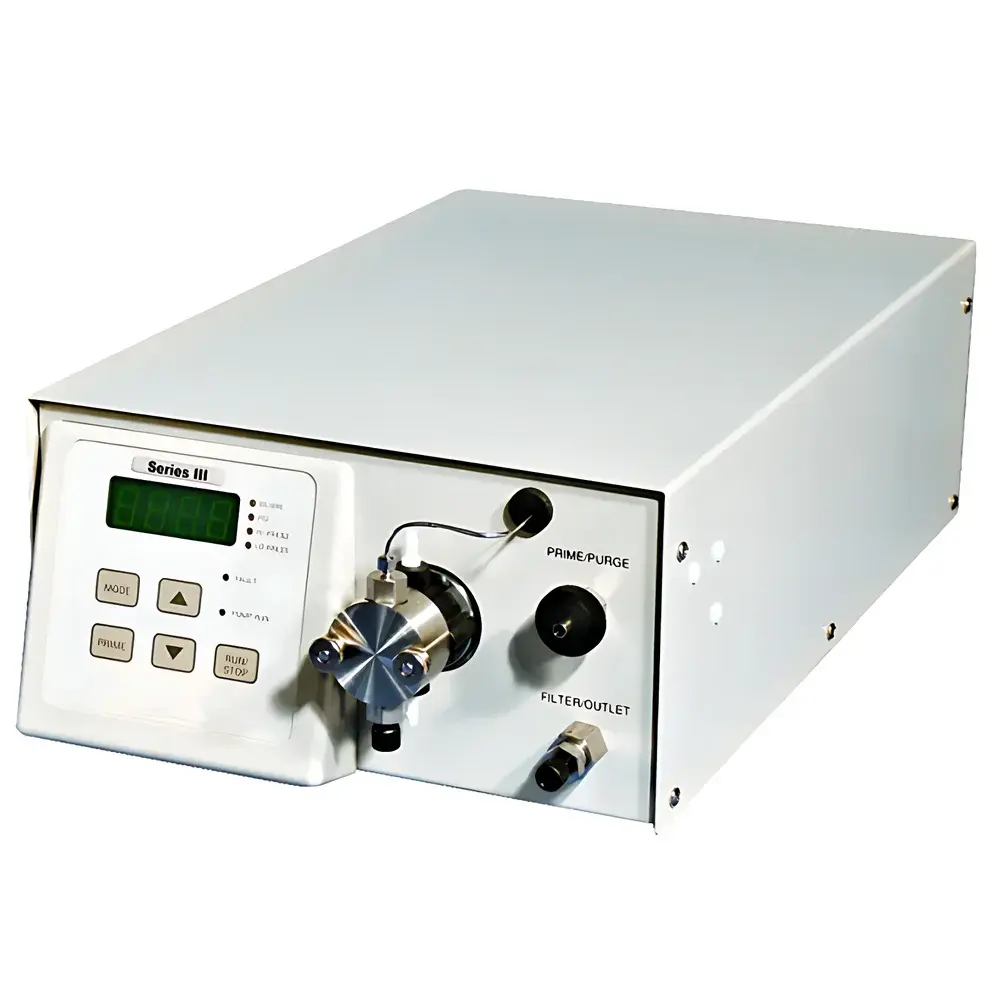
SSI Series III High-Pressure Piston Pump for HPLC and Chemical Process Applications
| Brand | SSI |
|---|---|
| Model | Series III |
| Flow Rate | 0.001–40 mL/min (selectable ranges) |
| Maximum Pressure | 6000 psi (stainless steel), 5000 psi (PEEK), 1500 psi (low-pressure configuration) |
| Accuracy | ±2% |
| Flow Precision | ≤0.2% RSD |
| Display | LED showing real-time flow rate and pressure |
| Pressure Sensor | Integrated |
| Pulse Damping | Low-volume diaphragm-type damper |
| Priming | Internal fast-fill cam mechanism |
| Self-Cleaning | On-line pump head flush function |
| Control Interface | Front-panel membrane keys (flow setpoint, pressure limits, start/stop, quick rinse, mode selection) |
| Remote Control | RS232 digital interface, analog voltage input (0–5 V or 0–10 V), frequency input |
| Wetted Materials | PEEK or 316L stainless steel |
| Dimensions | 140 H × 254 W × 432 D mm |
| Weight | 11 kg |
| Power Supply | 115 V / 230 V AC, 50 / 60 Hz |
Overview
The SSI Series III High-Pressure Piston Pump is an engineered constant-flow precision delivery system designed for demanding laboratory and pilot-scale applications requiring stable, pulse-minimized solvent or reagent delivery under elevated pressure. Built upon the proven architecture of the Series II platform, the Series III integrates enhanced mechanical and electronic subsystems—including a high-efficiency internal cam-driven priming mechanism and a compact diaphragm-type pulse damper—to achieve baseline noise reduction and flow stability essential for high-resolution liquid chromatography (HPLC), preparative chromatography, continuous-flow chemical synthesis, and quantitative dosing in analytical and process development workflows. Its core operating principle relies on positive displacement via dual opposing stainless-steel or PEEK-coated ceramic pistons driven by a microstepping motor and precision timing logic, ensuring repeatable volumetric displacement per stroke across the full pressure range. The integrated pressure transducer enables real-time monitoring and active safety enforcement—critical for method robustness and equipment protection in unattended operation.
Key Features
- Real-time dual-parameter LED display showing instantaneous flow rate and system pressure
- Configurable pressure limits with audible/visual alert and automatic shutdown on overpressure event
- On-line self-cleaning capability via programmable rapid flush sequence—minimizes residue accumulation without disassembly
- Modular pump head design with tool-free replacement; compatible with both PEEK and 316L stainless-steel fluidic paths to support organic solvents, aqueous buffers, and mildly corrosive reagents
- Low-pulse flow profile (<1.5% pulsation at 1 mL/min, 4000 psi) enabled by optimized cam geometry and dynamic damping
- Front-panel membrane keypad with dedicated functions: flow setpoint adjustment, pressure limit configuration, start/stop control, quick rinse activation, and operational mode selection
- Multi-mode remote interfacing: RS232 serial protocol for bidirectional command/response, analog voltage input for external flow modulation, and frequency input for synchronization with external triggers
Sample Compatibility & Compliance
The Series III pump accommodates a broad spectrum of chemically aggressive media, including acetonitrile, methanol, THF, dichloromethane, concentrated acids (e.g., 1 M HCl), and basic aqueous solutions—when configured with PEEK-wetted components. Stainless-steel variants are recommended for high-temperature (>60 °C) or ultra-high-pressure (>5000 psi) applications where thermal and mechanical stability are paramount. All configurations comply with IEC 61010-1 for electrical safety in laboratory environments. The firmware supports audit-trail-enabled operation when integrated into systems adhering to FDA 21 CFR Part 11 requirements (via external data logging and user access control layers). Pressure and flow calibration certificates traceable to NIST standards are available upon request for GLP/GMP-aligned validation protocols.
Software & Data Management
While the Series III operates as a standalone instrument, its RS232 interface enables seamless integration with third-party chromatography data systems (CDS), SCADA platforms, or custom LabVIEW/Python-based control suites. Command syntax follows ASCII-based SCPI-like conventions, supporting queries for current status, setting parameters, initiating sequences, and retrieving error logs. Flow and pressure telemetry can be streamed at up to 10 Hz for real-time process monitoring. For regulated environments, external software layers may implement electronic signatures, change control, and automated report generation—leveraging the pump’s deterministic response and timestamped event logging (e.g., pressure breach, motor stall, rinse cycle completion).
Applications
- HPLC and UHPLC mobile phase delivery in analytical and QC laboratories
- Preparative and semi-preparative chromatography systems requiring precise gradient formation and column protection
- Continuous-flow reactor feed control for homogeneous catalysis, photochemistry, and electrochemical synthesis
- Calibration and standardization of flow meters and mass flow controllers
- Automated titration and reagent addition in environmental and pharmaceutical assay development
- Teaching instrumentation labs—demonstrating positive displacement mechanics, pressure–flow relationships, and closed-loop control fundamentals
FAQ
What materials are available for wetted parts, and how do they affect chemical compatibility?
PEEK is recommended for most organic solvents and moderate pH aqueous solutions; 316L stainless steel provides superior strength and thermal conductivity for high-pressure, high-temperature, or low-solvent-permeability applications.
Can the Series III be used in gradient HPLC systems?
Yes—the pump supports external analog or digital triggering for synchronized flow rate changes; when paired with a proportioning valve module, it forms a binary or quaternary gradient system compliant with ISO 13843 and ASTM E2679.
Is the pressure sensor calibrated, and can it be recalibrated onsite?
The integrated pressure transducer is factory-calibrated with NIST-traceable documentation; field recalibration requires SSI-certified service tools and firmware access—recommended annually or after exposure to overpressure events.
How does the self-cleaning function operate, and what maintenance does it reduce?
A programmable high-flow flush cycle bypasses the main piston path through an auxiliary channel, clearing precipitates and viscous residues from check valves and seals—reducing manual disassembly frequency by up to 70% in routine use.
Does the pump meet electromagnetic compatibility (EMC) requirements for laboratory deployment?
Yes—it complies with EN 61326-1 (2013) for EMC in laboratory and industrial environments, including radiated and conducted emissions testing per CISPR 11.



