
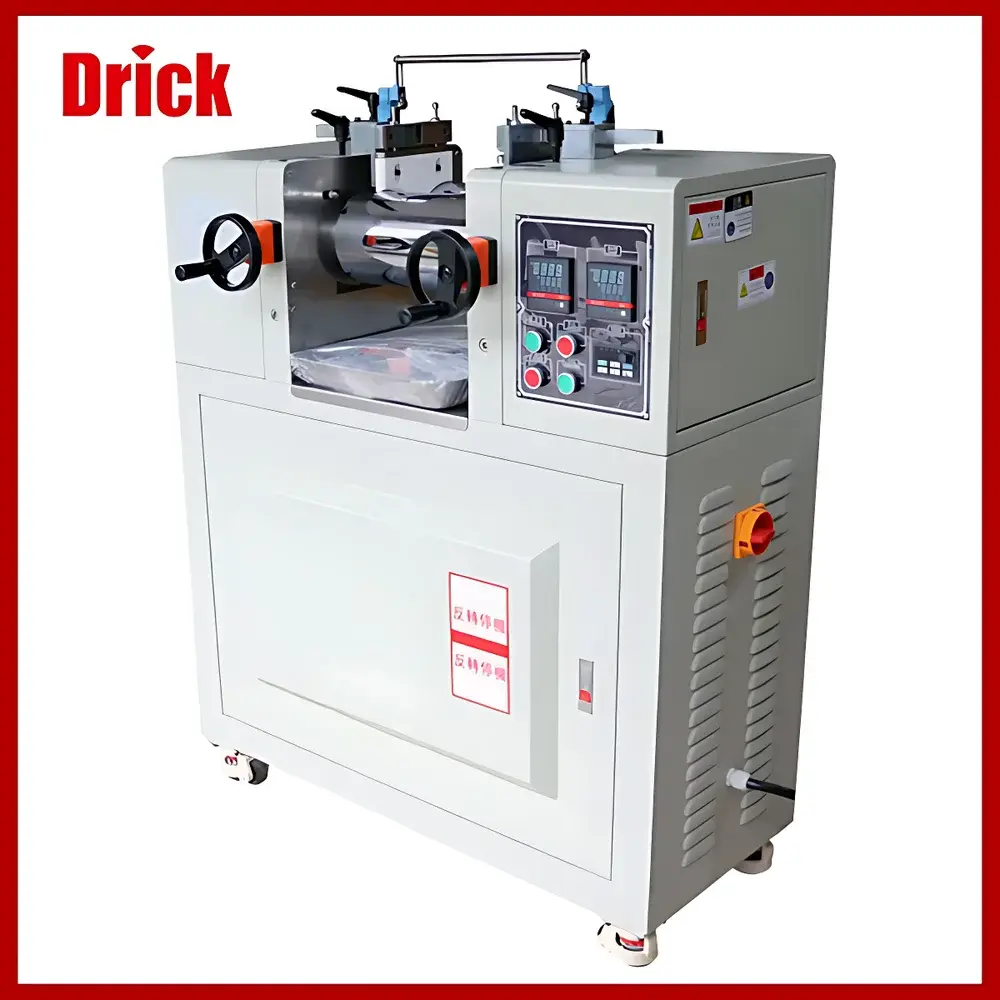
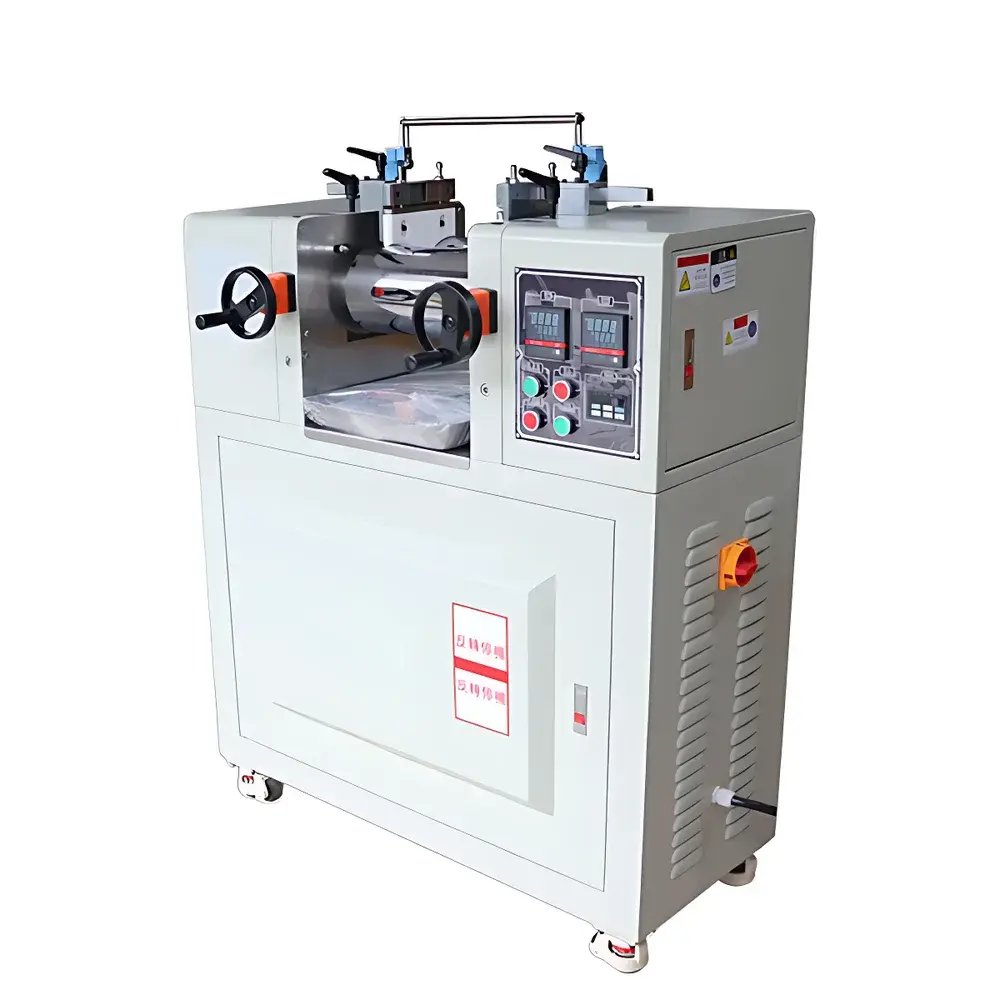
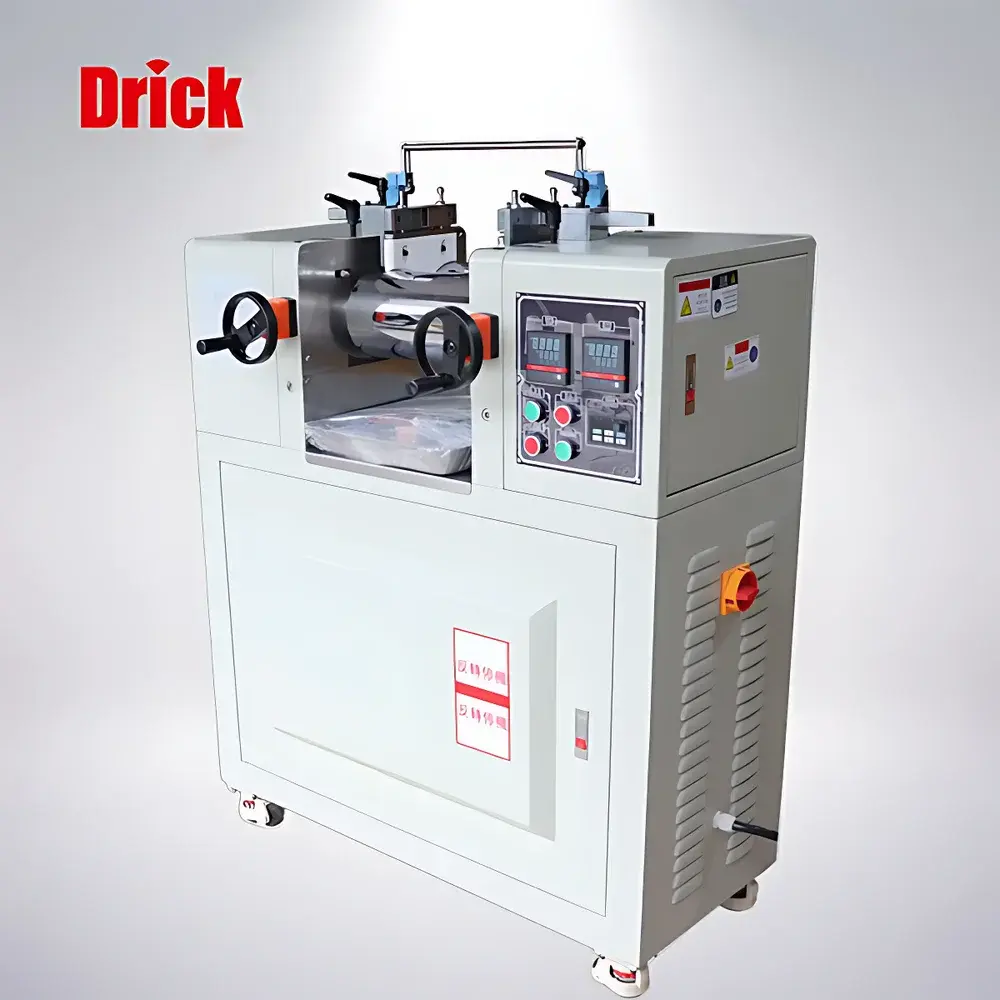
Drick DRK6175 Open Two-Roll Mill
| Brand | Drick |
|---|---|
| Origin | Shandong, China |
| Manufacturer Type | Direct Manufacturer |
| Model | DRK 6175 |
| Temperature Range | Ambient to 300 °C |
| Temperature Control Accuracy | ±2 °C |
| Roll Dimensions | Ø120 mm × 320 mm (L) |
| Roll Gap Adjustment | 0–6 mm |
| Roll Speed | 0–28 rpm (single-frequency inverter control, Delta VFD-CP series) |
| Speed Ratio | 1:1.27 |
| Roll Surface Hardness | HRC 58–62, Mirror-Finish Chromium Plating |
| Heating Method | Triple-Zone Imported Electric Cartridge Heaters |
| Warm-up Time (Ambient to 200 °C) | ~25 min |
| Total Power Consumption | 9 kW (Main Motor: 1.5 kW) |
| Safety Features | Emergency Pull Rod Stop, Knee-Activated Reverse Function |
| Dimensions (W×D×H) | 990 × 430 × 1150 mm |
| Weight | ~375 kg |
| Electrical Supply | 3-phase, 380 V AC, 22 A, 5-wire system |
Overview
The Drick DRK6175 Open Two-Roll Mill is an engineered laboratory-scale compounding and dispersion unit designed for precise thermal-mechanical processing of thermoplastic and thermoset compounds. It operates on the principle of shear-induced dispersion within a controlled gap between two counter-rotating, temperature-regulated rolls. The machine enables reproducible batch mixing, mastication, sheeting, and pigment dispersion—critical steps in R&D and quality assurance workflows for color masterbatch, PVC formulations, engineering plastics, and pigment concentrates. Its dual-roll geometry, adjustable nip gap, and synchronized speed ratio (1:1.27) generate defined shear history and residence time, supporting ASTM D3417, ISO 6721-10, and internal compound development protocols under GLP-compliant conditions.
Key Features
- Triple-zone electric heating system with imported cartridge heaters ensures uniform axial and circumferential temperature distribution across both rolls, minimizing thermal gradients that compromise dispersion homogeneity.
- Mirror-finish chromium-plated roll surfaces (HRC 58–62) provide exceptional wear resistance, low surface roughness (Ra < 0.2 µm), and minimal material adhesion—essential for clean sample transfer and repeatable rheological response.
- Single-frequency inverter drive (Delta VFD-CP series) delivers smooth, stepless speed control from 0 to 28 rpm, enabling precise shear rate modulation per ISO 3219 and facilitating comparative studies across formulation variants.
- Digital LED temperature controller with keypad input and real-time output display supports setpoint stability within ±2 °C over the full operating range (ambient to 300 °C), meeting requirements for USP <1058> analytical instrument qualification.
- Integrated mechanical safety interlocks—including pull-rod emergency stop and knee-activated reverse function—comply with EN ISO 13857 and IEC 60204-1 standards for operator protection during manual feeding and sheet removal.
- Structurally rigid cast-iron frame and precision-ground roll bearings ensure long-term dimensional stability and minimal runout (< 0.02 mm), preserving calibration integrity across extended operational cycles.
Sample Compatibility & Compliance
The DRK6175 accommodates viscous, semi-solid, and filled polymer systems including PVC plastisols, polyolefin masterbatches, thermoplastic elastomer blends, and high-loading carbon-black or titanium dioxide dispersions. Its open-roll configuration allows direct visual monitoring of melt behavior, agglomeration dynamics, and sheet formation—supporting ASTM D1600 classification and ISO 17989 process validation. All electrical components meet CE marking directives (2014/30/EU EMC and 2014/35/EU LVD). The temperature control system is traceable to NIST-traceable reference standards, and the unit supports audit-ready documentation per FDA 21 CFR Part 11 when paired with validated electronic logbook software.
Software & Data Management
While the DRK6175 operates as a standalone hardware platform, its digital temperature controller outputs analog (4–20 mA) and RS485 Modbus RTU signals for integration into centralized lab data acquisition systems (e.g., LabVIEW, Ignition SCADA, or Delta Tau PMAC). Optional firmware upgrades enable timestamped temperature logging at 1-second intervals, generating CSV-compatible records suitable for IQ/OQ documentation. All parameter settings—including setpoints, ramp rates, and hold durations—are password-protected and retainable after power loss, satisfying GLP requirement §58.130(a)(3) for data integrity and system reliability.
Applications
- Dispersion evaluation of organic/inorganic pigments in polymeric matrices
- Pre-compounding of conductive fillers (e.g., graphene, CNTs) prior to extrusion
- Rheological pre-conditioning of rubber compounds before Mooney viscosity testing
- Sheet preparation for tensile, tear, and hardness testing per ASTM D412, D624, and D2240
- Thermal stability screening of flame-retardant additives under controlled shear
- Batch-to-batch consistency verification in QC labs supporting ISO/IEC 17025 accreditation
FAQ
What is the maximum continuous operating temperature for the DRK6175?
The rolls are rated for sustained operation up to 300 °C, with thermal insulation and cooling channels preventing housing overheating beyond safe touch limits.
Can the speed ratio be modified to 1:1 for specific polymer systems?
No—the fixed 1:1.27 ratio is mechanically integrated via gear train design to ensure consistent shear profile and avoid slippage during high-viscosity processing.
Is the machine compatible with vacuum deaeration accessories?
Yes—optional vacuum hood kits (sold separately) can be mounted above the nip zone to reduce entrapped air in sensitive elastomer or optical-grade plastic formulations.
Does the unit include calibration certificates for temperature and speed?
Factory calibration reports for temperature sensors and tachometric verification are provided with shipment; third-party NIST-traceable recalibration services are available upon request.
What maintenance intervals are recommended for the chromium-plated rolls?
Roll surface inspection and light polishing with non-abrasive chromium-safe compound are advised every 500 operational hours; full re-chroming is typically required after ~5,000 hours of continuous use.
Related Products






