
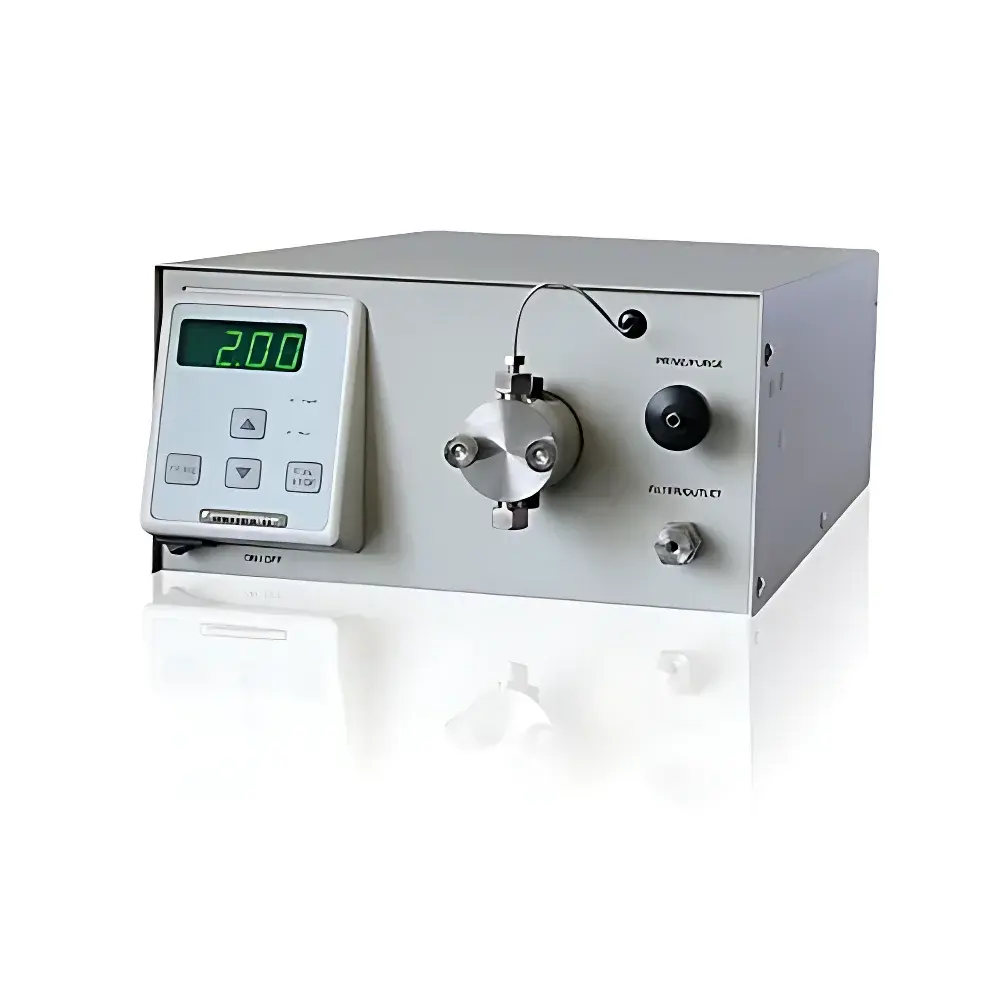
SSI Series II High-Pressure Constant Flow Pump
| Brand | SSI |
|---|---|
| Model | Series II |
| Type | Single-Piston High-Performance Solvent Delivery Pump |
| Flow Range | 0.001–5 mL/min, 0.01–10 mL/min, or 0.1–40 mL/min |
| Maximum Pressure | 6000 psi (316 SS), 5000 psi (PEEK), 1500 psi (low-pressure configuration) |
| Flow Accuracy | ±2% |
| Flow Precision | ≤0.2% RSD |
| Pulsation Damping | Integrated low-dead-volume pulsation damper |
| Auto-Cleaning System | On-column solvent-driven self-cleaning mechanism with weekly aqueous solution refresh |
| Seal Replacement | Tool-free, <5-minute procedure |
| Prime/Flush Function | One-touch automated priming, flushing, and degassing |
| Fluidic Path Materials | Selectable 316 stainless steel or biocompatible PEEK |
| Communication Interface | RS232 digital output, analog voltage/frequency input |
| Power Supply | 115 V / 230 V, 50 / 60 Hz |
| Dimensions (H×W×D) | 140 × 254 × 432 mm |
| Weight | 11 kg |
Overview
The SSI Series II High-Pressure Constant Flow Pump is an engineered solution for precision solvent delivery in analytical and semi-preparative liquid chromatography systems. Based on a single-piston positive displacement architecture, it delivers stable, pulse-free flow across three calibrated flow ranges—0.001–5 mL/min, 0.01–10 mL/min, and 0.1–40 mL/min—enabling seamless adaptation from trace-level HPLC analysis to mid-scale purification workflows. Its operation relies on digitally controlled microstepping motor actuation, ensuring consistent volumetric displacement independent of backpressure fluctuations within rated limits (up to 6000 psi with 316 stainless steel fluidic components). The integrated low-dead-volume pulsation damper eliminates flow perturbations at the source, while the pump’s hydraulic design minimizes compressibility effects common in high-pressure mobile phase delivery—critical for baseline stability in UV, fluorescence, and mass spectrometric detection.
Key Features
- Triple-range flow capability with factory-calibrated linearity and repeatability validated per ISO 5725-2 guidelines
- Selectively configurable fluidic path: 316 stainless steel for general-purpose robustness or PEEK for metal-sensitive applications including biomolecule separation, chelating eluents, and acidic/basic mobile phases
- On-axis, solvent-assisted auto-cleaning system positioned immediately downstream of the piston seal; activated during normal operation using eluent flow to remove particulate buildup and prevent premature seal wear
- Tool-free seal replacement—designed for field maintenance without disassembly of manifold or drive assembly; typical service interval exceeds 6 months under standard LC operating conditions
- One-touch prime/flush/debubble sequence initiated via front-panel interface or remote command; supports both full-system purge and targeted line evacuation
- RS232 serial interface compliant with ASTM E1382-95 (Standard Practice for Digital Data Exchange in Chromatography) and compatible with legacy and modern CDS platforms including Chromeleon, Empower, and OpenLab
Sample Compatibility & Compliance
The Series II pump accommodates a broad spectrum of mobile phase chemistries—including aqueous buffers, organic solvents (acetonitrile, methanol, THF), corrosive acids (TFA, phosphoric), and volatile bases—when configured with PEEK wetted parts. Its pressure rating meets ISO 13485-compliant design requirements for use in regulated QC/QA laboratories performing USP , EP 2.2.46, and ICH Q2(R2) method validation studies. The auto-cleaning function satisfies GLP audit expectations for documented preventive maintenance, while the RS232 interface supports FDA 21 CFR Part 11-compliant electronic record integrity when paired with audit-trail-enabled CDS software. No external pulse dampers or secondary degassers are required for routine operation, reducing system footprint and failure points.
Software & Data Management
Control and monitoring are executed via embedded firmware supporting both local keypad operation and host-driven automation. The RS232 port transmits real-time flow rate, pressure, and status flags (e.g., “priming,” “low solvent,” “seal warning”) using ASCII-based command-response protocol. Optional integration kits provide native drivers for LabVIEW, Python (pySerial), and MATLAB environments, enabling custom script-based method sequencing and long-term performance trending. All parameter changes—including flow setpoint, pressure limit, and cleaning cycle scheduling—are logged with timestamp and operator ID if linked to a compliant CDS. Internal memory retains last 100 operational events for root-cause analysis during troubleshooting.
Applications
- Analytical-scale reversed-phase, ion-exchange, and size-exclusion chromatography (SEC-MALS, SEC-UV)
- Semi-preparative purification of peptides, oligonucleotides, and small-molecule APIs under cGMP-aligned workflows
- Method development requiring precise gradient formation and dwell volume consistency
- Hyphenated techniques including LC-ICP-MS and LC-NMR where pulse-free flow is essential for signal coherence
- Environmental testing per EPA Methods 8081B, 8270, and 6200 series where extended unattended runtime and chemical resistance are critical
FAQ
What flow ranges are factory-validated and how are they selected?
Three discrete flow modules are mechanically installed during manufacturing: 0.001–5 mL/min (high-resolution analytical), 0.01–10 mL/min (general-purpose HPLC), and 0.1–40 mL/min (semi-prep). Selection is permanent per unit; range switching requires hardware modification by authorized service personnel.
Does the auto-cleaning system require dedicated reagents or consumables?
No—only deionized water or dilute buffer solution is needed for weekly reservoir replenishment. No proprietary cartridges or filters are involved.
Can the Series II replace older SSI models without plumbing or electrical modifications?
Yes—mounting holes, inlet/outlet port locations (1/4″-28 UNF), power connector type, and RS232 pinout match Series I and Legacy ProLine pumps. Firmware-level command syntax remains backward-compatible.
Is PEEK fluidic path certified for USP Class VI biocompatibility?
Yes—PEEK components comply with USP and cytotoxicity and implantation testing protocols, supporting use in preclinical bioanalysis and excipient compatibility studies.
How is flow accuracy verified during installation qualification (IQ)?
Using gravimetric measurement per ASTM D3427-17: collected effluent is weighed over ≥5 minutes at three setpoints (10%, 50%, 90% of range), with deviation calculated against theoretical volume based on pump displacement constant and motor step count.



