
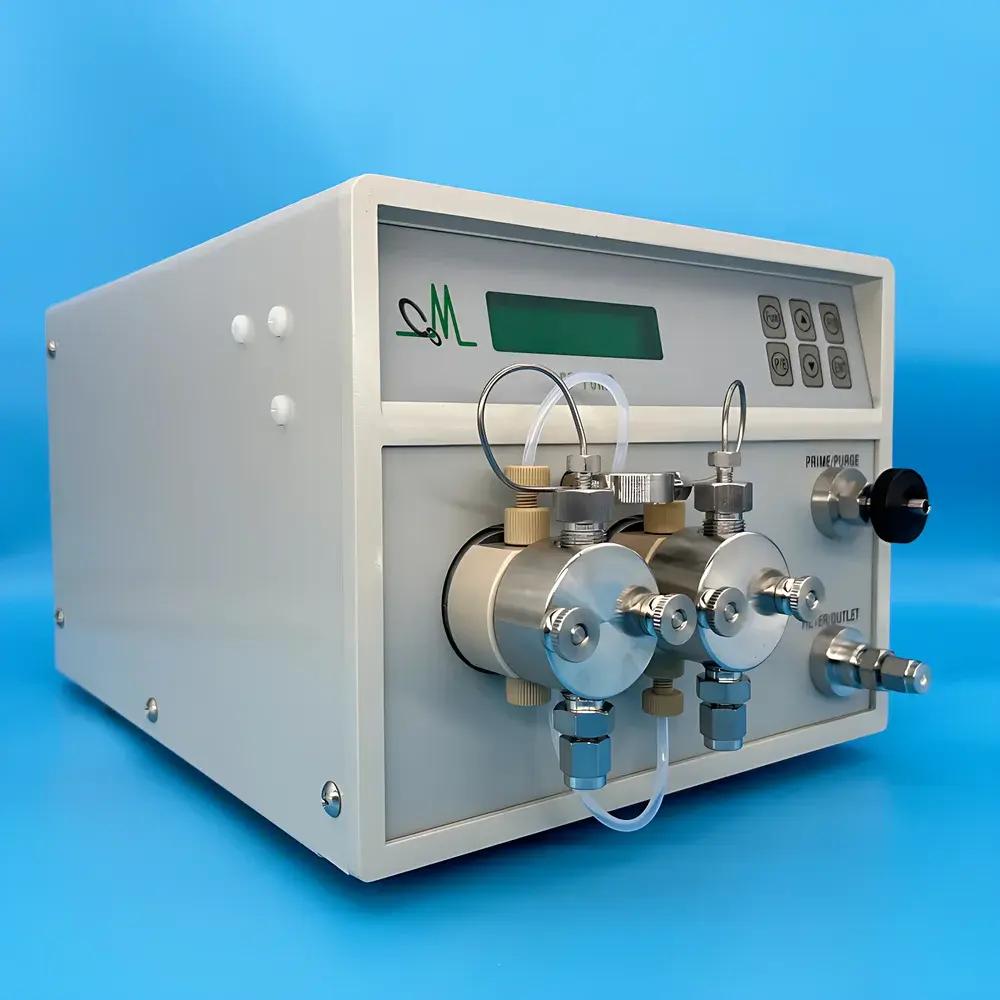
CoMetro CP-LDI Dual-Piston High-Pressure Constant Flow Pump
| Brand | CoMetro |
|---|---|
| Origin | Imported |
| Manufacturer Type | Authorized Distributor |
| Model | CP-LDI |
| Flow Rate Options | 0.001–12 mL/min, 0.01–24 mL/min, 0.1–100 mL/min, 0.1–200 mL/min |
| Max Pressure | Up to 6000 psi (414 bar) — model-dependent |
| Flow Accuracy | ±2% |
| Flow Precision | ≤0.2% RSD |
| Pump Head Configuration | Parallel dual-piston |
| Compliance | Designed for GLP/GMP-aligned lab environments |
Overview
The CoMetro CP-LDI Dual-Piston High-Pressure Constant Flow Pump is an engineered solution for precise, pulse-free liquid delivery in demanding analytical and process development applications. Based on reciprocating dual-piston displacement architecture, the CP-LDI operates on the principle of synchronized, counter-phased piston motion—minimizing flow pulsation while maintaining hydraulic stability under sustained high backpressure. This design enables continuous, reproducible volumetric delivery across a wide dynamic range, making it suitable as a core fluidic actuator in high-integrity laboratory systems where flow integrity directly impacts data fidelity and reaction control. Unlike single-piston or peristaltic alternatives, the CP-LDI’s dual-head configuration ensures inherent pressure damping and reduced mechanical wear, contributing to long-term calibration stability and extended service intervals.
Key Features
- Dual-piston parallel architecture with phase-shifted actuation for <0.2% RSD flow precision and minimal pulsation (<1.5% peak-to-peak at rated flow)
- Modular pressure rating options: standard configurations support up to 6000 psi (414 bar), with custom variants available for 4500 psi and 1500 psi operational envelopes
- Four selectable flow ranges—0.001–12 mL/min, 0.01–24 mL/min, 0.1–100 mL/min, and 0.1–200 mL/min—each optimized for distinct application tiers (analytical HPLC, semi-preparative, preparative, and process-scale simulation)
- Chemically resistant wetted path constructed from sapphire-rubies, PEEK, and 316L stainless steel—validated for compatibility with aggressive solvents (e.g., THF, chlorinated hydrocarbons, supercritical CO₂ co-solvents) and corrosive catalyst slurries
- Integrated real-time pressure monitoring with over-pressure shutdown (OPSD) and programmable ramp profiles for gradient elution or controlled catalyst bed pressurization
- RS-232 and optional Ethernet (TCP/IP) interfaces for remote control, audit trail logging, and integration into SCADA or LIMS environments
Sample Compatibility & Compliance
The CP-LDI supports broad sample matrix compatibility—including low-viscosity mobile phases, high-boiling-point ionic liquids, heterogeneous catalyst suspensions (≤5 µm particle size), and thermally sensitive biofluids (when paired with optional temperature-controlled pump heads). Its fluidic pathway meets USP extractables profiling requirements for pharmaceutical process equipment and conforms to ISO 13485 material biocompatibility guidelines where applicable. The pump is routinely deployed in laboratories adhering to FDA 21 CFR Part 11-compliant workflows; its firmware supports electronic signature capture, user-level access control, and immutable event logs for audit readiness. It satisfies ASTM D7985 test criteria for HPLC pump performance verification—including dwell volume measurement, gradient delay assessment, and flow accuracy validation under variable backpressure.
Software & Data Management
The CP-LDI operates natively with CoMetro’s PumpControl Suite v3.2—a Windows-based application enabling method-driven operation, multi-step gradient programming, and real-time graphical display of flow rate, pressure, and motor load. All operational parameters are timestamped and exportable in CSV/Excel format. For enterprise integration, the pump supports Modbus TCP and OPC UA protocols, allowing seamless interoperability with LabVIEW, DeltaV, or MATLAB-based experimental automation frameworks. Audit trails comply with ALCOA+ principles (Attributable, Legible, Contemporaneous, Original, Accurate, Complete, Consistent, Enduring, Available) and retain full traceability for ≥12 months without external storage dependency.
Applications
- HPLC and UHPLC system integration—especially for method development requiring ultra-low flow stability (e.g., capillary LC, nanoLC)
- Catalyst evaluation rigs: fixed-bed reactors, trickle-bed systems, and microchannel reactors requiring precise reagent dosing under elevated pressure (up to 6000 psi)
- Petroleum refining research: simulated distillation, hydrotreating kinetics studies, and asphaltene precipitation assays
- Process intensification trials: continuous-flow synthesis, photochemical reactor feeding, and electrochemical cell electrolyte circulation
- Nuclear fuel cycle research: actinide solution handling with radiation-tolerant seal options
- Environmental analysis: automated leaching tests (TCLP, SPLP), PFAS extraction protocols, and high-pressure SFE-SFC coupling
FAQ
What pressure ratings are available for the CP-LDI series?
Standard models are rated for 6000 psi, 4000 psi, and 1500 psi; custom configurations—including 4500 psi and 500 psi variants—are available upon engineering review.
Is the CP-LDI compatible with supercritical fluid applications?
Yes—when equipped with CO₂-compatible seals and pre-cooled inlet modules, the CP-LDI serves as a primary pump in SFC systems and hybrid SFE-SFC platforms.
Can flow accuracy be verified in-house without third-party calibration?
Yes—the pump includes built-in gravimetric self-validation mode compliant with ASTM D7985 Annex A2, requiring only a certified analytical balance and timer.
Does the CP-LDI support gradient mixing when used with multiple pumps?
While the CP-LDI itself is a single-solvent pump, it integrates with CoMetro’s GMI-4 quad-solvent gradient mixer module for precise binary, ternary, or quaternary gradient formation.
What maintenance intervals are recommended for continuous 24/7 operation?
Under typical lab conditions, piston seal replacement is recommended every 6,000 operating hours; full preventive maintenance—including check valve inspection and drive train lubrication—is scheduled at 12-month intervals or 10,000 hours, whichever occurs first.



