
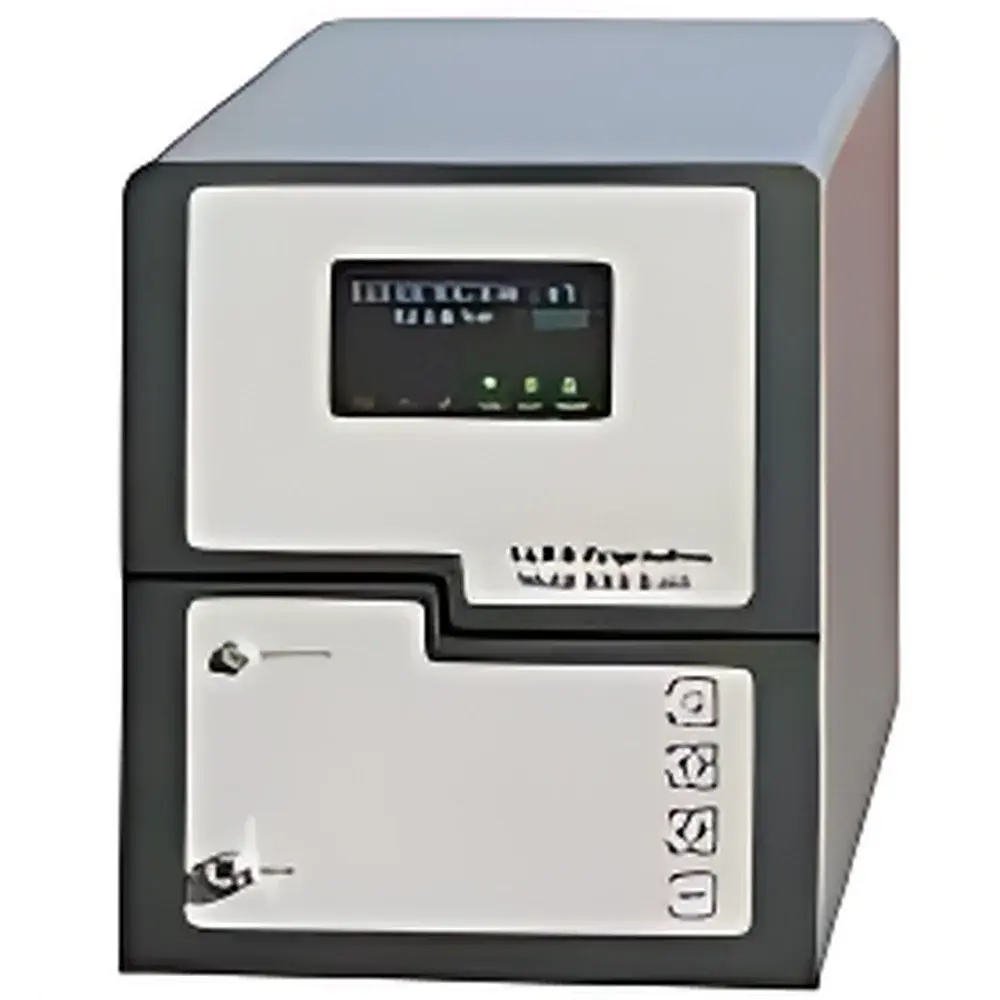
SofTA Model 300S Evaporative Light Scattering Detector (ELSD)
| Brand | SofTA |
|---|---|
| Origin | Imported |
| Manufacturer Type | Authorized Distributor |
| Model | Model 300S |
| Detection Principle | Evaporative Light Scattering |
| Compatible Systems | HPLC (Analytical & Preparative) |
| Wavelength Range | 195–600 nm |
| Optical Configuration | Dual-Beam |
| Light Source | Deuterium Lamp |
| Nebulizer Material | PTFE (Teflon®) |
| Drift Tube Temperature Range | Ambient to 120 °C |
| Nebulization Zone Temperature Range | 10–70 °C |
| Light Source for Detection | 650 nm Near-Infrared Laser (<5 mW, FCC Class I Eye-Safe) |
| Detector Element | Sealed, Large-Area Silicon Photodiode with Integrated High-Gain Amplifier |
| Minimum Detectable Mass | 100 pg Glucopyranoside (Micro-HPLC, 2 µL direct injection, peak width at 10% height: 3 s) |
| Dynamic Range (Normal Gain) | 3 decades |
| Dynamic Range (Extended Mode) | 4–4.5 decades |
| Mobile Phase Flow Rate Compatibility | Up to 5 mL/min |
| Carrier Gas | Nitrogen or other inert gas |
| Gas Pressure Requirement | 50 psi |
| Gas Consumption | ≤2.5 L/min |
| Integrated Gas Pressure Regulation | Yes (Built-in Regulator & Overpressure Protection) |
| Auto Shut-off Valve | Yes (Timed Delay Cutoff) |
| Fluidic Path Materials | PTFE, Stainless Steel, Alumina, Borosilicate Glass (Optical Lens) |
| User Interface | Vacuum Fluorescent Display (VFD) + 4 Multifunction Keys |
| Onboard Method Storage | 10 Methods |
| Signal Output Options | Fixed 10 mV / 5 V |
| Communication Interface | RS-232 (Rear Panel) |
| Power Supply | 120/240 V AC, 50/60 Hz, 600 W |
| Dimensions (W×D×H) | 25 × 45 × 29 cm |
| Weight | 15 kg |
Overview
The SofTA Model 300S Evaporative Light Scattering Detector (ELSD) is a precision optical detector engineered for universal, non-destructive quantification of non-volatile and semi-volatile analytes in liquid chromatography workflows. Unlike UV-Vis absorbance detectors, the Model 300S operates on the principle of nebulization, solvent evaporation, and light scattering—making it inherently mass-sensitive and independent of chromophore presence. The instrument employs SofTA’s proprietary thermal split-flow technology to precisely regulate aerosol formation and particle drying kinetics within the drift tube, ensuring consistent response across gradient elution, high-boiling solvents (e.g., DMSO, glycerol), and aqueous–organic mobile phases. Its dual-beam optical architecture—comprising a deuterium lamp (195–600 nm) for baseline stability and a dedicated 650 nm near-infrared laser for scatter detection—enables high signal-to-noise ratio and long-term photometric reproducibility. Designed for seamless integration with analytical and preparative HPLC systems, the Model 300S meets the operational requirements outlined in Chinese Pharmacopoeia monographs for ELSD-coupled HPLC assays, including those for polysaccharides, lipids, saponins, and excipients.
Key Features
- Thermally regulated split-flow nebulization: Precise control of nebulization zone temperature (10–70 °C) enables robust adaptation to diverse mobile phase compositions—including volatile buffers, high-boiling solvents, and multi-step gradients—without manual re-optimization.
- Cryogenic-capable operation: Refrigerated nebulization chamber supports low-temperature ELSD performance with both organic and inorganic mobile phases, minimizing thermal degradation of thermolabile compounds.
- Chemically inert fluidic path: Entire sample pathway—from PTFE nebulizer tip through stainless steel and alumina tubing to borosilicate optical lens—is resistant to corrosion, clogging, and adsorption, ensuring method longevity and carryover-free analysis.
- Intelligent gas management system: Integrated pressure regulator, overpressure protection, and timed auto-shutoff valve eliminate manual gas flow adjustment and prevent unintended cylinder depletion.
- Onboard method storage: Stores up to 10 user-defined detection protocols—including drift tube temperature, gain settings, filter constants, and gas parameters—with recall via intuitive VFD interface and four multifunction keys.
- FCC Class I eye-safe optical design: 650 nm NIR laser (<5 mW) and sealed silicon photodiode detector ensure operator safety and regulatory compliance without external shielding requirements.
Sample Compatibility & Compliance
The Model 300S delivers reliable detection for analytes lacking strong UV absorbance or electrochemical activity—including carbohydrates, lipids, polymers, surfactants, natural products, and pharmaceutical excipients. Its mass-proportional response facilitates quantitative analysis without compound-specific calibration standards in many applications. The detector supports GLP/GMP-aligned workflows through stable baseline performance, traceable parameter logging, and reproducible retention time–response correlation. While not FDA 21 CFR Part 11–certified out-of-the-box, its RS-232 interface enables integration with validated chromatography data systems (CDS) that support electronic signatures, audit trails, and secure method archiving per ISO/IEC 17025 and USP guidelines. All materials in contact with mobile phase comply with USP Class VI biocompatibility standards.
Software & Data Management
The Model 300S operates as a standalone detector with no proprietary software dependency. Analog output (0–5 V or fixed 10 mV/5 V) ensures compatibility with all major HPLC data acquisition systems—including Agilent ChemStation, Waters Empower, Shimadzu LabSolutions, and open-source platforms such as OpenChrom. Real-time status telemetry—including drift tube temperature, nebulizer zone temperature, carrier gas pressure, and self-test diagnostics—is continuously available via RS-232 serial communication. Users may configure acquisition parameters externally and log metadata (e.g., method ID, timestamp, gain setting) alongside chromatographic signals for full traceability. Firmware updates are delivered via ASCII command protocol, supporting version-controlled instrument maintenance.
Applications
- Pharmaceutical quality control: Quantitation of lactose, mannitol, and polyethylene glycols in tablet formulations per ChP and USP monographs.
- Natural product analysis: Detection of triterpenoid saponins, flavonoid glycosides, and polysaccharide fractions in herbal extracts without derivatization.
- Lipidomics: Gradient-compatible detection of phospholipids, triglycerides, and fatty acid esters in reversed-phase and HILIC separations.
- Polysaccharide characterization: Monitoring dextran, hyaluronic acid, and chitosan elution profiles under aqueous SEC conditions.
- Preparative HPLC fraction collection: Real-time ELSD-triggered fraction cutting for non-UV-absorbing targets, supported by stable baseline and rapid equilibration (<5 min after solvent change).
FAQ
What mobile phase flow rates does the Model 300S support?
The detector accommodates flow rates from 0.1 mL/min (microbore) up to 5 mL/min (preparative scale), with optimized nebulization efficiency across the entire range.
Is the instrument compatible with corrosive mobile phases such as TFA or HFBA?
Yes—the PTFE nebulizer, stainless steel tubing, and alumina components resist degradation from low-pH ion-pairing reagents when operated within specified temperature limits.
Does the Model 300S require daily recalibration?
No. The dual-beam optical design and thermally stabilized drift tube provide inherent baseline stability; routine verification using a standard (e.g., sucrose or glucopyranoside) every 24–48 hours is sufficient for GxP environments.
Can the detector be used with LC-MS systems?
Not directly—ELSD is incompatible with MS vacuum interfaces. However, it serves as an orthogonal offline detector for method development and fraction validation prior to MS analysis.
How is gas consumption monitored and controlled?
Gas flow is passively regulated by an internal pressure-reducing valve; actual consumption (≤2.5 L/min at 50 psi) remains constant regardless of inlet pressure fluctuations, and the timed auto-shutoff valve prevents unattended gas loss.
Related Products




