
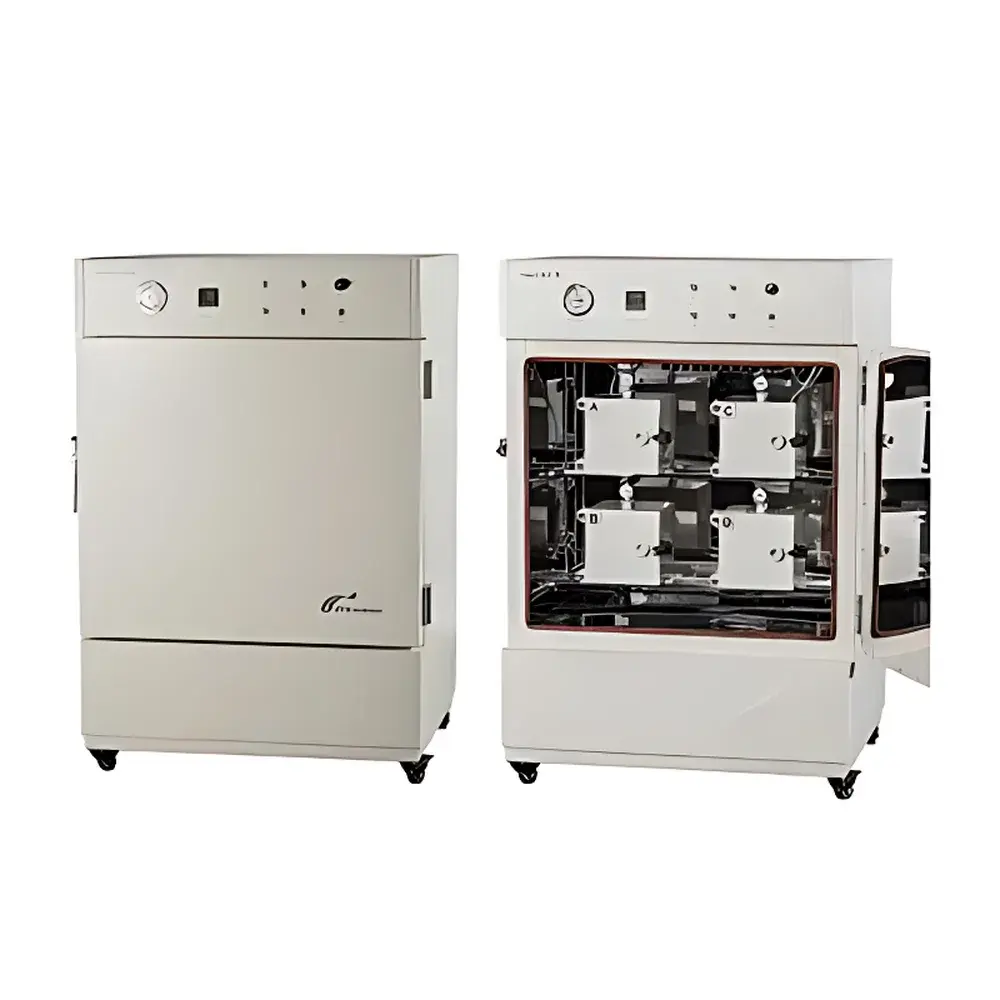
GeneScience Anaerobox IV Anaerobic Incubation System
| Brand | GeneScience |
|---|---|
| Origin | USA |
| Model | Anaerobox IV |
| Temperature Range | Ambient +5°C to 75°C |
| Temperature Uniformity & Stability | ±0.5°C |
| Humidity Control Range | Ambient +5°C to 75°C |
| Chamber Volume | 4 × 5.5 L (each chamber: 18 × 18 × 18 cm) |
| Operating Pressure | 1.5 bar |
| Gas Flow Rate | 0.9 m³/h |
| Anaerobic Generation Time | <3 minutes |
| Vacuum Pump Type | Oil-free diaphragm pump |
| Dimensions (W×D×H) | 140 × 92 × 77 cm |
Overview
The GeneScience Anaerobox IV Anaerobic Incubation System is a modular, high-precision controlled-atmosphere incubation platform engineered for reproducible anaerobic and microaerophilic cultivation of fastidious microorganisms. Unlike conventional single-chamber anaerobic workstations or jar-based systems, the Anaerobox IV implements a parallel four-chamber architecture grounded in positive-pressure gas displacement and vacuum-assisted deoxygenation—enabling independent atmospheric control per chamber without cross-contamination. Each 5.5 L chamber operates under programmable gas composition (e.g., 5% H₂ / 10% CO₂ / 85% N₂ for strict anaerobes; or 5–10% O₂ for microaerophiles), with real-time pressure monitoring via individual mechanical gauges. The system employs an oil-free diaphragm vacuum pump to evacuate residual oxygen prior to gas flush, eliminating hydrocarbon contamination risks associated with oil-lubricated pumps—critical for clinical isolate propagation, antibiotic susceptibility testing, and microbiome sample processing where chemical purity directly impacts colony morphology and metabolic activity.
Key Features
- Four independent anaerobic/microaerophilic chambers (5.5 L each), fully isolated by sealed gasketed doors and individually pressurized gas lines
- Precise temperature control from ambient +5°C to 75°C, with uniformity maintained within ±0.5°C across all chambers—validated per ISO 13408-2 Annex B for incubator thermal performance
- Rapid atmosphere conditioning: complete O₂ removal and target gas equilibration achieved in under 3 minutes per chamber, minimizing exposure of oxygen-sensitive cultures
- Integrated oil-free vacuum pump with sealed diaphragm design—zero lubricant migration, no scheduled oil changes, compliant with ISO 8573-1 Class 0 air purity requirements
- Dual-mode operation: configurable for strict anaerobiosis (O₂ < 0.1%) or microaerophilic conditions (O₂ 2–12%), supporting diverse taxa including Campylobacter, Helicobacter, and Bifidobacterium
- Front-access mechanical pressure indicators for immediate visual verification of chamber integrity and gas retention—no reliance on electronic sensors subject to drift or calibration drift
- Robust stainless-steel chassis (140 × 92 × 77 cm footprint) designed for laboratory benchtop integration with vibration-damped leveling feet and ESD-safe surface finish
Sample Compatibility & Compliance
The Anaerobox IV supports standard microbiological consumables—including Petri dishes (up to 150 mm), agar plates, blood culture bottles, and anaerobic transport tubes—without requiring proprietary accessories. Chamber dimensions (18 × 18 × 18 cm internal) accommodate stacked plate racks or multi-well formats for high-throughput screening. All materials contacting the incubation environment meet USP Class VI biocompatibility standards and are autoclavable up to 121°C for decontamination between runs. The system complies with ISO 13408-2 (sterile processing of pharmaceuticals), CLSI M47-A (anaerobic culture methods), and FDA-recommended environmental controls for clinical microbiology laboratories. Its pressure-regulated gas delivery architecture satisfies GLP audit requirements for traceable atmosphere documentation when paired with external data loggers.
Software & Data Management
The Anaerobox IV operates via a dedicated front-panel interface with non-volatile memory for storing up to 16 user-defined protocols (temperature setpoint, gas composition, cycle duration, purge count). While it does not include embedded software or network connectivity, its analog pressure gauges and discrete control knobs ensure deterministic, fail-safe operation—eliminating firmware vulnerabilities common in IoT-enabled incubators. For regulated environments, optional RS-232 or 4–20 mA analog outputs enable connection to validated laboratory information management systems (LIMS) or SCADA platforms. All operational parameters—including door-open events, temperature excursions, and pressure deviations—are mechanically recorded via time-stamped log sheets per 21 CFR Part 11 Annex A guidelines for manual audit trails.
Applications
- Clinical microbiology: Isolation and identification of obligate anaerobes (e.g., Clostridioides difficile, Fusobacterium nucleatum) from stool, abscess, and wound specimens
- Gut microbiome research: Cultivation of previously unculturable anaerobic strains for metagenomic strain isolation and functional characterization
- Pharmaceutical quality control: Anaerobic stability testing of probiotic formulations per USP <61> and EP 2.6.12
- Veterinary diagnostics: Culture of Actinobacillus pleuropneumoniae and other fastidious pathogens from porcine respiratory samples
- Academic teaching labs: Simultaneous demonstration of differential growth requirements across four bacterial species under contrasting O₂ tensions
- Antimicrobial resistance studies: Anaerobic MIC determination using broth microdilution in compliance with CLSI M100 and EUCAST standards
FAQ
Can the Anaerobox IV be used for microaerophilic culture without modification?
Yes—the system allows manual adjustment of gas mixture ratios and pressure setpoints to sustain stable microaerophilic atmospheres (e.g., 5–10% O₂), verified via integrated pressure gauges and validated using commercial O₂ sensors.
Is calibration of temperature sensors required, and how often?
Per ISO/IEC 17025, users must perform annual verification using NIST-traceable PT100 probes; factory calibration certificates are supplied with each unit, covering both chamber air and surface temperature profiles.
What maintenance is needed for the oil-free vacuum pump?
No routine maintenance is required—the diaphragm pump has no lubricants, filters, or wear-prone valves; only periodic inspection of inlet/outlet tubing for cracks or blockage is recommended every 6 months.
Does the system support regulatory-compliant data archiving?
While the device lacks built-in digital logging, its analog interface enables compliant data capture through external validated chart recorders or LIMS-integrated analog-to-digital converters meeting 21 CFR Part 11 electronic record requirements.





