
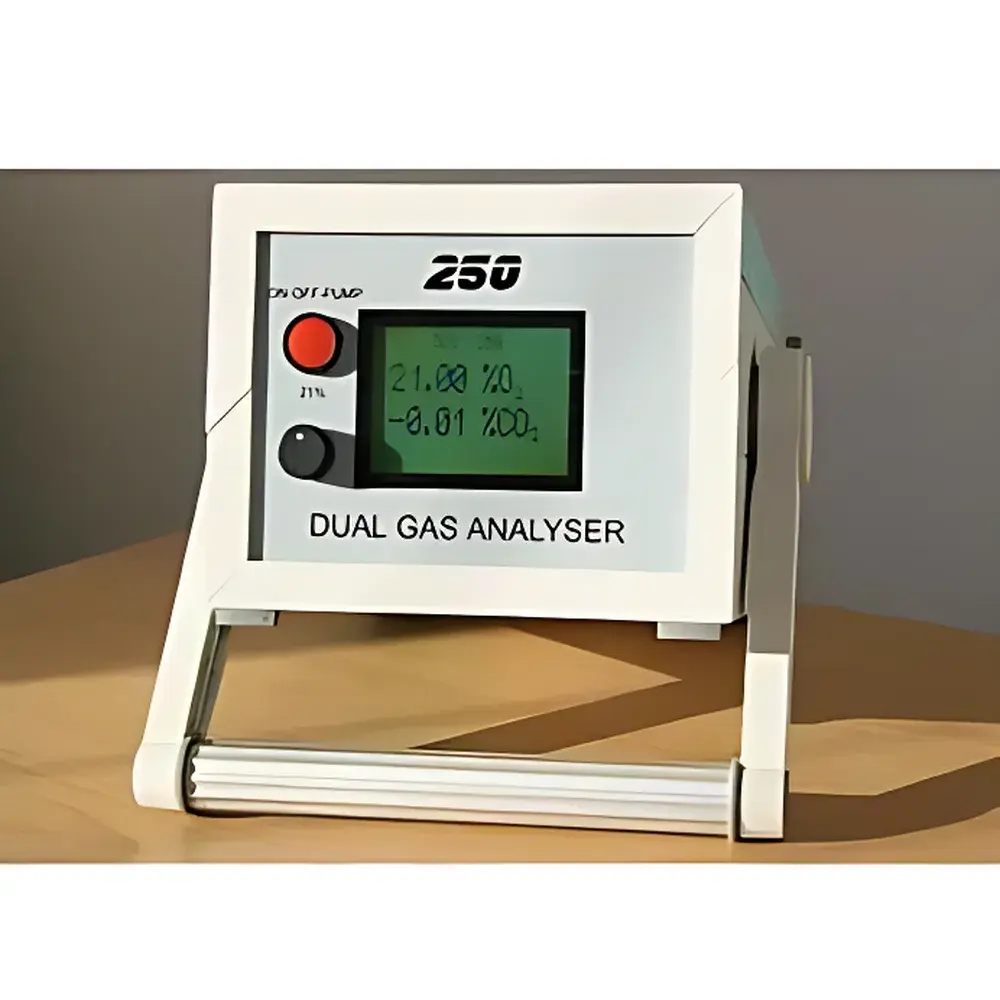
SCS SCS250 Portable Fruit & Vegetable Respiration Analyzer
| Brand | SCS |
|---|---|
| Origin | United Kingdom |
| Manufacturer Type | Authorized Distributor |
| Import Status | Imported |
| Model | SCS250 |
| Measurement Range | O₂ 0–25% vol, CO₂ 0–20% vol |
| Resolution | O₂ >5%: 0.1%, ≤5%: 0.01% |
| CO₂ >5% | 0.1%, ≤5%: 0.01% |
| Repeatability | O₂ ±0.1% (±0.05% at <5%), CO₂ ±0.1% (±0.05% at <5%) |
| Sensor Lifetime | O₂ electrochemical sensor — 4 years |
| Response Time | O₂: 99% in 30 s, CO₂: 99% in 60 s |
| Sample Flow Rate | 1 L/min |
| Power | NiMH battery — ≥4 h continuous operation |
| Dimensions (L×W×H) | 130 × 160 × 200 mm (excl. handle) |
| Output Signals | O₂ 0–25% → 0–2.5 V / 4–20 mA |
| Pump Type | Diaphragm pump with hydrophobic filter |
| Calibration | Zero-point calibration not required for O₂ sensor |
Overview
The SCS SCS250 Portable Fruit & Vegetable Respiration Analyzer is a field-deployable, dual-gas measurement instrument engineered for quantitative assessment of postharvest respiration physiology in horticultural commodities. It operates on the principle of concurrent electrochemical oxygen (O₂) detection and non-dispersive infrared (NDIR) carbon dioxide (CO₂) analysis—two complementary modalities that enable calculation of respiratory quotient (RQ = CO₂ produced / O₂ consumed) and metabolic status under controlled or ambient storage conditions. Designed for use in laboratories, cold chain logistics monitoring, controlled atmosphere (CA) storage facilities, and field-based postharvest trials, the SCS250 delivers stable, traceable gas concentration data without requiring external gas standards or frequent recalibration. Its sealed NDIR CO₂ cell and long-life electrochemical O₂ sensor eliminate drift-related uncertainty typical of low-cost solid-state sensors, supporting longitudinal studies where inter-session reproducibility is critical.
Key Features
- Dual-sensor architecture: High-stability electrochemical O₂ sensor (4-year rated lifetime) paired with a temperature-compensated, hermetically sealed NDIR CO₂ detector
- Zero-calibration O₂ measurement: Eliminates routine zero-gas dependency while maintaining ±0.05% repeatability below 5% O₂—critical for hypoxic CA storage validation
- Integrated sampling system: Precision diaphragm pump delivering consistent 1 L/min flow, coupled with a hydrophobic particulate filter to prevent moisture condensation on optical windows and sensor membranes
- Battery-operated portability: Rechargeable NiMH pack supports ≥4 hours of continuous operation; universal 100–240 VAC charger enables lab bench use or field deployment via portable power stations
- Real-time analog outputs: Simultaneous 0–2.5 V (O₂) and 0–2 V (CO₂), plus industry-standard 4–20 mA current loops for integration with SCADA, PLC, or data loggers compliant with IEC 61000-6-2/6-4
- Ruggedized enclosure: IP54-rated housing with ergonomic handle and shock-absorbing corners, validated for transport vibration per ISTA 2A and operating temperature range of 5–40 °C
Sample Compatibility & Compliance
The SCS250 is optimized for headspace gas analysis from sealed containers—including polyethylene bags, glass jars, custom respirometry chambers, and commercial modified-atmosphere packaging (MAP). It accommodates dynamic flow-through and static accumulation modes, supporting both short-term pulse measurements and extended time-series profiling (e.g., 24–72 h incubations). The instrument meets ISO 8583:2017 requirements for gas analysis instrumentation used in food quality assessment and aligns with ASTM D4222–22 (Standard Test Method for Determining Respiration Rate of Fresh Produce). All analog output signals are traceable to NIST-certified gas standards, and firmware supports audit-ready timestamped logging compatible with GLP-compliant workflows.
Software & Data Management
While the SCS250 operates autonomously with front-panel LCD readouts, optional PC connectivity via RS-232 or USB-to-serial interface enables real-time data streaming and configuration using SCS RespiroLog™ v3.x software (Windows 10/11). The software provides synchronized dual-channel time-series visualization, automatic RQ calculation, baseline correction tools, and export to CSV, Excel, or HDF5 formats. Raw analog outputs support third-party integration with LabVIEW, MATLAB, or Python-based acquisition systems. Firmware versioning, sensor health diagnostics, and calibration history logs are retained onboard and accessible via serial command protocol—ensuring full traceability for FDA 21 CFR Part 11–aligned environments when paired with electronic signature-enabled host software.
Applications
- Postharvest physiology research: Quantifying O₂ consumption and CO₂ evolution rates across cultivars, maturity stages, and pre-storage treatments (e.g., hot water dips, UV-C exposure)
- Controlled atmosphere (CA) and dynamic CA (DCA) system validation: Verifying setpoint accuracy and response latency during O₂ drawdown or CO₂ scrubbing cycles
- Modified atmosphere packaging (MAP) development: Optimizing film permeability and initial gas flush composition through iterative headspace monitoring
- Supply chain monitoring: Assessing respiration-induced gas shifts during sea freight, refrigerated truck transit, or warehouse holding
- Quality decay modeling: Correlating cumulative respiration metrics with firmness loss, ethylene emission, and microbial load in predictive shelf-life studies
FAQ
Does the SCS250 require daily zero or span calibration?
No. The electrochemical O₂ sensor is factory-zeroed and requires no routine zeroing; the NDIR CO₂ sensor is sealed and inherently stable. Optional annual verification against certified gas standards is recommended for ISO/IEC 17025-accredited labs.
Can the SCS250 be used inside high-humidity environments such as cold rooms or fogged shipping containers?
Yes—the integrated hydrophobic filter prevents liquid water ingress, and the pump’s flow profile ensures rapid sample turnover, minimizing dew point-related condensation on optical surfaces.
Is analog output scaling configurable?
Yes. Output voltage and current ranges are programmable via terminal commands or RespiroLog™ software to match downstream DAQ system input specifications.
What maintenance intervals are recommended for field use?
Filter replacement every 6 months under continuous operation; O₂ sensor replacement at 4-year end-of-life; CO₂ sensor service interval exceeds 10 years under normal storage conditions.
Does the device comply with electromagnetic compatibility (EMC) directives for laboratory use?
Yes. Certified to EN 61326-1:2013 (Class B) for EMC and EN 61010-1:2010 for electrical safety, including surge immunity per IEC 61000-4-5.
Related Products




