
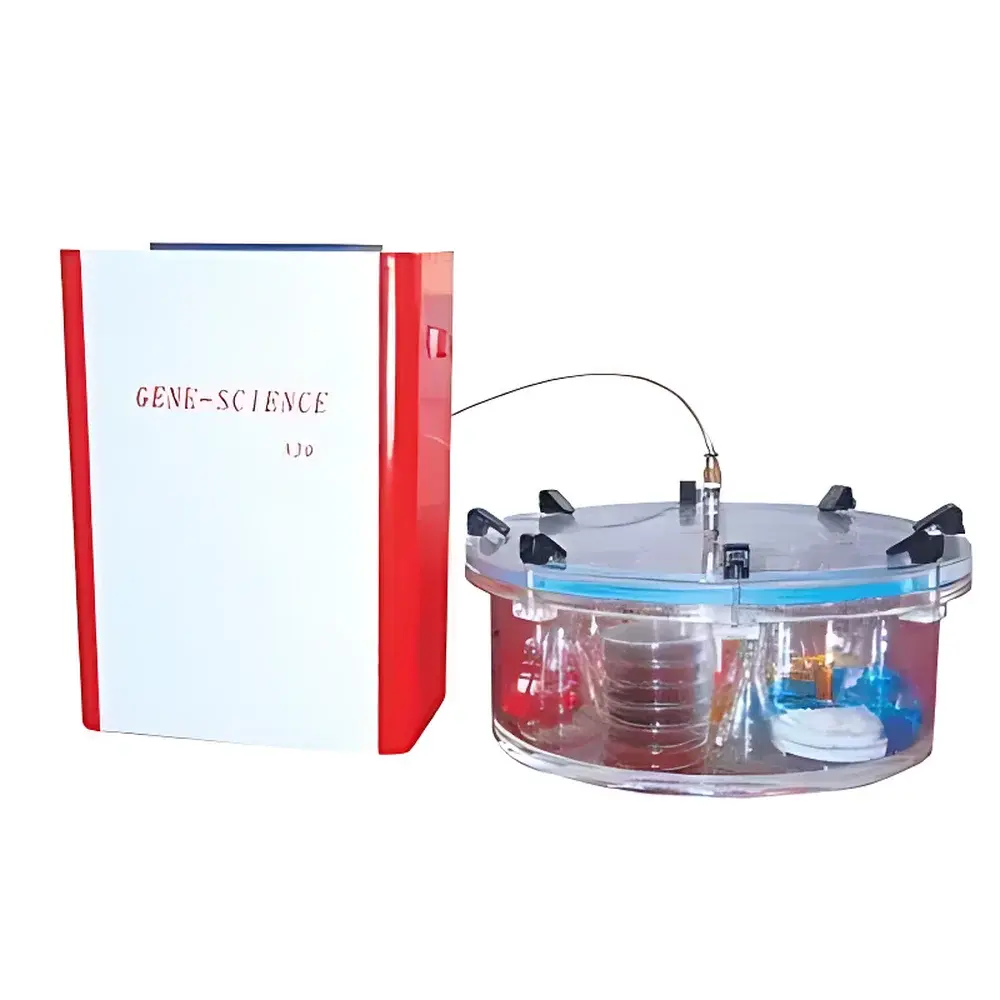
GeneScience A30 Anaerobic Workstation
| Brand | GeneScience |
|---|---|
| Origin | USA |
| Model | A30 |
| Temperature Control Range | Ambient to 45 °C (optional temperature control module) |
| Humidity Control Range | Ambient to 45 °C (optional temperature control module) |
| Final Chamber Pressure | <50 mbar |
| Max Gas Injection Pressure | 1 bar |
| Gas Flow Rate | 0.9 m³/h |
| Available Culture Volumes | 2.5 L, 3.5 L, 20 L, or 30 L |
| Integrated Vacuum Pump | Yes |
| Sealing Interface | Quick-connect bayonet coupling |
| Chamber Material | High-gloss, impact-resistant, temperature-stable polyester |
| Optical Clarity | Fully transparent chamber body and lid |
| Programmable O₂ Setpoints | User-defined (0.1–10% O₂) with multi-stage gas purge logic |
| Process Reproducibility | Six-tier QC protocol with full audit trail logging |
Overview
The GeneScience A30 Anaerobic Workstation is a compact, benchtop-controlled atmosphere system engineered for precise, reproducible cultivation of obligate anaerobes, microaerophiles, and oxygen-sensitive cell lines. Unlike conventional gas-pak systems or standalone anaerobic jars, the A30 employs active gas exchange and vacuum-assisted deoxygenation to establish and maintain defined low-oxygen environments—without reliance on chemical sachets or external gas cylinders. Its core operational principle integrates sequential evacuation, nitrogen/argon purging, and catalytic hydrogen-mediated oxygen scavenging to achieve sub-50 mbar residual pressure and stable O₂ concentrations as low as 0.1%. Designed for GLP-compliant microbiology labs, clinical diagnostics, and academic research facilities, the A30 delivers traceable environmental control across all operational phases—from chamber conditioning to endpoint harvest—while meeting essential requirements for ISO 13485-aligned workflows and FDA 21 CFR Part 11–ready data integrity.
Key Features
- Three-minute rapid atmosphere establishment: Achieves ≤0.5% O₂ in under 180 seconds via synchronized vacuum-purge-catalysis cycle
- Modular chamber architecture: Interchangeable transparent polyester culture vessels (2.5 L, 3.5 L, 20 L, 30 L) with optical-grade clarity for real-time visual monitoring and UV-compatible sterilization
- Integrated high-efficiency vacuum pump: Eliminates need for external vacuum sources; enables repeatable pressure ramp profiles and leak-tight sealing verification
- Quick-connect bayonet interface: Single-motion coupling between chamber and host unit ensures hermetic seal integrity without torque-dependent gaskets or O-rings
- Six-tier process validation protocol: Embedded microprocessor enforces pre-programmed QC checkpoints—including pressure decay test, gas flow calibration, catalyst activity verification, O₂ sensor drift compensation, thermal equilibration delay, and final atmosphere stability confirmation
- User-configurable gas management: Supports dual-gas input (N₂/CO₂ or N₂/H₂), programmable purge cycles, and adaptive catalyst regeneration logic based on cumulative exposure time
- Low-maintenance design: Catalyst cartridge life exceeds 2,000 cycles; no scheduled lubrication, filter replacement, or sensor recalibration required during standard operation
Sample Compatibility & Compliance
The A30 accommodates standard Petri dishes (up to 150 mm), multi-well plates (6–96-well), slant tubes, broth cultures, and tissue culture flasks within its modular chambers. All wetted surfaces are chemically inert to ethanol, isopropanol, hydrogen peroxide vapor (≤30% w/w), and saturated formaldehyde—enabling validated decontamination protocols compliant with CLSI M22-A3 and EU GMP Annex 1. The system meets IEC 61010-1 safety standards for laboratory equipment and supports audit-ready documentation through timestamped event logs, including chamber pressure traces, gas injection volumes, catalyst activation status, and user authentication records. Optional temperature control modules extend operational range to 45 °C ±0.3 °C (calibrated per ASTM E2251), facilitating simultaneous anaerobic thermophilic culturing per ISO 11133:2014.
Software & Data Management
The embedded firmware provides password-protected access levels (Operator, Technician, Administrator) and stores up to 500 complete run histories locally. Each log includes chamber ID, start/stop timestamps, O₂ setpoint, actual O₂ reading (electrochemical sensor, 0.01–21% range), pressure profile, gas consumption volume, and QC pass/fail flags. Export is supported via USB-C to CSV or PDF formats compatible with LIMS integration. When connected to institutional networks (via optional Ethernet adapter), the A30 supports remote monitoring through HTTPS-enabled web interface with TLS 1.2 encryption—meeting HIPAA and GDPR technical safeguards for protected health information handling in clinical microbiology applications.
Applications
- Clinical isolation of *Clostridioides difficile*, *Bacteroides fragilis*, and *Fusobacterium nucleatum* from stool and wound specimens
- Microbiome research requiring strict O₂ control for fecal microbiota transplantation (FMT) preparation and anaerobic fermentation assays
- Pharmaceutical stability testing of probiotic formulations under simulated gastrointestinal conditions
- Development of next-generation anaerobic bioreactors for metabolic engineering of *Clostridium acetobutylicum* and *Desulfovibrio vulgaris*
- Quality control of anaerobic culture media using reference strains per USP and EP 2.6.12
- Education and training in anaerobic techniques for undergraduate and graduate microbiology curricula
FAQ
Does the A30 require external gas cylinders or consumable gas-generating sachets?
No. The system operates using compressed nitrogen or argon (standard lab supply) and an integrated palladium-based catalyst that continuously removes residual O₂ via hydrogen-mediated recombination. No chemical sachets, gas generators, or disposable cartridges are needed beyond initial catalyst installation.
Can the A30 be validated for ISO 13485 or GMP environments?
Yes. The device includes factory-calibrated sensors, electronic audit trails, user-access controls, and IQ/OQ documentation templates aligned with Annex 15 and ISO/IEC 17025 requirements. Third-party PQ validation support is available upon request.
What maintenance intervals are recommended?
Catalyst replacement is advised every 2,000 cycles or 18 months (whichever occurs first). No other routine maintenance is required; the vacuum pump is sealed and lifetime-lubricated.
Is temperature control mandatory for anaerobic incubation?
No. Ambient-temperature operation is fully supported. The optional temperature control module is intended for applications requiring elevated incubation (e.g., *Campylobacter* microaerophilic growth at 42 °C) and must be specified at time of order.
How is chamber sterility maintained between runs?
The transparent polyester chamber withstands repeated cycles of 3% hydrogen peroxide vapor (HPV) decontamination. Full-cycle HPV validation reports and material compatibility data are provided in the Technical Dossier.
Related Products




