
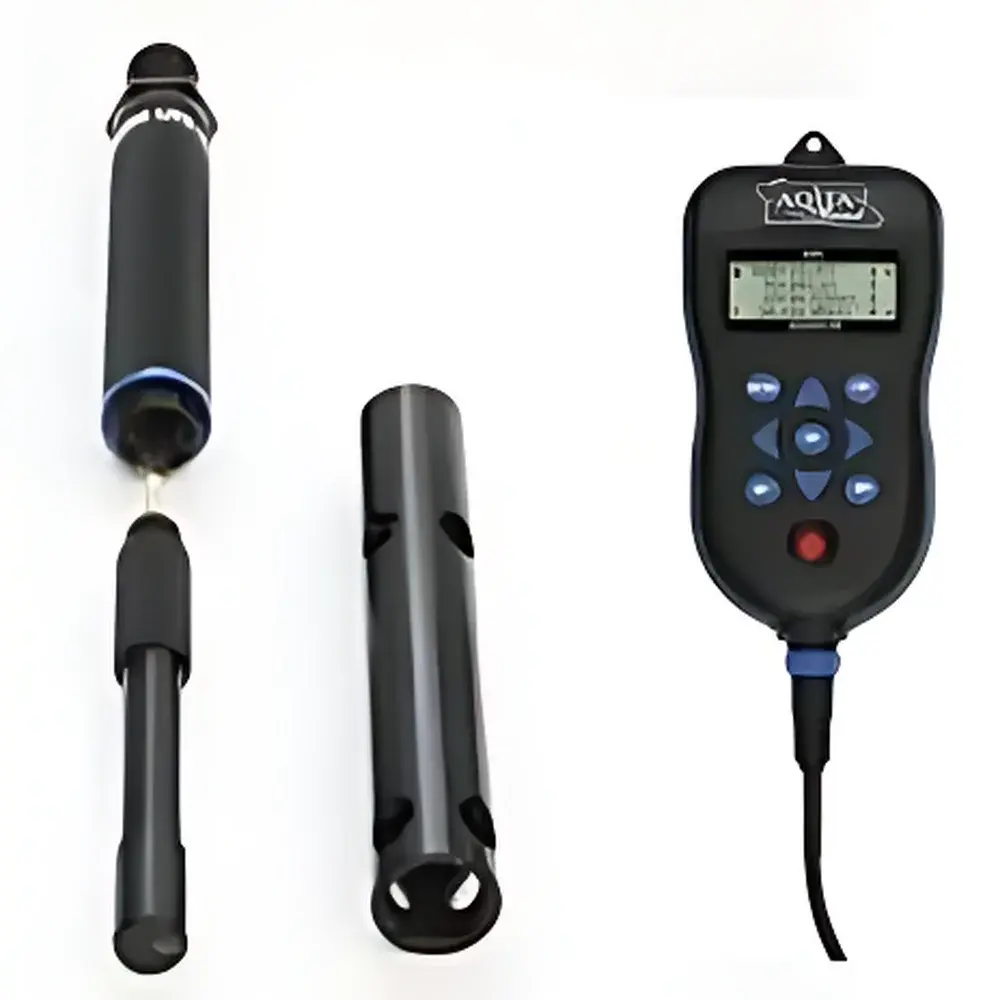
AQUAREAD AP-CPHYLL Portable In-Water Chlorophyll-a Fluorometer
| Brand | AQUAREAD |
|---|---|
| Origin | United Kingdom |
| Model | AP-CPHYLL |
| Portability | Handheld Submersible Design |
| Measurement Principle | In-situ Pulse-Amplitude Modulated (PAM) Fluorescence |
| Chlorophyll-a Range | 0–500 µg/L |
| Resolution | 0.1 µg/L |
| Repeatability | ±2% of reading |
| Sensor Housing Diameter | 24 mm |
| Sensor Housing Length | 250 mm |
| Aquameter Display | Backlit 80-character LCD |
| Aquameter Memory | 1900 data points |
| GPS | Built-in 12-channel, ±10 m accuracy |
| Barometric Pressure Sensor | 150–1150 mbar (±1 mbar) |
| Operating Temperature | −20 to +70 °C |
| Enclosure Rating | IP67 |
| Power | 5×AA alkaline or Ni-MH rechargeable batteries |
| Weight (with batteries) | 450 g |
| Dimensions (W×H×D) | 90×180×39 mm |
Overview
The AQUAREAD AP-CPHYLL Portable In-Water Chlorophyll-a Fluorometer is a field-deployable, submersible optical sensor system engineered for rapid, in-situ quantification of phytoplankton biomass via chlorophyll-a fluorescence. Based on pulse-amplitude modulated (PAM) fluorometry, the instrument measures the quantum yield of photosystem II (PSII) in live algal cells—providing a direct, non-destructive proxy for viable chlorophyll-a concentration. Unlike extractive spectrophotometric methods requiring filtration and solvent extraction, the AP-CPHYLL delivers real-time, depth-resolved data without sample preservation or laboratory processing. Its modular architecture integrates the AP-LITE sensor housing, LITE-CPHYLL optical sensor, and the Aquameter handheld display unit—enabling simultaneous acquisition of GPS position, barometric pressure, temperature, and fluorescence intensity at depths up to 25 m (dependent on cable length and probe configuration). Designed for compliance with ISO 10260:2021 (water quality — determination of chlorophyll-a by fluorometric measurement) and aligned with EPA Method 445.0 for in-vivo chlorophyll-a analysis, the system supports standardized monitoring protocols across freshwater, estuarine, and coastal marine environments.
Key Features
- True in-water, submersible operation with IP67-rated Aquameter and 24 mm diameter sensor housing—capable of continuous profiling from surface to benthic zones.
- PAM-based fluorescence detection optimized for high signal-to-noise ratio in turbid and low-light conditions; minimal photobleaching due to low-intensity excitation pulses.
- Modular sensor interchangeability: The LITE-CPHYLL sensor can be replaced in-field with other AQUAREAD LITE-series optical modules—including turbidity (NTU), phycocyanin (freshwater cyanobacteria), phycoerythrin (marine cyanobacteria), rhodamine WT (tracer studies), and hydrocarbon fluorescence sensors.
- Integrated GPS logging with 12-channel receiver and ±10 m positional accuracy—enabling georeferenced time-series mapping of chlorophyll hotspots and bloom dynamics.
- Onboard memory storing up to 1900 timestamped, multi-parameter records (Chl-a, GPS coordinates, pressure, temperature, battery voltage), exportable via USB-C to CSV or industry-standard formats compatible with GIS and LIMS platforms.
- Ruggedized design validated for field use: operating range −20 to +70 °C; 450 g total weight with batteries; backlit LCD readable under direct sunlight or low-light diving conditions.
Sample Compatibility & Compliance
The AP-CPHYLL is validated for direct immersion in natural water matrices including rivers, lakes, reservoirs, wetlands, estuaries, and nearshore marine systems. It exhibits minimal interference from common co-occurring substances such as humic acids (up to 20 mg/L DOC), suspended solids (<100 NTU), and dissolved organic matter—provided calibration is performed using site-specific reference standards. The system complies with ISO 10260:2021 Annex B for in-situ fluorometric Chl-a estimation and meets the performance criteria outlined in US EPA Method 445.0 for field-deployable fluorometers. Data traceability is supported through embedded audit logs, unique device ID, and timestamped metadata—facilitating GLP-aligned reporting and regulatory submissions under national water framework directives (e.g., EU WFD Article 8 reporting).
Software & Data Management
Data acquisition and post-processing are managed via AQUAREAD’s AQ-Suite desktop software (Windows/macOS), which provides automated calibration curve application, spectral correction for temperature drift (−20 to +40 °C), and batch export to CSV, Excel, or shapefile formats. Raw fluorescence units (RFU) are converted to µg/L Chl-a using user-defined or factory-installed calibration coefficients traceable to NIST-certified chlorophyll-a standards. Software-generated reports include QA/QC flags (e.g., saturation warnings, low signal thresholds), GPS track overlays, and statistical summaries (mean, SD, min/max per transect). All data files retain immutable metadata headers compliant with ASTM E2500-18 (standard guide for specification, design, and verification of pharmaceutical and biopharmaceutical manufacturing systems and equipment), supporting 21 CFR Part 11 readiness when configured with electronic signature modules.
Applications
- Real-time cyanobacterial bloom early warning and spatial extent mapping in drinking water source protection zones.
- Long-term trophic status assessment in lake restoration projects (e.g., Secchi depth correlation, Carlson’s TSI validation).
- Regulatory compliance monitoring for nutrient reduction programs under Total Maximum Daily Load (TMDL) frameworks.
- Research-grade phytoplankton productivity studies—paired with dissolved oxygen, PAR, and temperature profiles to model primary production rates.
- Ballast water management verification: rapid screening of viable algal load prior to discharge (per IMO G8 guidelines).
- Climate-driven phenology tracking: seasonal chlorophyll maxima timing, vertical migration patterns, and interannual variability analysis.
FAQ
Is the AP-CPHYLL suitable for saltwater applications?
Yes—the LITE-CPHYLL sensor is calibrated for both freshwater and marine matrices; salinity compensation is applied automatically using integrated conductivity input (when paired with optional LITE-COND module).
Can calibration be performed in the field?
Field calibration is supported using certified chlorophyll-a standard solutions (e.g., Anacystis nidulans extracts) and the two-point calibration routine in AQ-Suite; full validation requires lab-based spectrophotometric cross-check per ISO 10260.
What maintenance is required between deployments?
Rinse with deionized water after saltwater use; inspect O-rings for integrity; store sensor dry in protective case; perform quarterly verification against reference standard.
Does the system support real-time telemetry?
Standalone AP-CPHYLL operates offline; optional LTE-enabled Aquameter Pro variant allows encrypted cloud upload via MQTT or HTTP(S) to custom dashboards or SCADA systems.
How is sensor fouling mitigated during long-term deployment?
The AP-LITE housing features a smooth, chemically inert PEEK surface resistant to biofilm adhesion; anti-fouling wipers or copper-alloy sleeves are available as accessories for extended mooring applications.
Related Products







