
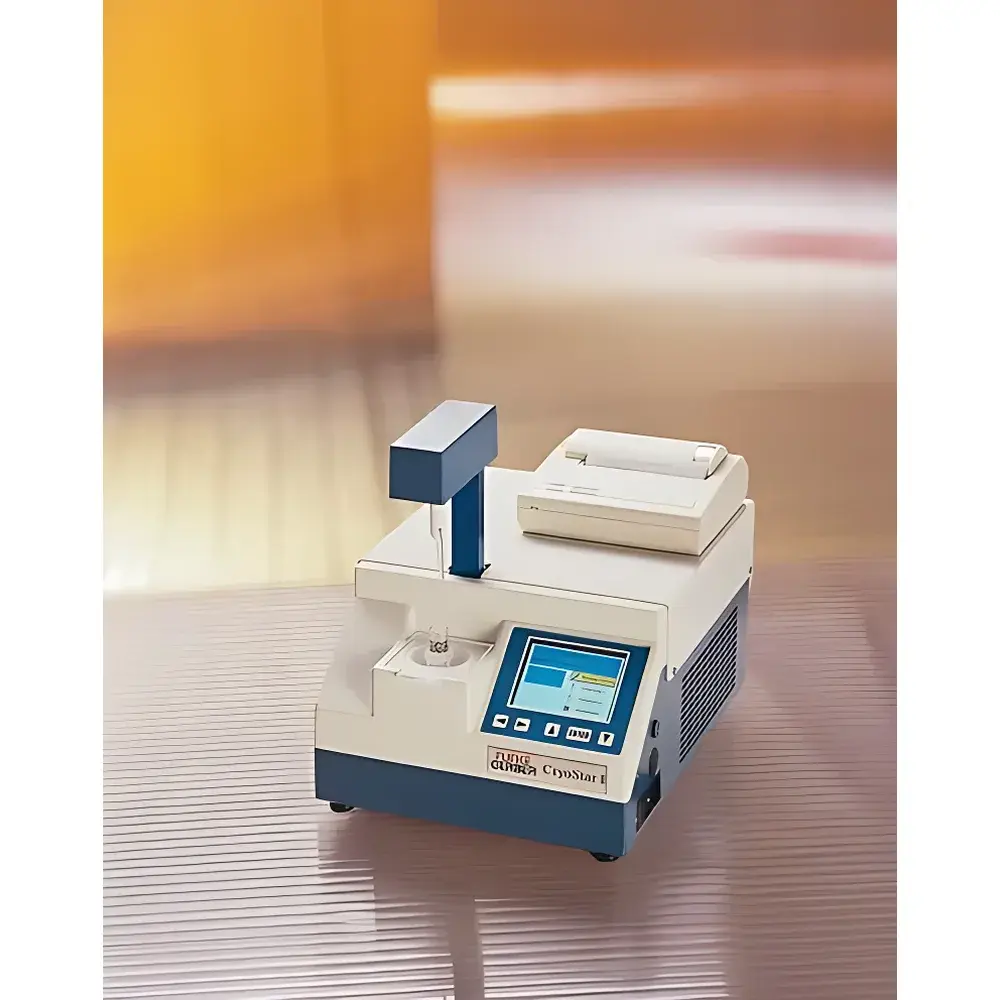
Gerber CryoStar Milk Cryoscope
| Brand | Gerber (FUNKE GERBER) |
|---|---|
| Origin | Germany |
| Model | CryoStar |
| Measurement Range | –1.500 °C to 0.000 °C |
| Resolution | 0.0001 °C |
| Repeatability | ±0.002 °C |
| Sample Volume | 2.2 mL |
| Throughput | 40 samples/hour |
| Interface | RS-232 port, 6 V printer port |
| Power Supply | 230 V / 115 V AC, 50–60 Hz, 180 W |
| Dimensions (W×H×D) | 290 mm × 190 mm × 380 mm |
| Weight | 12 kg |
Overview
The Gerber CryoStar Milk Cryoscope is a precision thermodynamic instrument engineered for the accurate determination of the freezing point depression of raw and processed bovine milk. Based on the colligative property principle—wherein the freezing point of an aqueous solution decreases linearly with increasing total solute molality—the CryoStar quantifies minute deviations from the expected freezing point of pure milk (–0.533 °C to –0.516 °C) to detect adulteration, primarily by water addition. This method is internationally recognized as the definitive reference technique for milk purity assessment under ISO 5725, IDF 119A, and AOAC Official Method 972.16. The instrument employs a high-stability Peltier-controlled cooling system, platinum resistance temperature sensing (Pt1000), and automated thermal equilibration algorithms to deliver traceable, reproducible measurements compliant with GLP and dairy quality assurance protocols.
Key Features
- High-resolution digital thermometry with 0.0001 °C resolution and ±0.002 °C repeatability—enabling detection of water dilution at ≤0.1% v/v.
- Automated sample handling cycle: precise 2.2 mL volumetric aspiration, controlled supercooling, nucleation induction, and dynamic freezing curve analysis.
- Dual-voltage universal power supply (115 V / 230 V AC) with active thermal regulation to ensure stable performance across laboratory environments.
- Compact benchtop design (290 × 190 × 380 mm) optimized for high-throughput dairy QC labs; 12 kg mass ensures mechanical stability during cryogenic cycling.
- RS-232 serial interface for direct integration into LIMS or QA data management systems; optional 6 V parallel printer port supports real-time hardcopy output of calibration logs and test reports.
- Factory-calibrated against NIST-traceable reference standards; includes built-in diagnostic routines for sensor drift monitoring and thermal gradient validation.
Sample Compatibility & Compliance
The CryoStar is validated for use with raw cow’s milk, standardized pasteurized milk, and reconstituted skim milk powders. It accommodates minor variations in fat content (0.5–5.0% w/w) and protein concentration without requiring matrix-specific recalibration. All measurement procedures conform to ISO 5725-2:2019 (accuracy and precision), IDF Standard 119A:2018 (determination of freezing point of milk), and Codex Alimentarius STAN 206-1999 (standard for milk). Instrument operation supports audit readiness for FDA 21 CFR Part 11 compliance when paired with validated software and electronic signature workflows. Routine calibration verification follows internal SOPs aligned with ISO/IEC 17025 requirements for testing laboratories.
Software & Data Management
The CryoStar operates via embedded firmware with configurable measurement protocols—including single-point freeze detection, multi-cycle averaging, and outlier rejection thresholds. Raw thermogram data (temperature vs. time) is exportable in CSV format via RS-232 for post-acquisition analysis in MATLAB, Python, or statistical QA platforms. Optional Gerber CryoLink software provides full audit trail functionality: user login tracking, timestamped result archiving, calibration history logging, and electronic signature support for regulated environments. Data integrity safeguards include write-protected memory storage, automatic backup on power loss, and tamper-evident report generation meeting GLP/GMP documentation standards.
Applications
- Verification of milk authenticity in receiving stations and dairy processing plants.
- Monitoring seasonal variation in natural freezing point due to lactation stage or feed composition.
- Supporting regulatory submissions for organic certification and export compliance (e.g., EU Regulation (EC) No 853/2004).
- Research applications in mammary physiology, colostrum characterization, and mastitis screening via osmolality correlation.
- Method validation and reference standard assignment in national reference laboratories and proficiency testing schemes.
FAQ
What is the theoretical basis for using freezing point depression to assess milk adulteration?
Freezing point depression is a colligative property dependent solely on the total molar concentration of dissolved solutes. Since water addition dilutes lactose, minerals, and other solutes, it raises the observed freezing point toward 0 °C—deviating from the species-specific baseline of –0.525 °C ± 0.008 °C.
Does the CryoStar require daily recalibration?
No. The instrument uses factory-traceable Pt1000 sensors and undergoes automatic self-diagnostic checks before each run. Daily verification with certified reference milk (CRM) is recommended per ISO 8586 and internal QA policy.
Can the CryoStar measure frozen or heat-treated milk samples?
Only fresh or refrigerated (2–8 °C) liquid milk samples are suitable. Heat treatment above 40 °C may induce casein micelle aggregation, altering crystallization kinetics and compromising accuracy.
Is the CryoStar compatible with modern LIMS platforms?
Yes—via ASCII-based RS-232 communication using standard SCPI-like command syntax. Gerber provides protocol documentation and driver libraries for LabVIEW, Python pySerial, and common LIMS vendors.
How does the CryoStar handle samples with high somatic cell count or antibiotic residues?
Neither somatic cells nor residual antibiotics significantly affect freezing point within regulatory limits. However, severe mastitis (>1 million SCC/mL) may cause minor colloidal shifts; such samples should be flagged for parallel conductivity testing per IDF 148A.



