
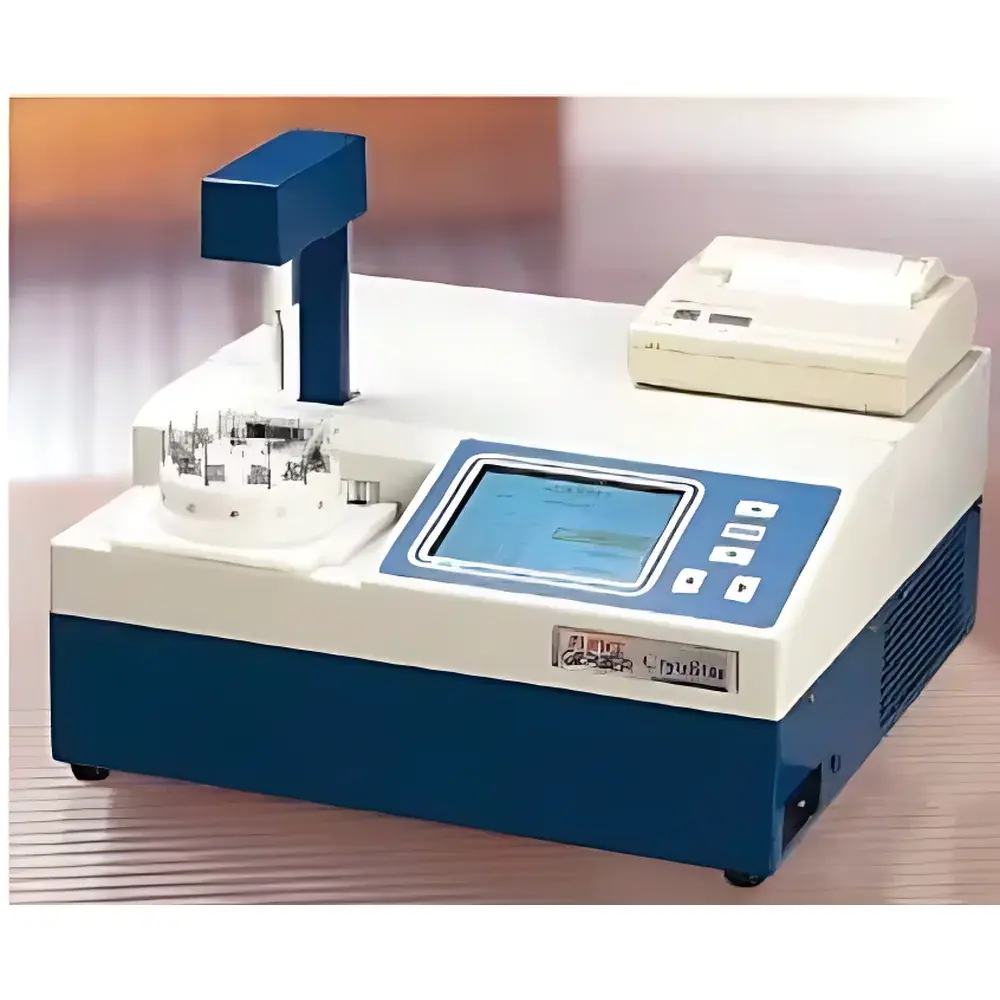
Gerber CryoStar-I Milk Cryoscope
| Origin | Germany |
|---|---|
| Manufacturer Type | Authorized Distributor |
| Origin Category | Imported |
| Model | CryoStar-I |
| Price | USD 10,800 (FOB Hamburg) |
| Measurement Range | 0.000 °C to −1.500 °C |
| Sample Volume | 2.2 mL |
| Resolution | 0.0001 °C |
| Repeatability | ±0.002 °C (typical operational precision ±0.0002 °C) |
| Throughput | 40 samples/hour (1.5 min/sample) |
| Dimensions (W×H×D) | 290 × 190 × 380 mm |
| Weight | 12 kg |
| Power Supply | 230/115 V AC, 50–60 Hz, 180 W or 12 V DC |
| Interfaces | RS-232 serial port, 6 V parallel printer port |
| Compliance | EN ISO 5725, IDF Standard 126A:2017, AOAC Official Method 972.16 |
Overview
The Gerber CryoStar-I Milk Cryoscope is a precision thermometric instrument engineered for the rapid, traceable, and regulatory-compliant determination of freezing point depression in raw bovine milk—a primary indicator of adulteration by water addition. It operates on the fundamental colligative principle that dissolved solutes (e.g., lactose, minerals, proteins) lower the freezing point of aqueous solutions relative to pure water (0.000 °C). Fresh, unadulterated milk exhibits a characteristic freezing point range of −0.512 °C to −0.548 °C, with a mean value of −0.530 °C. Each 1% (v/v) dilution with potable water elevates the measured freezing point by approximately +0.0053 °C; full dilution yields a reading of 0.000 °C. The CryoStar-I employs a high-stability glass resistance thermometer probe immersed in a precisely agitated sample within a Peltier-cooled chamber, enabling real-time monitoring of the phase transition curve. Its algorithm computes both the thermodynamic freezing point (defined as the temperature at maximum slope of the solidification curve) and the corresponding water adulteration percentage using the internationally accepted formula per IDF Standard 126A:2017.
Key Features
- Patented dual-stage Peltier cooling system delivering stable thermal control across ambient temperatures from 10 °C to 35 °C—minimizing drift and eliminating need for external chillers or compressed gas.
- High-resolution platinum RTD probe (Class A, IEC 60751) with 0.0001 °C digital resolution and verified repeatability of ±0.002 °C (validated per ISO 5725-2 interlaboratory studies).
- Dual measurement modes: fixed-time protocol (optimized for routine QC) and dynamic scanning mode (for method development or atypical samples), both programmable and recallable via non-volatile memory.
- Multi-language interface supporting English, German, French, Italian, Spanish, and Greek—fully compliant with EU multilingual regulatory requirements for dairy inspection labs.
- Integrated 12 V DC operation capability—enabling field deployment via automotive battery or solar power systems without performance degradation.
- Automated calibration sequence with dual-point verification using certified reference standards (CryoCal-A and CryoCal-B), with all calibration coefficients permanently stored in EEPROM.
Sample Compatibility & Compliance
The CryoStar-I is validated exclusively for raw, pasteurized, and standardized bovine milk (whole, skim, and low-fat). It is not intended for use with ultra-high-temperature (UHT) processed, fermented, or plant-based milks due to matrix interference from Maillard reaction products or non-lactose solutes. All measurements adhere to the harmonized methodology defined in ISO 5725 (accuracy, trueness, precision), IDF Standard 126A:2017 (Milk — Determination of freezing point), and AOAC Official Method 972.16. Instrument firmware supports audit-ready data logging—including timestamped freezing curves, operator ID, calibration history, and environmental ambient readings—to satisfy GLP and GMP documentation requirements under FDA 21 CFR Part 11 when paired with validated software.
Software & Data Management
Bundled CryoSoft v4.2 provides secure, configurable data acquisition and reporting. It enables export of raw thermograms (CSV), summary reports (PDF/Excel), and batch-level statistical analysis (mean, SD, CV%, trend charts). The software enforces role-based access control (administrator/operator), electronic signature capture, and immutable audit trails for all critical events (calibration, result modification, user login/logout). Data files include embedded metadata: instrument serial number, firmware version, probe ID, and traceable reference standard lot numbers—ensuring full chain-of-custody compliance for regulatory submissions or third-party accreditation (e.g., ISO/IEC 17025).
Applications
- Routine quality control in dairy collection centers and processing plants to detect intentional water adulteration prior to payment or processing.
- Regulatory surveillance by national food safety authorities (e.g., EU DG SANTE, USDA AMS, FSSAI) during farm-gate or transport inspections.
- Research applications investigating cryoscopic behavior of milk variants (e.g., mastitis-affected, seasonal composition shifts, breed-specific profiles).
- Validation of membrane filtration efficiency in whey concentration processes via post-filtration freezing point monitoring.
- Training laboratories requiring NIST-traceable reference instrumentation for technician certification programs.
FAQ
What reference standards are required for daily calibration?
CryoCal-A (−0.530 °C certified reference) and CryoCal-B (−0.545 °C certified reference), supplied in 250 mL bottles—both traceable to PTB (Physikalisch-Technische Bundesanstalt) and certified per ISO/IEC 17025.
Is the instrument suitable for testing goat or sheep milk?
No. Goat and ovine milk exhibit significantly different baseline freezing points (−0.560 °C to −0.580 °C) and solute profiles; use requires method revalidation and instrument recalibration per ISO 5725-3, which is outside the scope of factory certification.
Can results be integrated into LIMS?
Yes. RS-232 ASCII output supports direct integration with major LIMS platforms via configurable delimiter protocols (e.g., tab-separated values with header metadata). Optional OPC UA gateway module available for IIoT-enabled infrastructure.
How often must the cooling fluid be replaced?
The proprietary ethylene glycol–water coolant (500 mL bottle supplied) requires replacement every 12 months or after 5,000 test cycles—whichever occurs first—to maintain thermal stability and avoid crystallization-induced sensor drift.
Does the instrument meet FDA 21 CFR Part 11 requirements?
The hardware and CryoSoft v4.2 software package are designed for Part 11 compliance when deployed in a validated environment: electronic signatures, audit trail integrity, and data encryption (AES-256) are fully implemented and documented in the vendor’s Validation Master Plan (VMP).
Related Products





