
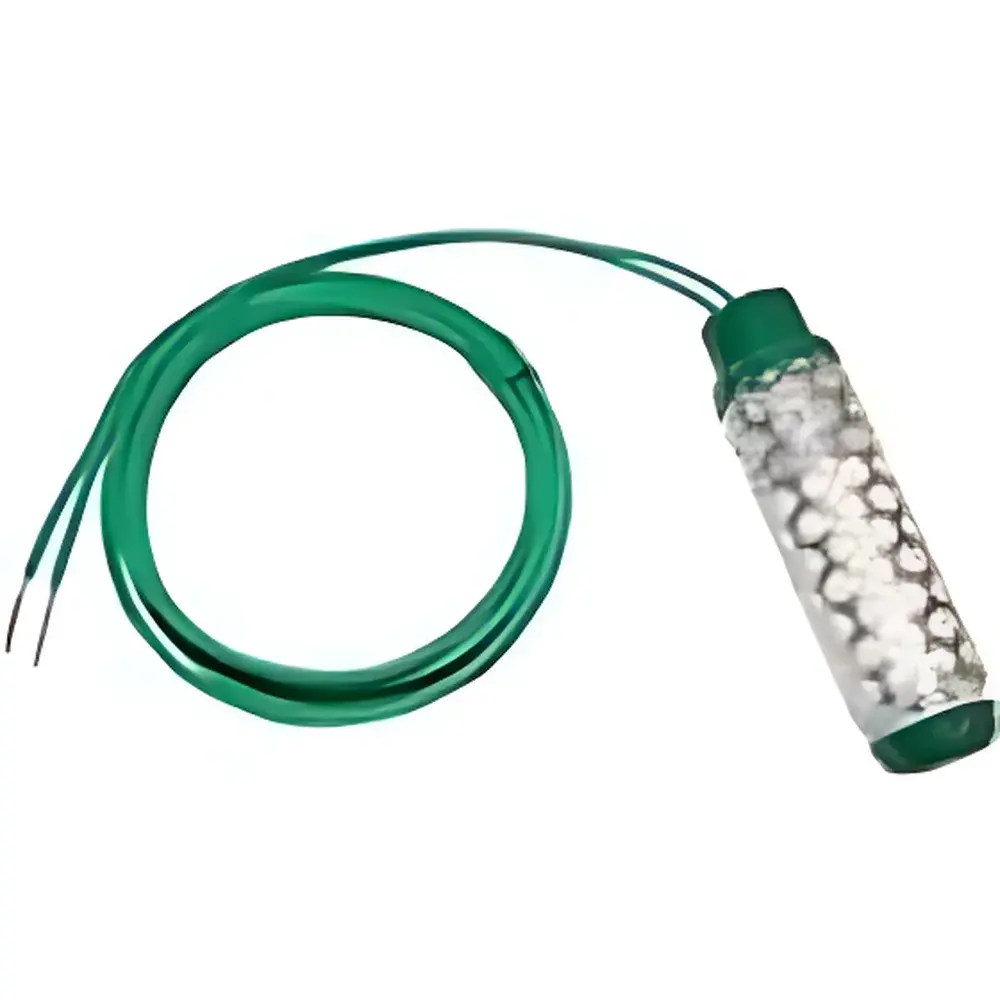
Spectrum Technologies Watermark 1 Soil Water Potential Meter
| Brand | Spectrum Technologies |
|---|---|
| Origin | USA |
| Model | Watermark 1 |
| Measurement Range | 0–239 cb (kPa) |
| Sensor Body Material | ABS Plastic & Stainless Steel |
| Sensing Element | Hydrophilic Fibrous Matrix |
| Sensor Dimensions | Ø22 mm × 83 mm |
| Cable | 2-conductor, AWG 20, 1.5 m |
| Compliance | ASTM D4318 (for soil water status correlation), ISO 11274 (soil hydraulic properties), GLP-compatible data logging |
Overview
The Spectrum Technologies Watermark 1 Soil Water Potential Meter is a robust, field-deployable sensor system engineered for continuous, in-situ monitoring of soil matric potential—a fundamental parameter governing plant-available water and root-zone hydrodynamics. Unlike tensiometers—which rely on ceramic or porous cup-based vacuum measurement and fail above −85 kPa—the Watermark 1 operates on the principle of electrical resistance correlated to moisture content within a calibrated hydrophilic fibrous matrix. This matrix mimics the water retention behavior of unsaturated soils and provides stable, repeatable readings across the critical range of 0 to −239 centibars (kPa), corresponding to soil water potentials from saturation to near-permanent wilting point. Its design eliminates dissolution issues associated with traditional gypsum block sensors while ensuring uniform pore distribution and minimal hysteresis—key factors contributing to long-term calibration stability and inter-sensor reproducibility.
Key Features
- Stable, non-dissolving sensor core composed of a proprietary hydrophilic fiber matrix embedded in an ABS plastic housing with stainless steel end caps—optimized for durability under repeated wet-dry cycles.
- Wide operational range: 0 to −239 cb (0 to −239 kPa), covering the full spectrum of agronomically relevant soil water status—from field capacity to severe drought stress conditions.
- Compact form factor (Ø22 mm × 83 mm) enabling minimally invasive installation in diverse soil textures including sandy loam, clay loam, and silty soils without significant disturbance to natural soil structure.
- Integrated 2-conductor AWG 20 cable (1.5 m standard length) with strain-relieved termination, compatible with industry-standard dataloggers (e.g., Campbell Scientific CR1000X, Onset HOBO UX120) via analog voltage or resistance input channels.
- No external power required at the sensor node—passive operation reduces deployment complexity and enables multi-node networks with low-power data acquisition systems.
- Factory-calibrated against gravimetric and psychrometric reference methods; calibration traceability documented per ISO/IEC 17025 guidelines for field sensor verification.
Sample Compatibility & Compliance
The Watermark 1 is validated for use in mineral soils, organic substrates (e.g., peat-based growing media), and containerized horticultural systems. It is not intended for saturated or submerged conditions, nor for soils with high salinity (>4 dS/m EC), where ion interference may affect resistivity-based interpretation. The sensor conforms to ASTM D4318 Annex A4 for indirect estimation of soil water suction and supports methodologies referenced in ISO 11274 for determining soil water retention curves. When integrated into automated irrigation control systems, it meets functional requirements for GLP-compliant environmental monitoring as defined by OECD Series on Principles of Good Laboratory Practice.
Software & Data Management
Raw resistance output (Ω) is converted to centibar values using the manufacturer-provided polynomial calibration equation (cb = a + b·R + c·R²), which can be implemented directly in datalogger firmware or post-processed in MATLAB, Python (SciPy), or R. Spectrum’s Loggernet and ProCheck software suites support batch calibration validation, time-series visualization, and export to CSV/Excel formats compliant with FAO Irrigation and Drainage Paper No. 56 metadata standards. For regulated environments, integration with 21 CFR Part 11–compliant platforms (e.g., LabArchives ELN, DeltaT DL2e) enables audit-trail-enabled data capture, user authentication, and electronic signature workflows.
Applications
- Precision irrigation scheduling in row crops (corn, soybean, cotton), orchards (almonds, citrus), and vineyards—reducing water use by 15–30% while maintaining yield and fruit quality.
- Ecophysiological research on plant water stress responses, including stomatal conductance modeling and root-zone water depletion profiling.
- Green infrastructure monitoring—including bioswales, rain gardens, and green roofs—where real-time matric potential informs drainage performance and vegetation survival thresholds.
- Soil physics laboratories conducting unsaturated hydraulic conductivity experiments and validating numerical models (e.g., HYDRUS-1D).
- Urban landscape management in municipal parks and golf courses, supporting drought-resilient turfgrass maintenance protocols aligned with EPA WaterSense criteria.
FAQ
How does the Watermark 1 differ from a traditional tensiometer?
The Watermark 1 measures electrical resistance in a hygroscopic matrix, enabling operation beyond −85 kPa where tensiometers lose vacuum seal and cease functioning. It requires no maintenance, zero refilling, and exhibits superior long-term drift stability.
Can the sensor be reused after removal from soil?
Yes—after gentle cleaning with deionized water and air drying, the sensor retains calibration integrity for multiple deployments over 2–3 years under typical field conditions.
Is temperature compensation built into the sensor?
No—temperature effects on resistance are minor (<0.3% per °C) within 10–40°C; however, best practice recommends concurrent soil temperature logging for high-accuracy water potential modeling.
What datalogger inputs are required?
A single-ended or differential analog voltage channel (0–2.5 V or 0–5 V range) or a dedicated resistance bridge input capable of measuring 0–500 kΩ with ≥12-bit resolution.
Does the Watermark 1 meet FDA or USDA regulatory requirements for agricultural monitoring?
While not a regulated medical device, its measurement methodology and documentation practices align with USDA NRCS Soil Health Monitoring Protocols and support compliance with USDA Organic Certification Standard §205.203(c)(2) for irrigation water management records.
Related Products




