
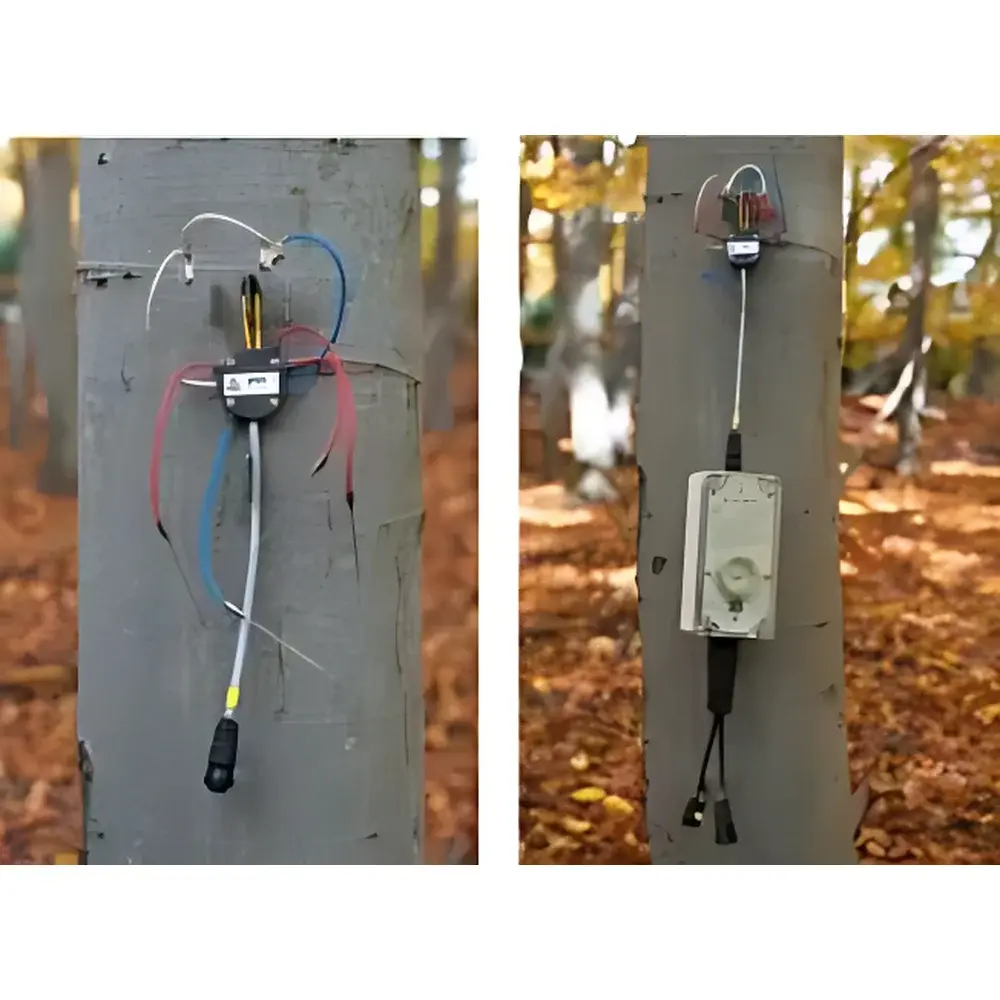
PSI EMS81 Portable Tree Stem Flow Monitor
| Brand | PSI / Photon Systems Instruments |
|---|---|
| Origin | Czech Republic |
| Model | EMS81 |
| Measurement Principle | Tissue Heat Balance (THB) |
| Stem Diameter Range | ≥12 cm |
| Power Supply | Rechargeable Battery (Standalone) or Centralized DC |
| Electrode Configuration | 3+1 Insulated/Reference Electrodes |
| Heating Current | 40–200 mA (1 kHz) |
| Max Power Consumption | 4 W |
| Typical Power Consumption | 0.3–0.4 W @ ΔT = 1 K |
| Output Unit | kg·hr⁻¹ |
| Compliance | Designed for GLP-aligned field ecophysiology studies |
| Software Integration | MicroSet 8X Control Unit with DR26 Stem Growth Sensor Interface |
| Data Logging | Onboard Acquisition, Synchronized Stem Flow & Stem Growth |
Overview
The PSI EMS81 Portable Tree Stem Flow Monitor is a field-deployable, physics-based instrumentation system engineered for continuous, non-invasive quantification of sap flux density in woody stems. It implements the Tissue Heat Balance (THB) method—a thermodynamic approach grounded in first-principles energy conservation—where electrical current is passed directly through the xylem tissue between insulated electrodes to induce localized resistive heating. Unlike thermal dissipation or heat ratio methods, THB measures the power required to maintain a stable temperature differential (ΔT) across a defined xylem segment, directly linking input electrical energy (P, in watts) to mass flow rate (Q, in kg·s⁻¹) via the equation: P = Q · ΔT · cw + ΔT · z, where cw is the specific heat capacity of water (4186 J·kg⁻¹·K⁻¹) and z represents conductive heat loss to surrounding tissues and environment. This principle eliminates empirical calibration against reference transpiration, delivering absolute mass-based stem flow output in kg·hr⁻¹ with inherent traceability to SI units. The EMS81 is specifically validated for stems ≥12 cm in diameter, including irregular, sloped, or heterogeneous stand conditions where radial flow asymmetry necessitates dual-sensor deployment (e.g., sun-facing vs. shaded aspects).
Key Features
- Integrated THB measurement architecture: 3 insulated current-injection electrodes + 1 unshielded reference electrode positioned 100 mm distally, enabling precise spatial control of heating volume within functional xylem.
- MicroSet 8X control unit: Embedded data acquisition system with 24-bit resolution ADC, real-time ΔT monitoring (±0.01 K), programmable heating duty cycle (1 kHz carrier frequency), and onboard storage for >1 year of 15-minute interval data.
- Synchronized multi-parameter monitoring: Native interface for DR26 dendrometer sensor, permitting concurrent high-resolution stem radius change (µm-level resolution) and sap flow dynamics on a single time axis.
- Flexible deployment topology: Operates as an autonomous node powered by rechargeable Li-ion battery (72 h typical runtime at 15-min logging), or integrates into scalable multi-node networks via RS-485 daisy-chain with optional centralized DC power distribution.
- Low-power thermal design: Average power draw of 0.3–0.4 W under typical field ΔT gradients (1 K), peak consumption capped at 4 W—enabling long-term unattended operation in remote forest plots without solar supplementation.
Sample Compatibility & Compliance
The EMS81 is applicable to broadleaf and coniferous species with stem diameters ≥12 cm, including but not limited to Fagus sylvatica, Quercus robur, Picea abies, and Pinus sylvestris. Its electrode geometry and current regulation accommodate variable bark thickness, cambial activity, and xylem moisture heterogeneity. For trees exhibiting pronounced azimuthal flow asymmetry—common in steep terrain, partial canopy exposure, or edaphic gradients—the system supports paired installation (e.g., north/south or east/west positions) with arithmetic averaging of outputs to estimate whole-stem flux. All firmware and data handling protocols conform to principles outlined in ISO 17025:2017 for field measurement uncertainty management. While not certified for regulatory submission per se, raw THB-derived kg·hr⁻¹ values are fully auditable and compatible with GLP-compliant data workflows when paired with timestamped metadata and environmental context logging.
Software & Data Management
Data acquisition, visualization, and export are managed through PSI’s MicroSet Control Suite (v4.2+), a Windows-based application supporting direct USB or RS-485 connection. The software provides real-time monitoring of heating current, ΔT, calculated sap flow, and dendrometer displacement; applies user-defined corrections for wood-specific thermal conductivity (if known); and exports time-series data in CSV and NetCDF-4 formats compliant with FAIR (Findable, Accessible, Interoperable, Reusable) data principles. Audit trails—including parameter configuration history, firmware version stamps, and operator annotations—are retained in encrypted binary logs. Exported datasets include full metadata headers specifying sensor ID, installation date, electrode depth, stem circumference, and ambient temperature/humidity (when interfaced with optional external气象 stations). No cloud dependency or vendor-locked format is imposed.
Applications
- Forest hydrology modeling: Quantifying stand-scale transpiration partitioning and coupling with eddy covariance towers.
- Drought response phenotyping: Tracking diurnal and seasonal shifts in sap flow magnitude, timing, and hysteresis under controlled irrigation or natural stress gradients.
- Carbon–water coupling analysis: Integrating stem flow with concurrent CO₂ assimilation (via portable gas exchange systems) to derive intrinsic water-use efficiency (iWUE).
- Urban tree physiology: Assessing irrigation efficacy, root-zone restriction impacts, and microclimate buffering capacity in street tree inventories.
- Ecohydrological validation: Ground-truthing of satellite-derived evapotranspiration (ET) products (e.g., MOD16, SSEBop) at plot scale.
FAQ
Does the EMS81 require calibration against gravimetric or porometer measurements?
No. THB is a first-principles method; output is derived directly from measured electrical power and temperature differentials. Calibration is neither necessary nor recommended.
Can the EMS81 be used on stems smaller than 12 cm in diameter?
Not reliably. Below this threshold, radial heat loss dominates the energy balance, violating the core assumption of one-dimensional axial conduction. Alternative methods (e.g., heat pulse velocity) are advised for saplings.
How is electrode insertion depth determined?
Electrodes must penetrate bark and phloem to contact functional sapwood. Depth is species-dependent and verified histologically post-installation; PSI provides standardized insertion guides based on wood anatomy databases.
Is the system compatible with third-party dataloggers?
Yes—via analog voltage output (0–5 V) representing normalized sap flow or digital RS-485 Modbus RTU protocol. Full register mapping is documented in the technical manual.
What maintenance is required during multi-season deployments?
Annual inspection of electrode insulation integrity, battery health check, and verification of dendrometer mechanical zero point. No recalibration or firmware updates are needed under normal operating conditions.





