
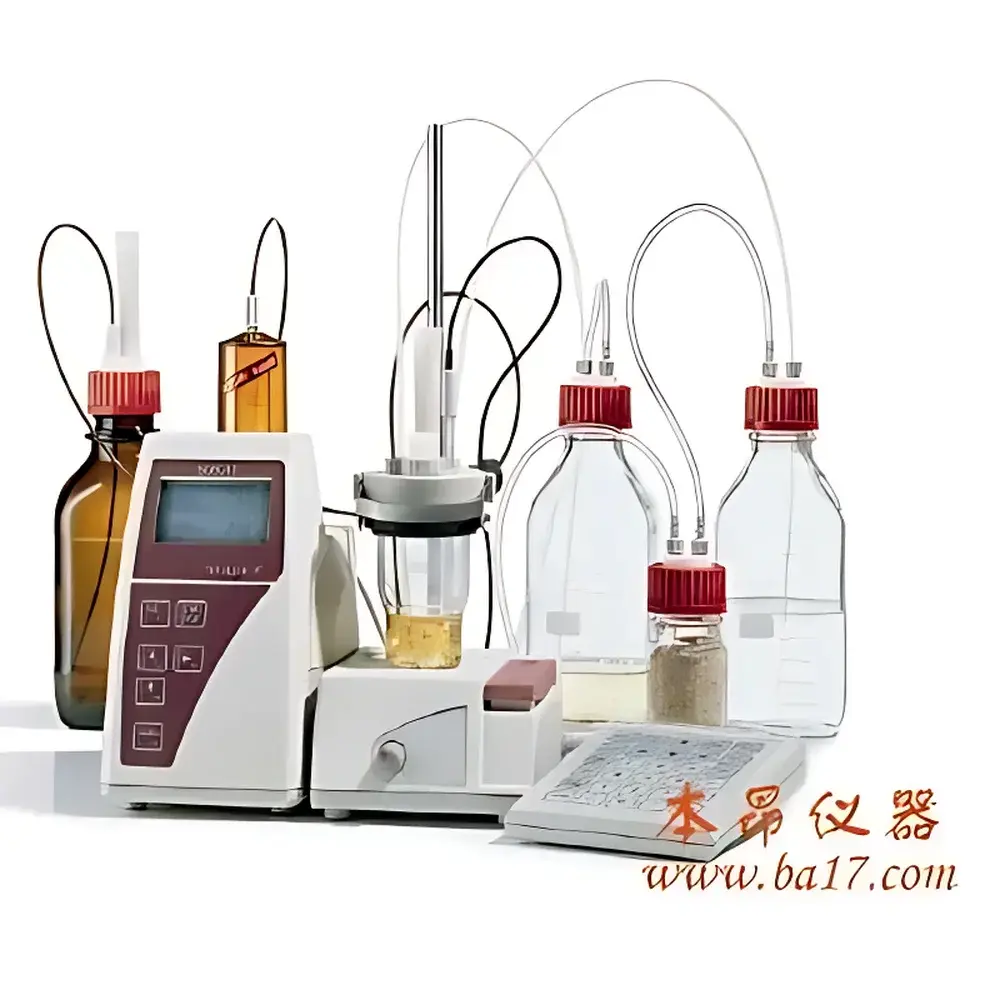
Schott TitroLine KF Automated Karl Fischer Moisture Analyzer
| Origin | Shanghai, China |
|---|---|
| Manufacturer Type | Authorized Distributor |
| Origin Category | Domestic (China) |
| Model | TitroLine KF |
| Price | USD 10,700 (approx.) |
| Moisture Range | 10 ppm – 100% H₂O |
| Compliance | DIN 12650-5, EN ISO 8655-3 & EN ISO 8655-6 |
| Burette | 20 mL Duran® glass with UV shield |
| Dispensing Accuracy | ±0.05% (per EN ISO 8655-6) |
| Electrode | Dual platinum electrode, ±1900 mV potential, ±200 µA current |
| Display | Backlit LCD |
| Dimensions/Weight | 310 × 265 × 205 mm (H×W×D), ~3.2 kg |
| Interface | Dual RS-232C ports |
| Measurement Time | 30 s to several minutes |
| Sample Forms | Liquids, solids, gases, viscous matrices |
Overview
The Schott TitroLine KF Automated Karl Fischer Moisture Analyzer is a compact, benchtop coulometric and volumetric KF titration system engineered for precision moisture quantification across pharmaceutical, chemical, food, petrochemical, and materials science laboratories. It operates on the electrochemical principle of Karl Fischer titration—where iodine generated *in situ* via controlled electrolysis (coulometric mode) or delivered from a standardized titrant solution (volumetric mode) stoichiometrically reacts with water in the sample according to the classic Bunsen reaction: I₂ + SO₂ + H₂O + 3RN + CH₃OH → 2RN·HI + RN·HSO₄CH₃. The TitroLine KF implements bipotentiometric endpoint detection using dual platinum electrodes, ensuring high reproducibility and low drift sensitivity—even under variable ambient humidity or complex matrix conditions. Its modular architecture integrates reagent handling, electrode sensing, and real-time current monitoring into a single, self-contained unit weighing just 3.2 kg, enabling rapid deployment without external gas purging or solvent conditioning systems.
Key Features
- Integrated 20 mL Duran® glass burette with UV-blocking shield, compliant with EN ISO 8655-3 for volumetric accuracy and EN ISO 8655-6 for dispensing precision (±0.05%)
- Dual platinum indicator electrodes with extended dynamic range (±1900 mV, ±200 µA), optimized for both low-moisture (10%) samples
- Three configurable report formats—Simple, Standard, and GLP-compliant—with full audit trail metadata including operator ID, timestamp, sample ID, reagent lot number, blank correction, and drift value
- Seven preprogrammed titration modes: sample titration, pure water standardization, liquid standard titration, dihydrate tartaric acid calibration, drying oven blank, solvent blank, and user-defined method sequences
- Adjustable titration parameters: pre-titration duration, extraction time, drift termination threshold, endpoint delay, polarization voltage, and min/max titration time limits
- Multi-unit result output: % H₂O, ppm, mg H₂O, mg/L, mg per piece (mg/pc), and mL; blank values reported exclusively in mL per ISO 8655 conventions
- Dual RS-232C interfaces support seamless integration with analytical balances (e.g., METTLER TOLEDO, SARTORIUS), LIMS, and validated PC-based titration software for 21 CFR Part 11 compliance
Sample Compatibility & Compliance
The TitroLine KF accommodates heterogeneous sample types—including volatile liquids (e.g., acetone, THF), hygroscopic solids (e.g., APIs, excipients), gaseous streams (via gas sampling valve), and high-viscosity substances (e.g., polymers, lubricants, pastes)—using optional accessories such as the drying oven (for thermally released water), homogenizer (for in-cup sample dispersion), and temperature-controlled titration vessel. All hardware components—including 3-way solenoid valves, FEP-lined tubing, and reagent reservoirs—are chemically inert to KF reagents (imidazole-based anolytes, methanol-free solvents) and resistant to UV degradation. The system conforms to DIN 12650-5 (Karl Fischer titration—general requirements), EN ISO 8655-3 (piston burettes), and EN ISO 8655-6 (performance testing of dispensers). For regulated environments, Schott provides vendor-supplied DQ/IQ/OQ documentation packages supporting GMP/GLP validation per ICH Q2(R2) and FDA guidance.
Software & Data Management
Data integrity is enforced through built-in GLP reporting with electronic signature fields, automatic timestamping, and non-erasable method logs. Raw titration curves (current vs. time), endpoint detection events, and drift-corrected water mass calculations are stored locally on the instrument’s internal memory and exportable via RS-232 to CSV or proprietary .TIT files. When paired with optional TitroLine Control Software, users gain access to advanced features: method library management, statistical process control (SPC) charts, automated calibration verification, and electronic audit trails meeting 21 CFR Part 11 requirements—including user authentication, role-based permissions, and immutable record archiving. All exported data retain traceability to reagent batch numbers, electrode calibration history, and environmental drift baselines.
Applications
In pharmaceutical manufacturing, the TitroLine KF verifies moisture content in active pharmaceutical ingredients (APIs), lyophilized powders, and tablet granulations—ensuring mechanical stability (preventing capping or lamination) and microbial control (water activity 50 ppm H₂O accelerates oxidation and corrosion. Materials scientists use it to characterize residual moisture in battery-grade LiCoO₂ cathodes and silica aerogels—parameters directly affecting electrochemical performance and thermal stability.
FAQ
What sample preparation is required before analysis?
Minimal preparation is needed for liquids and low-viscosity samples. Solids may require grinding and homogenization; hygroscopic or oxygen-sensitive materials should be weighed in glove boxes or under nitrogen purge.
Can the TitroLine KF perform both coulometric and volumetric KF titration?
The TitroLine KF is a volumetric system only; coulometric capability requires the separate Schott TitroLine Coulometric series.
Is method validation support available for regulated industries?
Yes—Schott offers DQ/IQ/OQ protocol templates, system suitability test (SST) procedures, and IQ/OQ execution services aligned with ASTM E2500 and EU Annex 15.
How is blank correction handled during analysis?
Solvent and drying oven blanks are measured independently and subtracted automatically from sample results using the built-in calculation engine, with blank volume recorded in mL per ISO standards.
What maintenance is recommended for long-term reliability?
Monthly electrode cleaning with ethanol, quarterly burette calibration verification, and annual replacement of FEP tubing and septa—documented in the included maintenance log template.




