
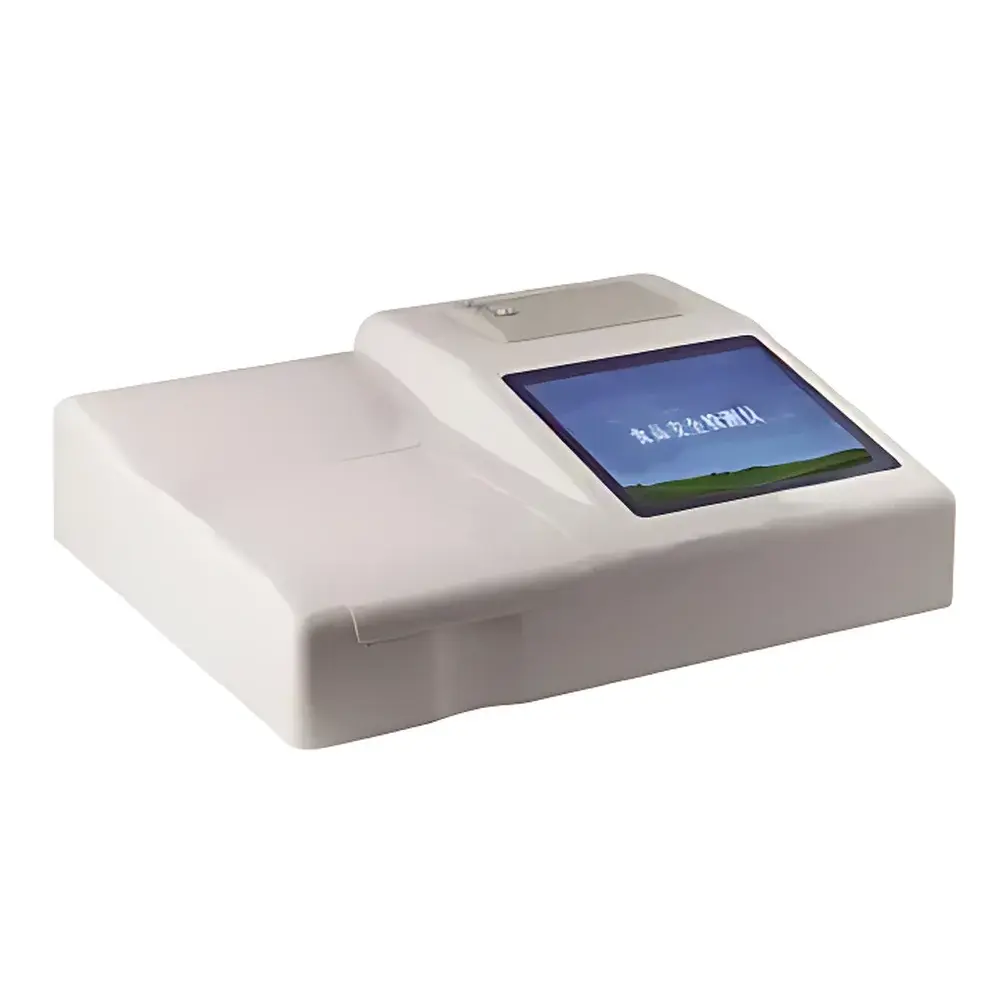
HJ FX-NC08 Pesticide Residue Rapid Tester
| Brand | HJ Purification |
|---|---|
| Origin | Shanghai, China |
| Manufacturer Type | OEM Manufacturer |
| Regional Classification | Domestic (China) |
| Model | FX-NC08 |
| Price | USD 1,020 (approx.) |
| Detection Method | Spectrophotometry |
| Measurement Range | 0–100% inhibition |
| Number of Channels | 8 |
| Measurement Error | ≤1.5% |
| Limit of Detection (LOD) | 0.1 mg/kg |
| Wavelength | 410 nm |
| Transmittance Accuracy | ±1.5% |
| Transmittance Repeatability | ≤0.5% |
| Absorbance Drift | ≤0.005 Abs/3 min |
| Inhibition Rate Display & Measurement Range | 0–100% |
| Inhibition Rate Indication Error | ≤10% |
| Inhibition Rate Repeatability | ≤5% |
| Display | ≥5-inch capacitive touch LCD (optional 7-inch upgrade) |
| Light Source | Imported high-brightness LED |
| Interface | USB 2.0 |
| Self-diagnostic functions | power-on self-test, auto-zero calibration, repeatability verification |
Overview
The HJ FX-NC08 Pesticide Residue Rapid Tester is a dedicated benchtop spectrophotometric analyzer engineered for the quantitative screening of organophosphorus and carbamate pesticide residues in agricultural commodities. It operates on the principle of enzyme inhibition assay—specifically, acetylcholinesterase (AChE) inhibition—where residual pesticides suppress enzymatic activity in proportion to their concentration. The resulting colorimetric change, measured at 410 nm via high-stability LED illumination, is converted into inhibition rate (%) and correlated with residue levels using pre-calibrated reference curves. Designed for field-deployable and semi-laboratory use, the FX-NC08 delivers rapid, standardized results within 3 minutes per batch, supporting compliance-driven workflows in food safety monitoring without requiring certified laboratory infrastructure.
Key Features
- Eight independent optical detection channels enable parallel analysis of up to eight samples simultaneously, eliminating cross-contamination risk and maximizing throughput in high-volume screening environments.
- Capacitive touch interface with ≥5-inch LCD display (7-inch optional) provides intuitive Chinese/English bilingual navigation, real-time graphing of absorbance kinetics, and context-sensitive prompts for reagent handling and calibration.
- Integrated thermal printer supports both manual trigger and automatic post-assay output; printed reports include sample ID, test time, inhibition rate, pass/fail status (vs. national MRL thresholds), and instrument serial number for audit traceability.
- Imported high-intensity 410 nm LED light source ensures stable photometric output (<0.005 Abs drift over 3 min), low thermal load, and extended operational lifetime—critical for consistent transmittance accuracy (±1.5%) across ambient temperature fluctuations.
- Onboard self-diagnostic suite performs automated power-on verification, zero-point calibration, and intra-run repeatability validation—generating diagnostic logs compliant with GLP documentation requirements.
- USB 2.0 host port enables direct connection to Windows/Linux PCs for firmware updates, method export/import, and raw data retrieval in CSV format; optional GPRS module permits encrypted upload of test records to centralized cloud dashboards or LIMS endpoints.
Sample Compatibility & Compliance
The FX-NC08 is validated for homogenized extracts from fresh produce (e.g., lettuce, cucumber, apple), dried herbs (green tea, oolong), cereal grains (rice, wheat), and processed agricultural products (dried mushrooms, soybean paste). Sample preparation follows AOAC Official Method 2007.01 and GB/T 5009.199–2003 protocols, including acetone extraction, buffer dilution, and AChE–substrate reaction incubation. Instrument performance meets the metrological criteria specified in JJG 861–2015 (Chinese National Verification Regulation for Spectrophotometric Pesticide Testers) and aligns with FAO/WHO JMPR residue evaluation frameworks. Data integrity safeguards—including electronic signature support, audit trail logging, and user-level access control—facilitate alignment with ISO/IEC 17025:2017 clause 7.7 and FDA 21 CFR Part 11 readiness when deployed in regulated QA/QC settings.
Software & Data Management
Embedded firmware v3.2.1 supports method-driven assay sequencing, customizable threshold configuration (e.g., 50% inhibition = positive screen), and batch-level statistical reporting (mean, SD, CV%). Data files retain full metadata: operator ID, GPS coordinates (if GPRS enabled), environmental temperature/humidity (via optional sensor input), and raw absorbance values at t=0s, t=60s, and t=180s. PC software (HJ DataLink v2.4, Windows 10/11 compatible) enables trend analysis across time-series batches, comparative heatmaps by commodity category, and PDF report generation with embedded QR codes linking to digital audit trails. All exported datasets conform to ASTM E1469–22 (Standard Practice for Electronic Records in Laboratory Information Systems).
Applications
- On-site screening at farm gate collection points and wholesale markets to enforce pre-distribution compliance with national Maximum Residue Limits (MRLs) for omethoate, methamidophos, carbaryl, and propoxur.
- Routine surveillance in school cafeterias, hospital kitchens, and corporate catering facilities to verify supplier declarations and fulfill HACCP prerequisite program requirements.
- Quality assurance triage in food processing plants—prioritizing suspect lots for confirmatory GC-MS/MS analysis per ISO 14501:2021 guidelines.
- Extension service training programs for smallholder farmers on integrated pest management (IPM) efficacy assessment through longitudinal residue trend mapping.
- Research applications in agricultural chemistry labs evaluating novel biopesticide degradation kinetics under controlled storage conditions.
FAQ
What regulatory standards does the FX-NC08 comply with for food safety testing?
It adheres to GB/T 5009.199–2003 (China), AOAC 2007.01, and supports data integrity practices aligned with ISO/IEC 17025:2017 and FDA 21 CFR Part 11.
Can the instrument be used without a computer?
Yes—the standalone operation includes full assay execution, result calculation, touchscreen visualization, and thermal printing; PC connectivity is optional for advanced data aggregation.
Is method validation documentation available for laboratory accreditation?
HJ provides a comprehensive validation package including linearity studies (R² ≥0.995), LOD/LOQ verification (0.1 mg/kg), precision profiles (intra-day CV ≤3.2%), and inter-instrument reproducibility data across 12 units.
How is temperature control managed during assays?
The built-in heating module maintains reaction cuvettes at 37±0.5°C, critical for optimal AChE enzyme kinetics; ambient compensation algorithms adjust baseline correction in real time.
What maintenance is required for long-term photometric stability?
LED source lifetime exceeds 50,000 hours; quarterly verification using NIST-traceable neutral density filters and annual recalibration by authorized service centers are recommended.
Related Products





