
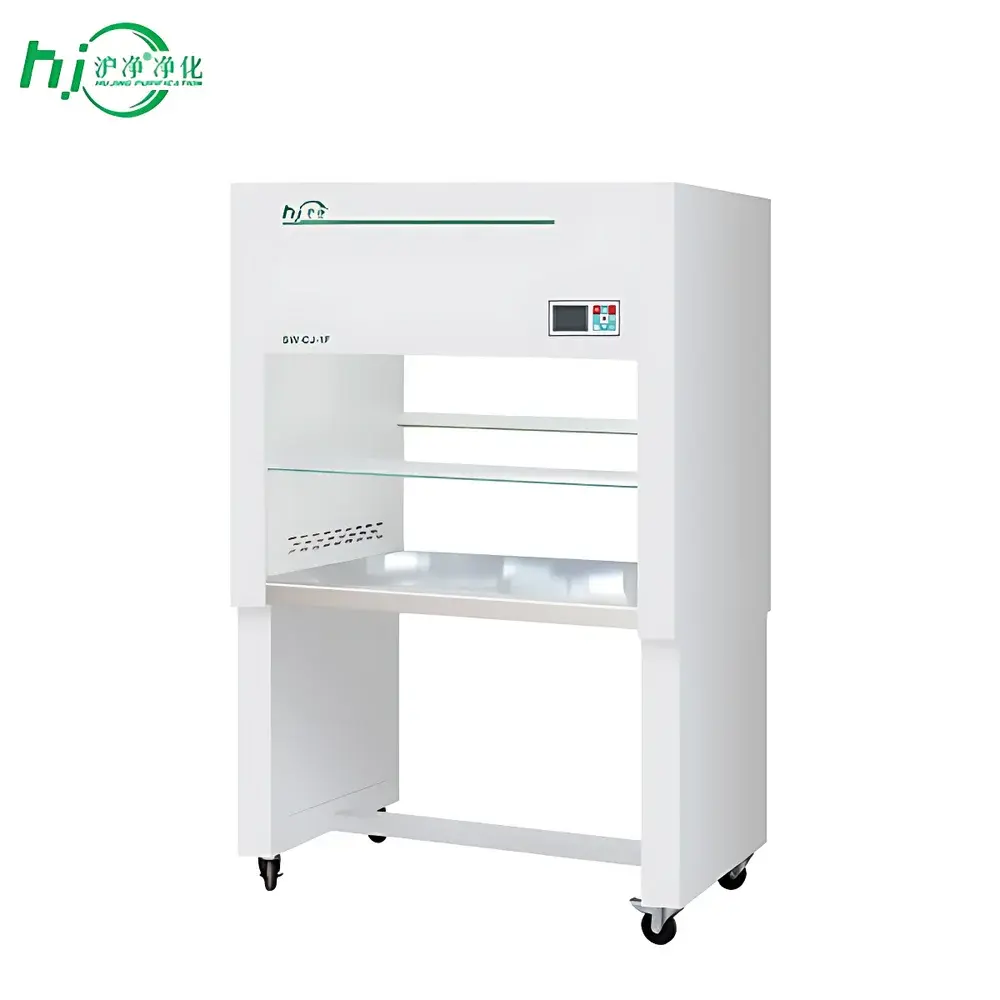
HJ SWCJ-1F Vertical Laminar Flow Clean Bench
| Brand | HJ Purification |
|---|---|
| Origin | Shanghai, China |
| Manufacturer Type | Direct Manufacturer |
| Product Category | Domestic |
| Model | SWCJ-1F |
| Price Range | USD 700 – 1,400 (FOB) |
| Instrument Type | Vertical Laminar Flow Clean Bench |
| Cleanliness Class | ISO Class 5 (equivalent to Federal Standard 209E Class 100 @ ≥0.5 µm) |
| Noise Level | ≤62 dB(A) |
| User Capacity | Single-user, dual-front access |
| Airflow Pattern | Vertical downward laminar flow |
| Pre-filter | Polyester synthetic media |
| HEPA Filter | 865 × 555 × 50 mm, H14 grade (EN 1822), single unit |
| Average Air Velocity | 0.25–0.45 m/s |
| Microbial Contamination | ≤0.5 CFU/plate·hour (90 mm Petri dish) |
| Vibration | ≤5 µm peak-to-peak (X/Y/Z axes) |
| Illuminance | ≥300 lux |
| Power Supply | AC 220 V / 50 Hz |
| Max. Power Consumption | 490 W |
| Net Weight | 90 kg |
| Work Area Dimensions (W×D×H) | 880 × 650 × 580 mm |
| Overall Dimensions (W×D×H) | 1040 × 720 × 1600 mm |
| Lighting | 12 W fluorescent lamp × 1 |
| UV Lamp | 20 W germicidal lamp × 1 |
| Control Interface | Digital LCD display with UV timer and interlock logic |
Overview
The HJ SWCJ-1F Vertical Laminar Flow Clean Bench is an ISO Class 5-certified (Federal Standard 209E Class 100) personnel-protective workstation engineered for routine aseptic procedures in microbiology, cell culture, pharmaceutical quality control, and academic research laboratories. Unlike biosafety cabinets, this clean bench provides unidirectional vertical laminar airflow—filtered through a certified H14-grade HEPA filter (EN 1822)—to maintain a particle-free work environment for non-hazardous samples. Air enters the unit via a pre-filter to capture coarse particulates, then passes through the HEPA filter before being directed downward at a controlled velocity (0.25–0.45 m/s) across the stainless-steel work surface. This downward flow forms a continuous, low-turbulence air curtain that isolates the work area from ambient room air, minimizing cross-contamination risks during handling of sterile media, reagents, or sensitive biological materials.
Key Features
- Vertical laminar airflow architecture compliant with ISO 14644-1 and Federal Standard 209E for Class 5 environments
- Full stainless-steel work surface (SUS304 brushed finish) — corrosion-resistant, non-porous, and compatible with standard laboratory disinfectants including 70% ethanol and sodium hypochlorite solutions
- Electrostatically powder-coated cold-rolled steel enclosure with integrated structural rigidity for long-term dimensional stability
- Interlocked UV germicidal lamp (20 W, 254 nm) and fluorescent lighting (12 W) — activation disabled when sash is open, ensuring operator safety per IEC 61000-4-2 and ANSI/NSF 49 guidance principles
- Digital LCD controller with programmable UV exposure timer (0–60 min), real-time airflow status indication, and system fault alerts
- Adjustable vertical sash with friction-based positioning mechanism — enables precise height setting without mechanical stops or detents
- Optimized aerodynamic chamber design featuring a near-closed front aperture and downward-flow airfoil geometry to suppress turbulence and enhance containment integrity
Sample Compatibility & Compliance
The SWCJ-1F supports a broad range of non-pathogenic sample types including bacterial and fungal cultures, mammalian cell lines, plant tissue explants, and sterile formulation components. It is not intended for use with volatile organic solvents, radioactive isotopes, or Risk Group 2+ biological agents. The unit meets ISO 14644-1:2015 for airborne particulate cleanliness verification and is validated per ASTM F2102-21 for laminar flow performance. Its microbial performance (≤0.5 CFU/plate·hour using settle plate methodology per ISO 14698-1) satisfies GLP-compliant environmental monitoring requirements in QC labs. While not certified to NSF/ANSI 49 or EN 12469, its construction and operational parameters align with institutional SOPs for non-hazardous aseptic technique in GMP-aligned facilities where regulatory oversight focuses on process validation rather than cabinet certification.
Software & Data Management
This clean bench operates as a standalone hardware platform with no embedded firmware logging or network connectivity. All operational parameters—including UV runtime, lighting status, and airflow readiness—are displayed locally on the LCD interface. No data export, audit trail, or electronic record functionality is provided, consistent with its classification as a Class I environmental control device under FDA 21 CFR Part 11 definitions. For laboratories requiring traceability, manual logbook entries are recommended for UV decontamination cycles, filter replacement dates (HEPA and pre-filter), and periodic airflow velocity verification using calibrated anemometry per ISO 14644-3 Annex B.
Applications
- Aseptic transfer of microbial cultures and stock solutions in teaching and research labs
- Preparation of sterile culture media, agar plates, and antibiotic solutions
- Handling of primary cells and established cell lines prior to incubation
- Assembly and loading of sterile filtration devices and syringe filters
- Non-hazardous reagent dispensing and vial filling in pharmaceutical QC environments
- Supporting ISO 13485-compliant device manufacturing processes where particulate control is required but personnel protection is not mandated
FAQ
What standards does the SWCJ-1F comply with for cleanroom classification?
It meets ISO Class 5 (formerly Federal Standard 209E Class 100) for airborne particles ≥0.5 µm, verified per ISO 14644-1:2015 test protocols.
Can this unit be used for handling pathogenic organisms?
No. It provides product protection only—not personnel or environmental protection—and must not be used with Risk Group 2 or higher agents.
How often should the HEPA filter be replaced?
Under typical usage (6–8 hrs/day), replace every 18–24 months; monitor pressure drop across the filter and replace when differential exceeds 250 Pa or airflow velocity falls below 0.25 m/s.
Is the UV lamp intensity validated upon installation?
UV output is factory-calibrated but not individually certified; users should verify irradiance (≥40 µW/cm² at 1 m) with a NIST-traceable radiometer before first use and annually thereafter.
Does the unit support integration with building management systems (BMS)?
No. It lacks analog/digital I/O ports, Modbus, or Ethernet interfaces; operation is fully local and manual.



