
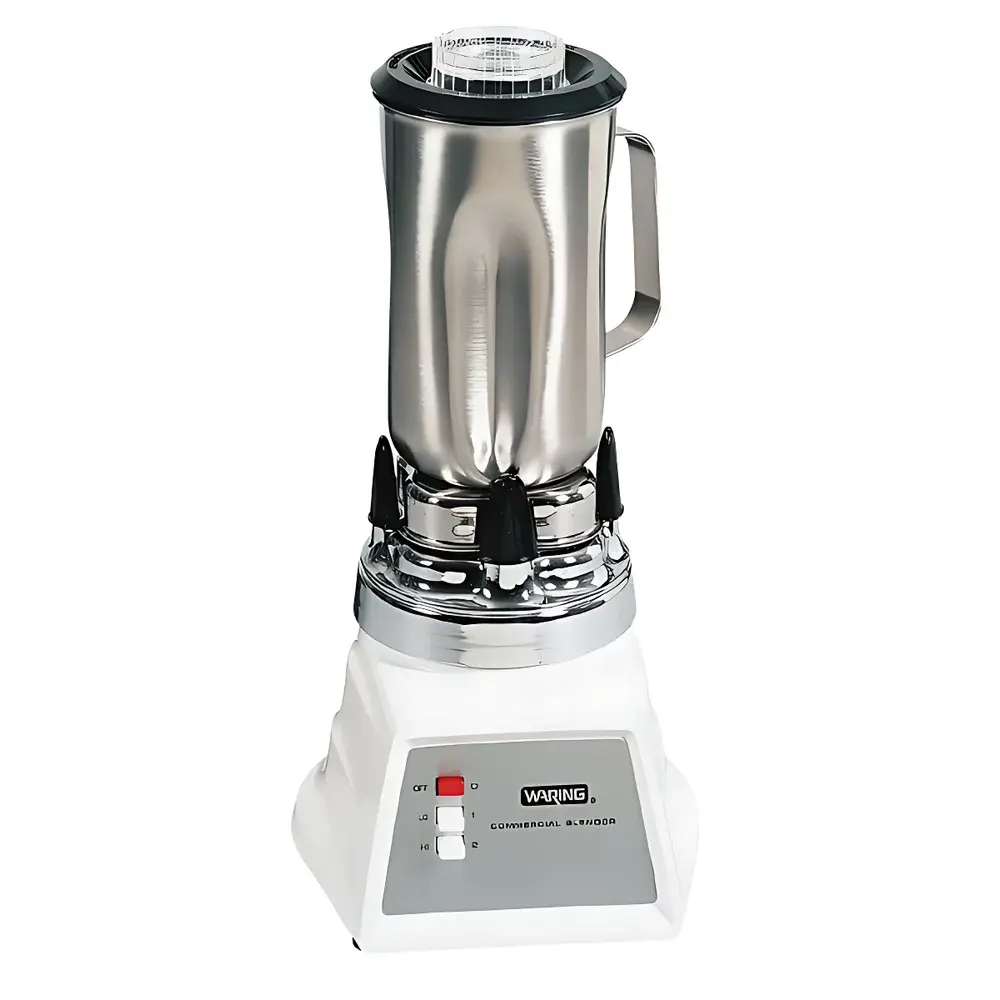
Waring 7011HG/7010HS Dual-Speed Heavy-Duty Laboratory Homogenizer
| Brand | Waring |
|---|---|
| Origin | USA |
| Model | 7011HG / 7010HS / 7010HG / 7011HS |
| Voltage | 120 V AC |
| Speed Settings | 18,000 rpm and 22,000 rpm |
| Capacity | 1.0 L (7011HG/7010HG) or 1.2 L (7010HS/7011HS) |
| Base Material | Epoxy-coated metal |
| Container Options | Stainless steel (with handle) or borosilicate glass (heat-resistant, with handle) |
| Lid | Two-layer polyethylene/polypropylene seal |
| Timer Function | 3-minute mechanical timer (models 7010HG & 7011HS only) |
| Height | 38 cm (7011HG/7010HG) or 40.5 cm (7010HS/7011HS) |
| Weight | 5.0 kg (7011HG/7010HS) or 5.9 kg (7010HG/7011HS) |
| Blade | Precision-ground stainless steel, fixed-mount, dual-edge design |
Overview
The Waring 7011HG/7010HS Dual-Speed Heavy-Duty Laboratory Homogenizer is a precision-engineered rotor-stator homogenization system designed for reproducible, high-shear sample processing in regulated and research-intensive laboratory environments. Operating on the principle of high-velocity rotor-driven fluid shear within a constrained stator chamber, this instrument generates intense mechanical forces—including cavitation, turbulent mixing, particle impact, and hydrodynamic shearing—to achieve rapid cell lysis, tissue disruption, emulsification, and suspension homogenization. Its 120 V, thermally protected induction motor delivers consistent torque across both speed settings (18,000 rpm and 22,000 rpm), enabling users to select optimal shear intensity based on sample viscosity, particulate load, and desired particle size distribution. The unit’s robust architecture—featuring an epoxy-coated metal base, vibration-dampening feet, and sealed motor housing—ensures operational stability during extended use and supports compliance with general laboratory safety standards (ANSI Z9.5, UL 61010-1).
Key Features
- Dual-speed electromechanical control via front-panel toggle switch—no variable speed dial or external controller required; eliminates calibration drift associated with analog potentiometers.
- Interchangeable 1.0 L stainless steel or 1.2 L borosilicate glass containers, both fitted with ergonomic handles and chemically resistant two-layer polymer lids (polyethylene inner layer + polypropylene outer layer) ensuring leak-proof sealing under high-pressure homogenization.
- Fixed-position, precision-machined stainless steel blade assembly with dual cutting edges optimized for axial flow generation and radial shear maximization—designed to minimize heat accumulation and blade wobble at maximum RPM.
- Mechanical 3-minute auto-shutoff timer integrated into models 7010HG and 7011HS—provides repeatable processing duration without reliance on external timing devices, supporting SOP-driven workflows in GLP/GMP-aligned labs.
- Low-profile base geometry (38–40.5 cm height) and balanced mass distribution (5.0–5.9 kg) reduce countertop footprint and improve ergonomics during manual vessel loading/unloading.
Sample Compatibility & Compliance
The Waring 7011HG/7010HS accommodates a broad range of biological, pharmaceutical, food, and chemical matrices—including soft animal tissues (liver, spleen), plant leaves and roots, bacterial pellets, lipid suspensions, viscous dairy emulsions, and polymer dispersions. Stainless steel vessels are compatible with aqueous, mildly acidic, and organic solvent-based systems (e.g., ethanol, acetone); glass vessels extend compatibility to alkaline solutions and high-temperature applications (up to 120 °C for short-term exposure). All models meet general electrical safety requirements per UL 61010-1 and conform to electromagnetic compatibility (EMC) limits defined in FCC Part 18. While not certified for IEC 61000-4-2 (ESD) or ATEX environments, the unit is routinely deployed in ISO 17025-accredited testing laboratories for sample preparation prior to HPLC, GC-MS, ELISA, and microbiological analysis.
Software & Data Management
This homogenizer operates as a stand-alone electromechanical device with no embedded firmware, digital interface, or data logging capability. Its design prioritizes operational simplicity, mechanical reliability, and audit-trail transparency: all process parameters (speed selection, run duration, vessel type, and operator ID) are manually recorded in laboratory notebooks or LIMS-integrated electronic batch records. The absence of software dependencies ensures full compatibility with FDA 21 CFR Part 11-compliant environments when used in conjunction with validated procedural controls—no electronic signature, audit trail, or system validation is required for the instrument itself. Timing consistency is maintained through the mechanical timer’s NIST-traceable calibration interval (recommended annually), and speed fidelity is verified using non-contact optical tachometry per ASTM E2594.
Applications
- Tissue homogenization for molecular biology: Efficient lysis of mammalian and avian tissues prior to RNA/DNA extraction, protein solubilization, or enzyme activity assays—validated for use with TRIzol®, RIPA, and QIAzol® reagents.
- Pharmaceutical formulation development: Preparation of uniform suspensions of active pharmaceutical ingredients (APIs) in excipient matrices; generation of nanoemulsions for topical delivery systems.
- Food quality control: Homogenization of meat composites, cheese slurries, and vegetable purees for compositional analysis (fat content, protein quantification, pathogen detection).
- Microbial sample preparation: Disruption of yeast cell walls and Gram-positive bacterial aggregates for downstream plating or flow cytometry.
- Environmental sample processing: Extraction of microplastics from sediment slurry or homogenization of biofilm-coated filter membranes.
FAQ
Is the Waring 7011HG/7010HS compliant with FDA 21 CFR Part 11?
No electronic components or software reside in the device; therefore, it falls outside the scope of Part 11 requirements. It may be used in Part 11-regulated workflows when paired with documented manual procedures and controlled recordkeeping.
Can the glass container withstand autoclaving?
Yes—the borosilicate glass vessel (models 7010HS/7011HS) is rated for steam sterilization at 121 °C for up to 20 minutes; repeated autoclaving requires visual inspection for microfractures prior to each use.
What maintenance is required for long-term reliability?
Routine cleaning of the blade assembly and vessel threads with isopropanol; annual verification of motor brush wear (if applicable) and timer actuation accuracy using calibrated stopwatch and optical tachometer.
Are replacement blades and lids available as spare parts?
Yes—Waring supplies OEM-certified stainless steel blades (P/N 030215), polypropylene lids (P/N 030217), and glass/stainless vessel assemblies under standard catalog numbers traceable to USFDA Device Listing #D329245.
Does this homogenizer support continuous operation mode?
No—it is engineered for intermittent duty cycles (maximum 3 minutes per run, with ≥2-minute cooldown between cycles) to prevent thermal overload and maintain blade edge integrity.



