
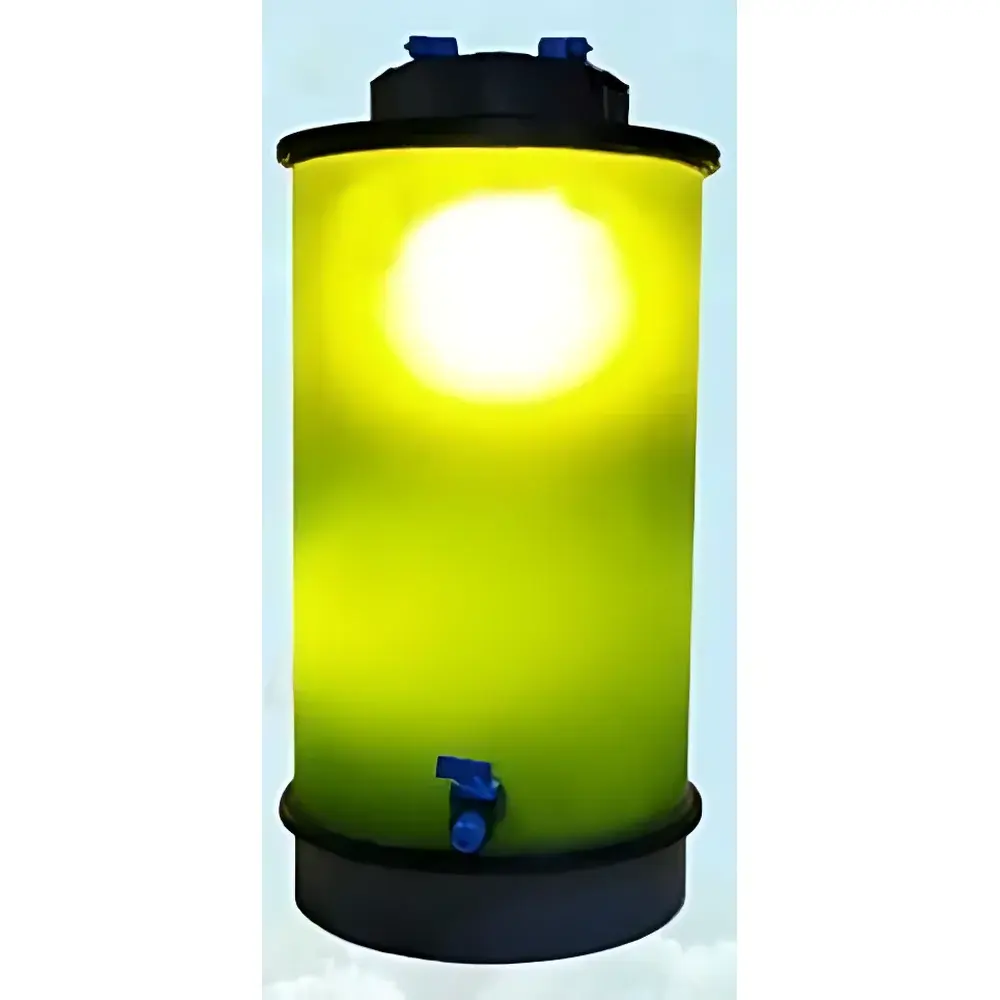
PB250 Large-Scale Phytoplankton Cultivation System
| Origin | Germany |
|---|---|
| Manufacturer Type | Authorized Distributor |
| Origin Category | Imported |
| Model | PB-250 |
| Price | Upon Request |
| Cultivation Volume | 12 L |
| Inner Diameter | 200 mm |
| Height | 520 mm |
| Controller Dimensions | 220 × 80 × 70 mm |
| Input Voltage | 85–250 VAC |
| Controller Power Consumption | 5 W |
Overview
The PB250 Large-Scale Phytoplankton Cultivation System is an engineered platform designed for controlled, reproducible, and scalable cultivation of microalgal and phytoplankton species under laboratory and pilot-scale conditions. Built to ISO 9001-certified manufacturing standards in Germany, the system operates on a continuous or semi-continuous culture principle—enabling daily medium exchange at up to 30% volume (3.6 L/day) to maintain exponential growth phases, minimize metabolite accumulation, and sustain physiological consistency across generations. Its cylindrical, optically transparent cultivation vessel (12 L working volume, 200 mm inner diameter, 520 mm height) ensures uniform light penetration and gas–liquid mass transfer. The system integrates core bioreactor functions—including regulated illumination, magnetic stirring, sterile aeration, and programmable environmental control—within a modular, benchtop-compatible architecture suitable for academic research, biotechnology development, and pre-commercial algal biomass production.
Key Features
- Optically clear borosilicate glass cultivation tank with standardized G1/2″ threaded top port for secure, leak-tight closure and easy access—designed for repeated sterilization (autoclavable up to 121°C, 20 min) and long-term chemical resistance to algal media components.
- Integrated high-efficiency LED illumination unit with adjustable intensity (0–100%) and photoperiod programming (on/off cycles down to 1-minute resolution), spectrally optimized for photosynthetic active radiation (PAR: 400–700 nm).
- Non-invasive magnetic stirrer with corrosion-resistant PTFE-coated stir bar and speed control (0–600 rpm), ensuring homogeneous suspension without shear-induced cell damage or mechanical seal leakage.
- Dual-channel air supply system: one line for sterile filtered ambient air (0.2 µm membrane filter), another for optional CO2 enrichment—both independently regulated via precision needle valves and flow meters (range: 0–5 L/min).
- Dedicated PB-Series Cultivation Controller (220 × 80 × 70 mm, 5 W max power draw, universal 85–250 VAC input) providing centralized timing logic for lighting, nutrient dosing pumps (external), and alarm-triggered events.
- Rugged aluminum frame with integrated cable management, leveling feet, and reinforced mounting points for ancillary sensors (e.g., dissolved oxygen, pH, temperature probes—compatible with standard BNC or 4–20 mA interfaces).
Sample Compatibility & Compliance
The PB250 supports cultivation of diverse phytoplankton taxa—including Chlorella vulgaris, Nannochloropsis oceanica, Tetraselmis suecica, and diatom strains—across freshwater, marine, and hypersaline media formulations. Its design complies with GLP-relevant operational requirements for traceable process documentation: all controller events (light activation, pump triggers) are timestamped and stored locally with non-volatile memory retention (>10,000 event logs). While not a GMP-grade device per FDA 21 CFR Part 11, its programmable logic and physical access controls support audit-ready workflows when paired with validated external data loggers. The system meets CE marking requirements for electromagnetic compatibility (EMC Directive 2014/30/EU) and low-voltage safety (LVD Directive 2014/35/EU).
Software & Data Management
The PB250 operates autonomously via its embedded controller; no proprietary software installation is required. Configuration is performed through a tactile keypad interface with LCD status display. All setpoints—including photoperiod start/end times, stirrer activation windows, and relay output schedules—are retained after power loss. For extended data integration, the controller provides a TTL-level serial output (RS-232, 9600 baud) to feed timestamps and state changes into third-party SCADA or LabVIEW environments. Optional analog outputs (0–10 V) can be configured for real-time monitoring of internal temperature or external sensor inputs—facilitating synchronization with environmental chambers or downstream harvesting systems.
Applications
- Physiological studies of photosynthetic efficiency, nutrient limitation responses, and stress acclimation (e.g., nitrogen starvation for lipid induction).
- Strain selection and stability assessment over ≥50 consecutive subcultures under standardized conditions.
- Production of biomass for biochemical analysis (fatty acid profiling, pigment quantification, protein expression).
- Calibration and validation of online optical sensors (e.g., in vivo chlorophyll fluorescence, turbidity) against gravimetric and cell-counting reference methods.
- Training platform for bioprocess engineering curricula covering chemostat dynamics, dilution rate optimization, and light–growth coupling models.
FAQ
Is the PB250 suitable for axenic cultures?
Yes—when used with sterile filtration (0.2 µm), laminar flow hood inoculation, and routine surface disinfection, the system maintains contamination-free operation. The threaded lid design minimizes airborne particulate ingress during sampling.
Can I integrate a pH probe or dissolved oxygen sensor?
The controller includes two analog input channels (0–10 V) compatible with standard industrial sensors; custom calibration curves may be applied externally via data acquisition software.
What maintenance intervals are recommended?
LED modules: rated for 50,000 hours; magnetic stirrer bearings: inspected annually; silicone tubing in air lines: replaced every 6 months under continuous use.
Does the system support remote monitoring?
Not natively—but the RS-232 interface enables connection to networked PCs or Raspberry Pi-based gateways for cloud logging via MQTT or HTTP POST protocols.
Is replacement glassware available separately?
Yes—original-specification borosilicate tanks, lids, and gaskets are stocked and supplied with batch-specific dimensional certification reports.



