
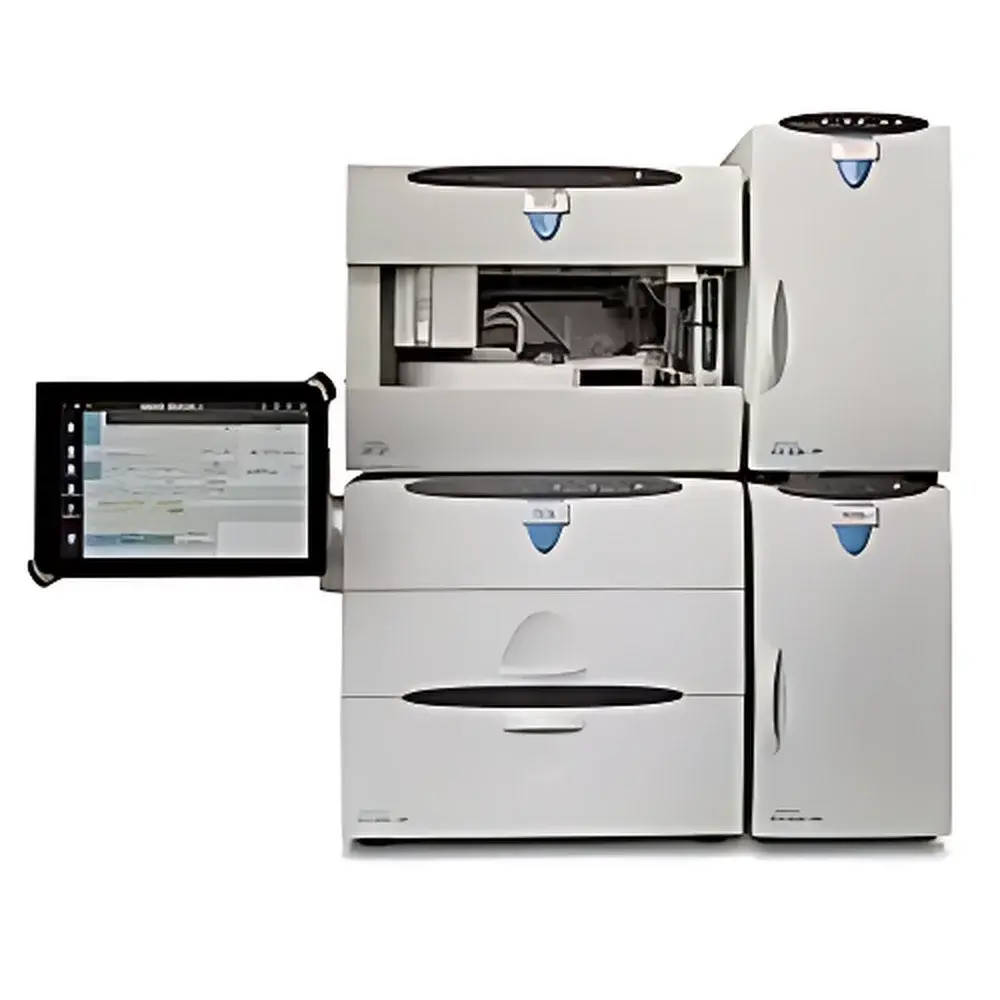
Thermo Fisher Dionex ICS-5000+ Conductivity Detector
| Brand | Thermo Fisher |
|---|---|
| Origin | USA |
| Manufacturer Type | Original Equipment Manufacturer (OEM) |
| Product Category | Imported Instrument |
| Model | ICS-5000+ CD |
| Application Environment | Laboratory-Based Ion Chromatography System |
| Configuration Options | Capillary and Analytical (Standard-Bore & Microbore) Flow Paths |
| Detector Architecture | Digital Signal Processing (DSP)-Enabled, Thermally Stabilized Conductivity Detection Module |
| Dynamic Range | 0–15,000 µS/cm |
| Cell Volume (Capillary Mode) | 0.02 µL |
| Installation Interface | Tool-Free Snap-In Mounting with Auto-Detection via Chromeleon™ CDS |
Overview
The Thermo Fisher Dionex ICS-5000+ Conductivity Detector (CD) is a high-performance, digitally controlled conductivity detection module engineered for integration into the modular ICS-5000+ Reagent-Free™ Ion Chromatography (RFIC™) platform. It operates on the principle of non-suppressed or suppressed conductivity detection—depending on system configuration—and delivers quantitative measurement of ionic species based on their electrical conductance in aqueous eluent streams. Designed for rigorous laboratory environments, the detector employs microprocessor-driven digital signal processing to ensure linear response across an exceptionally wide dynamic range (0–15,000 µS/cm), enabling simultaneous quantification of trace-level anions (e.g., F⁻, Cl⁻, NO₂⁻) and high-concentration cations (e.g., Na⁺, K⁺, NH₄⁺) without manual range switching or dilution. Its thermally isolated detection cell and independent temperature regulation minimize baseline drift and thermal noise—critical for long-duration gradient runs and low-conductivity mobile phases used in hydroxide-eluent systems.
Key Features
- Digital Signal Processing (DSP) architecture with real-time baseline correction and adaptive filtering for ultra-low electronic noise (<0.1 nS peak-to-peak)
- Independent Peltier-based temperature control (±0.01 °C stability) for the conductivity cell, decoupled from column oven or ambient fluctuations
- Modular snap-in mechanical interface: tool-free installation with automatic hardware recognition by Chromeleon™ CDS—no manual cable routing or configuration required
- Two interchangeable flow-path configurations: analytical mode (standard-bore and microbore columns) and capillary mode (optimized for <0.4 mm ID columns)
- Capillary-optimized cell volume of just 0.02 µL—reducing sample consumption by >90% versus conventional cells while maintaining full sensitivity
- No external heat exchanger required; integrated thermal management eliminates condensation risk and simplifies plumbing in multi-detector setups
- Compatible with both suppressed and non-suppressed IC modes, including RFIC electrolytic suppression and chemical suppression variants
Sample Compatibility & Compliance
The ICS-5000+ CD supports aqueous-based ionic analytes across environmental, pharmaceutical, food & beverage, and industrial process control applications. It complies with key regulatory frameworks governing analytical data integrity, including FDA 21 CFR Part 11 (via Chromeleon™ CDS audit trail and electronic signature support), ISO/IEC 17025 requirements for calibration traceability, and USP <645> guidelines for water conductivity testing. Its design accommodates standard IC eluents (e.g., KOH, methanesulfonic acid, carbonate/bicarbonate buffers) and is validated for use with Thermo Fisher’s proprietary electrolytically generated eluents. The detector meets IEC 61000-4 electromagnetic compatibility standards and is CE-marked for laboratory instrumentation.
Software & Data Management
Fully integrated with Thermo Scientific™ Chromeleon™ Chromatography Data System (CDS) v7.3 or later, the detector enables method-driven acquisition, real-time conductivity calibration, and automated cell constant verification. Chromeleon™ provides GLP/GMP-compliant features including secure user roles, instrument qualification templates (IQ/OQ/PQ), and full electronic record retention—including raw detector voltage output, temperature logs, and event timestamps. All detector parameters—including gain, filter time constant, temperature setpoint, and cell constant—are stored within method files and exported with chromatograms in ASTM E1982-compliant .cdf format. Remote monitoring and diagnostic alerts are accessible via Chromeleon™ Web Services.
Applications
- Environmental monitoring: quantification of anions (Cl⁻, SO₄²⁻, NO₃⁻) and cations (Ca²⁺, Mg²⁺, Na⁺) in drinking water, wastewater, and rainwater per EPA Methods 300.0, 300.1, and 317.0
- Pharmaceutical quality control: assay of counterions (e.g., acetate, chloride) in APIs and excipients; residual ion testing in purified water (USP <645>) and WFI
- Food safety: nitrate/nitrite analysis in meat products and vegetables; organic acid profiling (e.g., lactate, citrate) in dairy and beverages
- Battery electrolyte analysis: Li⁺, PF₆⁻, and TFSI⁻ quantification in lithium-ion battery R&D
- Geochemical research: high-precision major and minor ion ratios in seawater and brine samples
FAQ
Is the ICS-5000+ CD compatible with non-Thermo Fisher IC systems?
No—it is a proprietary module designed exclusively for physical and electronic integration with the ICS-5000+ platform and requires Chromeleon™ CDS for operation.
Can the same CD module switch between capillary and analytical flow paths without hardware modification?
Yes—mechanical adapters and flow-cell inserts are field-replaceable; no recalibration is needed when switching between modes.
Does the detector support real-time conductivity compensation for temperature-induced drift?
Yes—built-in platinum resistance thermometer (Pt1000) feeds continuous temperature data to the DSP engine, which applies ISO 7888-compliant linear compensation algorithms.
What is the recommended calibration frequency for routine QC use?
Daily verification using certified KCl standards is advised; full 5-point calibration every 72 hours or per SOP, depending on application stringency and regulatory scope.
Is the 0.02 µL cell volume applicable to both suppressed and non-suppressed modes?
Yes—the capillary cell geometry is optimized for both configurations, though optimal sensitivity in suppressed mode typically requires sub-µL injection volumes and low-dead-volume tubing.





