
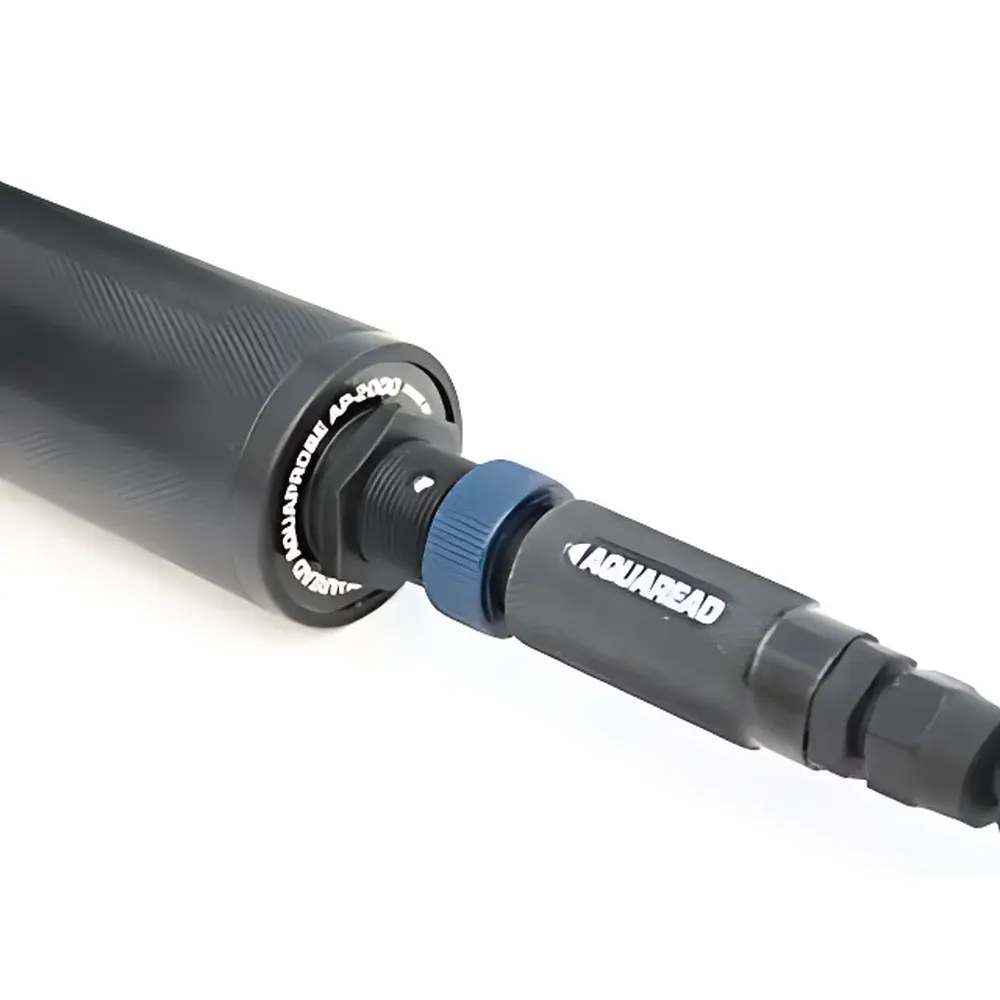
Aquaread AP-2000-AM Portable Ammonia-Nitrogen Water Quality Analyzer
| Brand | Aquaread |
|---|---|
| Origin | United Kingdom |
| Model | AP-2000-AM |
| Instrument Type | Portable/Handheld Multi-Parameter Water Quality Analyzer |
| Dimensions (W×H×D) | 90×180×39 mm |
| Weight (incl. battery) | 450 g |
| Display | Backlit 80-character LCD |
| Memory Capacity | 1,900 data points |
| GPS | Built-in 12-channel antenna, ±10 m accuracy |
| Barometric Pressure Range | 150–1,150 mbar (±1 mbar) |
| Interface | RS-485/RS-232 |
| Power Supply | Replaceable internal battery |
| Operating Temperature | −20 to +70 °C |
| IP Rating | IP67 |
| DO | 0–500 % / 0–50.00 mg/L (res: 0.1 % / 0.01 mg/L |
| acc | ±0.01 mg/L) |
| Conductivity | 0–200 mS/cm (res: 0.1 µS/cm |
| acc | ±0.5 % of reading) |
| TDS | 0–100,000 mg/L (two auto-ranging scales |
| acc | ±1 % of reading or ±0.1 unit, whichever is greater) |
| Resistivity | 5 Ω·cm – 1 MΩ·cm (two auto-ranging scales |
| acc | ±1 % of reading or ±0.1 unit) |
| Salinity | 0–70 PSU (res: 0.01 PSU |
| acc | ±1 % of reading or ±0.1 unit) |
| Seawater Density (σt) | 0–50 σt (res: 0.1 σt |
| acc | ±1.0 σt) |
| ORP | ±2000 mV (res: 0.1 mV |
| acc | ±0.5 mV) |
| Depth | 0–30 m (res: 0.01 m |
| acc | ±0.1 m) |
| Temperature | −5 to +50 °C (res: 0.1 °C |
| acc | ±0.5 °C) |
| pH | 0–14 pH (res: 0.01 pH |
| acc | ±0.01 pH) |
| Ammonium (NH₄⁺/NH₃-N) | 0–1,000 mg/L as N (two auto-ranging scales |
| acc | ±10 %) |
Overview
The Aquaread AP-2000-AM is a field-deployable, multi-parameter water quality analyzer engineered for precise, real-time measurement of ammonia-nitrogen (NH3-N/NH4+) alongside core physicochemical parameters in freshwater, estuarine, and coastal environments. It operates on an integrated platform combining a rugged handheld display unit (AM-200) with interchangeable, temperature-compensated electrochemical and optical sensors. Ammonia-nitrogen quantification is achieved via a selective ammonium ion-selective electrode (ISE), leveraging potentiometric detection principles compliant with ISO 14911 and ASTM D1428 standards for ion analysis in natural waters. The system simultaneously acquires concurrent measurements of temperature, depth, pH, oxidation-reduction potential (ORP), dissolved oxygen (DO), conductivity, total dissolved solids (TDS), salinity, resistivity, and seawater density (σt—calculated from conductivity, temperature, and pressure). All measurements are time-stamped and georeferenced using an embedded 12-channel GPS module, enabling spatially explicit data collection essential for regulatory monitoring, watershed assessment, and environmental impact studies.
Key Features
- Rugged IP67-rated housing certified for immersion up to 1 m for 30 minutes—suitable for deployment in rain, mud, or shallow inundation.
- Modular sensor architecture: Supports up to one ISE (ammonium, nitrate, chloride, fluoride, calcium) and one optical probe (chlorophyll-a, phycocyanin, turbidity, hydrocarbon fluorescence) per sampling event.
- Automatic temperature compensation across all sensor channels—eliminates manual correction and improves inter-site reproducibility.
- Onboard data logging capacity of 1,900 records with UTC timestamping and GPS coordinates (±10 m horizontal accuracy).
- Backlit 80-character LCD display optimized for outdoor readability under variable ambient lighting conditions.
- Wide operating temperature range (−20 to +70 °C) and barometric pressure sensing (150–1,150 mbar) support high-altitude and sub-zero deployments.
- RS-485/RS-232 interface enables direct connection to external dataloggers, telemetry systems, or field laptops for real-time telemetry or batch download.
Sample Compatibility & Compliance
The AP-2000-AM is validated for use in surface water, groundwater, wastewater effluents, aquaculture systems, and drinking water distribution networks. Its ammonium ISE exhibits minimal interference from potassium, sodium, and calcium ions within typical environmental concentration ranges—verified per ISO 15173 Annex B. Sensor calibration protocols align with EPA Method 350.1 (potentiometric ammonia determination) and GLP-compliant field documentation requirements. The instrument’s firmware supports audit-trail-enabled calibration logging, including date/time stamps, operator ID input, standard concentrations used, and slope/offset verification—meeting foundational traceability expectations for ISO/IEC 17025-accredited laboratories conducting field-based compliance testing. While not FDA 21 CFR Part 11-certified out-of-the-box, raw data export formats (CSV, ASCII) facilitate integration into validated LIMS environments requiring electronic record integrity.
Software & Data Management
Data retrieval and post-processing are supported via Aquaread’s proprietary AquaSuite software (Windows-compatible), which provides tools for spectral visualization, multi-parameter correlation analysis, spatial mapping (via integrated GPS), and automated report generation compliant with UK Environment Agency WFD templates and USGS NWIS formatting conventions. Export options include CSV, Excel (.xlsx), and XML for interoperability with GIS platforms (e.g., QGIS, ArcGIS) and statistical packages (R, Python pandas). Calibration history, sensor diagnostics, and battery status logs are stored separately and can be audited independently. Firmware updates are delivered via secure HTTPS download and applied through the RS interface—no cloud dependency required for field operations.
Applications
- Regulatory compliance monitoring under the EU Water Framework Directive (WFD) and US Clean Water Act Section 303(d) listing criteria for ammonia toxicity thresholds.
- Rapid response assessments following agricultural runoff events, sewage overflows, or industrial discharges where NH3-N elevation poses acute ecological risk.
- Long-term trend analysis in protected wetlands and sensitive headwater streams where low-level ammonium fluctuations indicate early nutrient enrichment.
- Aquaculture facility management—real-time tracking of unionized ammonia (NH3) concentration calculated from measured pH, temperature, and total ammonium to prevent fish gill damage.
- Urban stormwater quality characterization, particularly in combined sewer overflow (CSO) outfalls where ammonia serves as a tracer for domestic wastewater intrusion.
- Academic research on nitrification/denitrification kinetics in sediment-water interfaces using depth-profiling capability and synchronized redox-pH-DO logging.
FAQ
What is the detection principle for ammonia-nitrogen in the AP-2000-AM?
The system uses a gas-permeable membrane ammonium-selective electrode that measures the potential difference generated by NH4+ ions diffusing across a hydrophobic barrier into an internal electrolyte solution—converted to mg/L NH3-N via Nernst equation calibration.
Can the AP-2000-AM measure unionized ammonia (NH3) directly?
No—it reports total ammonium (NH4+ + NH3) as nitrogen. Unionized ammonia concentration must be calculated post-hoc using simultaneous pH and temperature readings per standard equilibrium equations (e.g., Emerson et al., 1975).
Is the GPS module suitable for precise geotagging in forested or urban canyon environments?
The 12-channel receiver maintains lock under partial canopy but may experience reduced accuracy (<±20 m) in deep urban canyons or dense coniferous stands; differential correction is not supported.
How frequently must the ammonium ISE be recalibrated during extended field campaigns?
Calibration is recommended before each sampling day or after every 8 hours of continuous use; drift exceeding ±5% of mid-range standard warrants immediate recalibration.
Does the system support GLP-compliant electronic signatures for field data validation?
While the AM-200 display does not support biometric or digital signature capture, AquaSuite software allows operator-defined user IDs and password-protected calibration logs—sufficient for Tier-1 GLP field documentation when paired with procedural SOPs.







