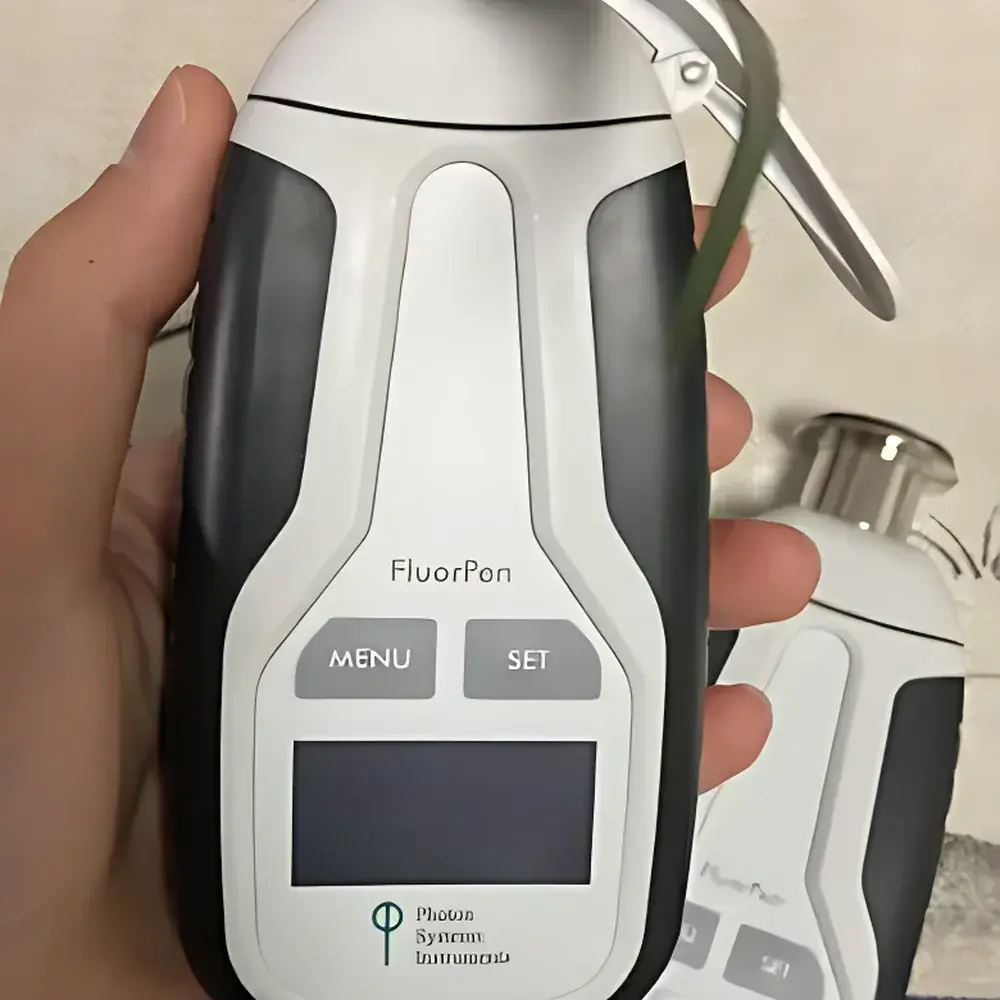
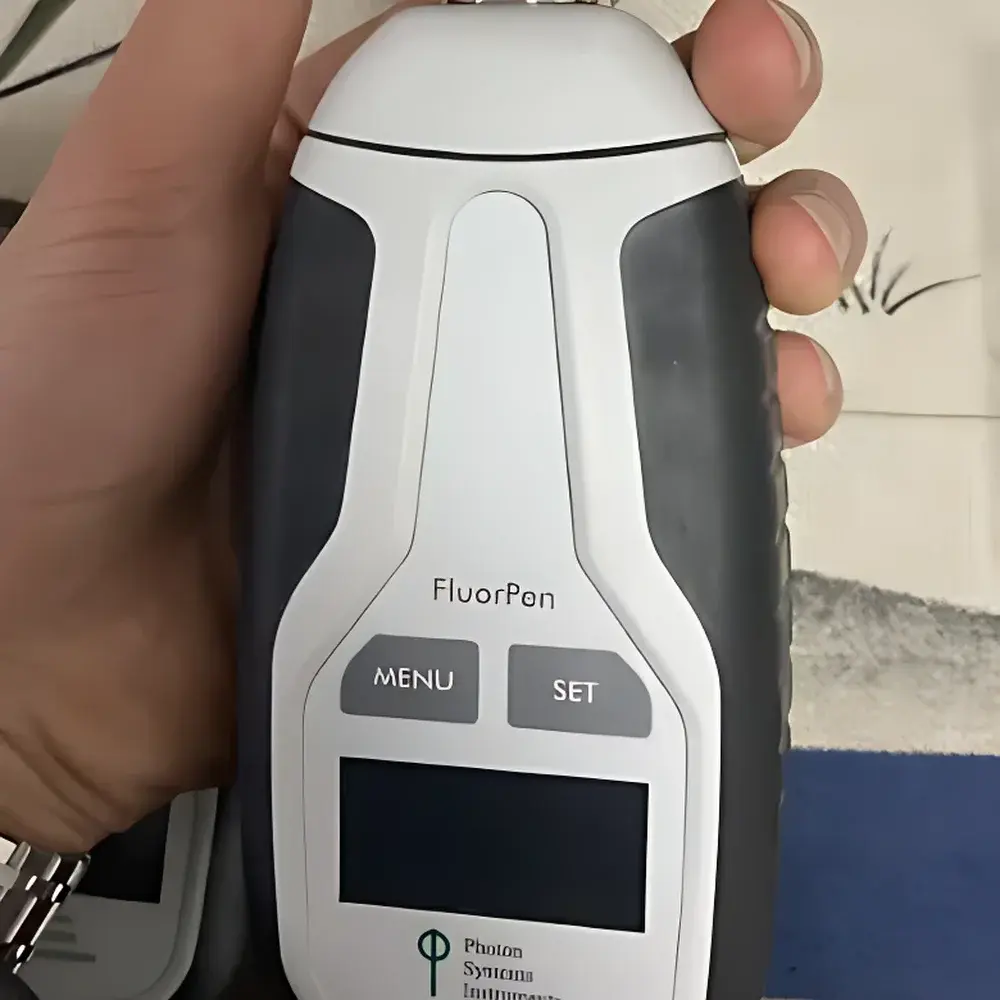
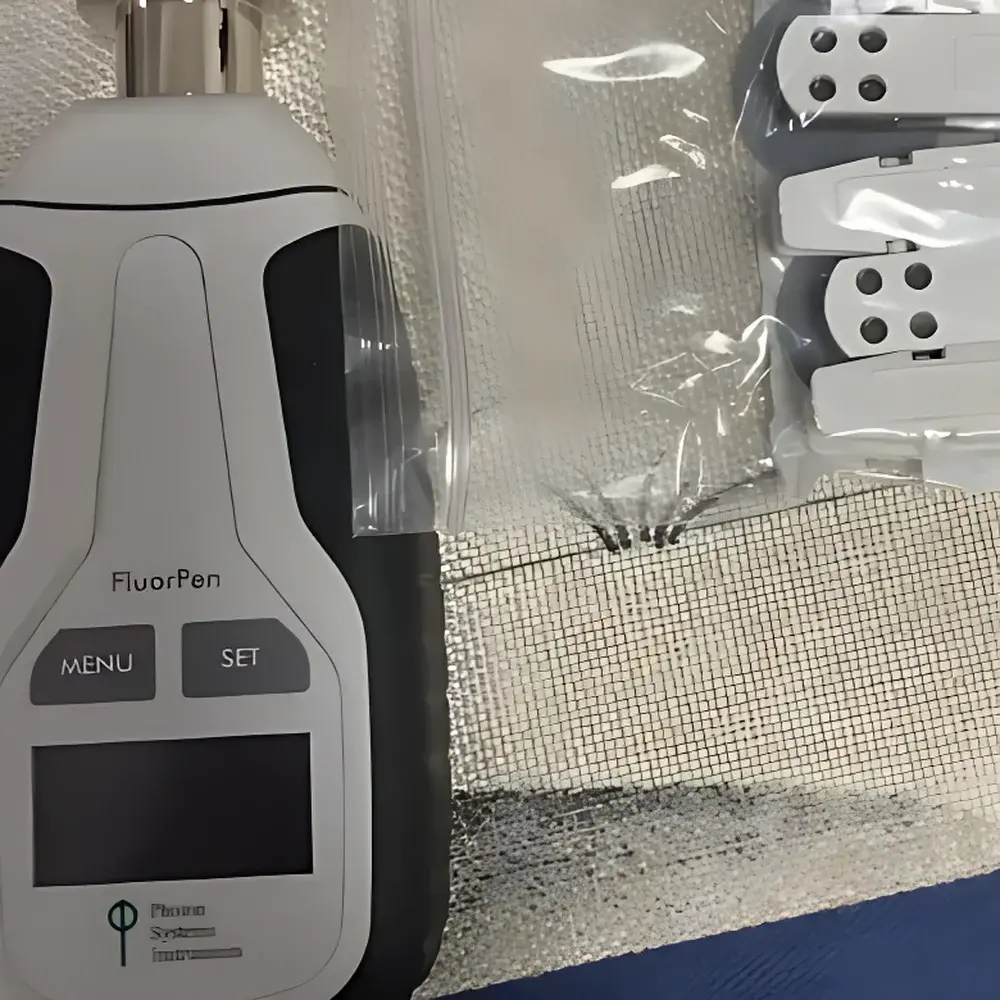
PSI FluorPen FP110 Portable Chlorophyll Fluorescence Analyzer
| Brand | PSI / Photon Systems Instruments |
|---|---|
| Origin | Czech Republic |
| Model | FP110 |
| Portability | Handheld, Battery-Powered |
| Display | Integrated Graphical LCD |
| Power Supply | Rechargeable Lithium-ion Battery |
| Data Storage | Internal Non-volatile Memory |
| Measurement Modes | Ft, QY (ΦPSII & Fv/Fm), OJIP Transient, NPQ Kinetics, LC (Light Curve), PAR (optional sensor) |
| Sample Interface | Interchangeable Leaf Clips (FP110-CLIP series) |
| Application Scope | Photosynthesis Research, Stress Physiology, Herbicide Mode-of-Action Screening, Mutant Phenotyping, Ecotoxicological Bioassay |
Overview
The PSI FluorPen FP110 is a field-deployable, high-fidelity chlorophyll fluorescence analyzer engineered for quantitative assessment of photosynthetic performance in vivo. Based on pulse-amplitude modulated (PAM) fluorometry principles, the FP110 measures kinetic and steady-state parameters of chlorophyll a fluorescence emission following controlled excitation by narrow-band red LEDs (650 nm). Its optical architecture enables non-invasive, real-time probing of Photosystem II (PSII) photochemical efficiency, electron transport capacity, and regulatory energy dissipation mechanisms—including photochemical quenching (qP), non-photochemical quenching (NPQ), and maximum quantum yield (Fv/Fm). Designed for rigorous scientific use across laboratory, greenhouse, and natural field conditions, the FP110 delivers traceable, reproducible fluorescence data aligned with internationally accepted protocols (e.g., Maxwell & Johnson, 2000; Schreiber et al., 1986).
Key Features
- Compact handheld form factor with ergonomic grip and integrated graphical LCD for immediate visualization of fluorescence transients and parameter overlays.
- Onboard lithium-ion battery supporting >8 hours of continuous operation under typical measurement cycles—no external power required during extended field surveys.
- Internal flash memory stores up to 10,000 individual measurement records, each timestamped and tagged with user-defined metadata (e.g., treatment ID, leaf position, ambient PAR).
- Modular leaf clip system (FP110-CLIP-S, -M, -L) ensures optimal optical coupling across species with diverse leaf morphologies—from thin herbaceous leaves to thick sclerophyllous or waxy surfaces.
- Pre-programmed measurement protocols compliant with standard physiological assays: dark-adapted Fv/Fm, light-adapted ΦPSII, rapid OJIP kinetics (2 ms–1 s), NPQ induction/recovery, and PAR-dependent light response curves (when equipped with optional quantum sensor).
- Firmware supports firmware-upgradable measurement algorithms, enabling future integration of advanced fluorescence-derived indices (e.g., RC/CS, ABS/RC, DI0/RC) without hardware modification.
Sample Compatibility & Compliance
The FP110 accommodates intact, attached leaves from angiosperms, gymnosperms, ferns, and bryophytes—provided leaf thickness falls within 0.1–5 mm and surface reflectance does not exceed 40% in the 630–670 nm band. It is routinely deployed in GLP-compliant ecotoxicology studies (OECD 202, ISO 15204) where plant-based bioindicators are exposed to soil leachates, aqueous effluents, or airborne pollutants. Instrument calibration is traceable to NIST-traceable reference standards for LED irradiance and photodetector linearity. All stored datasets include full audit trails (operator ID, GPS coordinates if externally linked, environmental timestamps), supporting adherence to FDA 21 CFR Part 11 requirements when used in regulated agricultural biotechnology workflows.
Software & Data Management
Raw fluorescence time-series and derived parameters are exported via USB-C to FluorPen PC Software (v4.2+), a Windows-based application supporting batch processing, statistical comparison (ANOVA, Tukey HSD), curve fitting (OJIP multi-exponential decay modeling), and export to CSV, Excel, or MATLAB-compatible .mat formats. The software enforces data integrity through encrypted project files, version-controlled protocol templates, and automated QC flagging for low signal-to-noise ratios (<15 dB) or motion-induced artifacts. For institutional deployment, optional network-enabled license management allows centralized configuration control and remote firmware updates across distributed lab networks.
Applications
- Quantitative phenotyping of photosynthetic mutants in Arabidopsis, rice, maize, and tobacco—enabling high-throughput screening of PSII repair cycle defects or antenna size variations.
- Field-based drought, salinity, heavy metal, or ozone stress monitoring—using NPQ relaxation half-times and ΦPSII depression thresholds as early-warning biomarkers preceding visible symptom onset.
- Mode-of-action validation of herbicides targeting PSII (e.g., triazines, ureas) or electron transport inhibitors (e.g., DCMU), with dose-response curves generated from Fv/Fm inhibition kinetics.
- Educational laboratories—supporting undergraduate instruction in plant physiology through guided experiments on light acclimation, CO₂ limitation effects, and temperature-dependent quenching dynamics.
- Ecological risk assessment—comparing interspecific sensitivity of native vs. invasive flora to contaminated sediments using standardized OJIP parameter deviation indices (e.g., VJ, MO, Area above OJIP curve).
FAQ
What is the minimum dark adaptation time required for accurate Fv/Fm measurement?
A minimum of 20 minutes of complete darkness is recommended for most C3 species; longer durations (30–45 min) may be necessary for conifers or shade-adapted plants to ensure full relaxation of NPQ.
Can the FP110 measure fluorescence from detached leaves or excised tissue?
Yes—though measurements should be initiated within 2 minutes of detachment to avoid rapid stomatal closure and metabolic perturbation that confound PSII parameter interpretation.
Is the PAR sensor included by default?
No—the quantum sensor (LI-190R or equivalent) is an optional accessory; the base FP110 model reports relative irradiance only. PAR-integrated units are designated FP110-PAR.
How is instrument calibration maintained over time?
Users perform daily zero-point calibration using the built-in dark reference shutter; annual factory recalibration is advised for labs operating under ISO/IEC 17025 quality systems.
Does the FP110 support synchronization with external environmental loggers?
Yes—via TTL trigger output and RS-232 serial interface, enabling coordinated acquisition of fluorescence, temperature, humidity, and CO₂ data streams in long-term ecophysiological monitoring setups.