
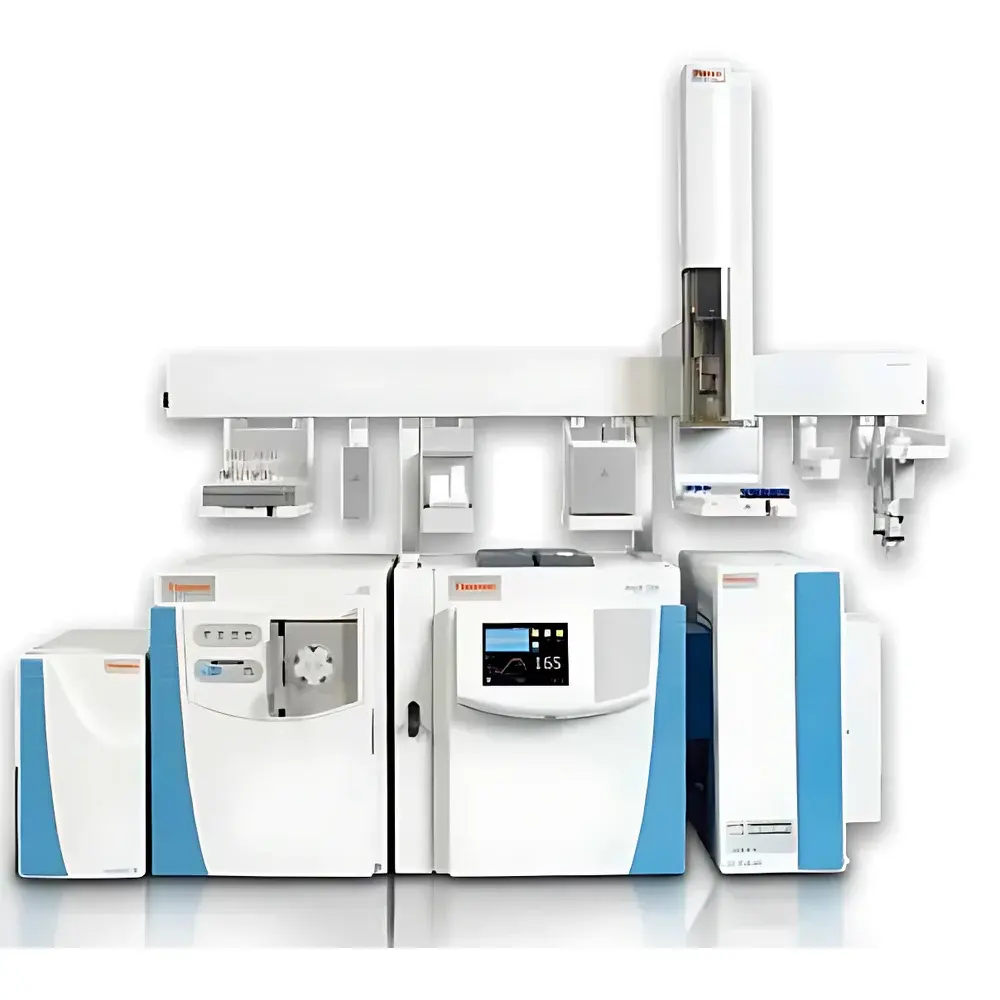
Thermo Scientific GC IsoLink II Isotope Ratio Mass Spectrometry Interface
| Origin | Germany |
|---|---|
| Manufacturer Type | Authorized Distributor |
| Origin Category | Imported |
| Model | GC IsoLink II |
| Quotation | Upon Request |
| Measurement Precision | δ¹³C < 0.2‰, δ¹⁵N < 0.5‰, δ¹⁸O < 0.8‰, δ²H < 3.0‰ |
| Measured Isotopes | ¹³C, ¹⁵N, ¹⁸O, ²H |
| Mass Range | 1–80 u |
| Resolution | 110 (10% valley) |
Overview
The Thermo Scientific GC IsoLink II is a high-performance, dedicated gas chromatography–isotope ratio mass spectrometry (GC-IRMS) interface engineered for precise, continuous-flow isotope ratio analysis of volatile organic compounds. It serves as the critical front-end interface between a capillary gas chromatograph—such as the Thermo Scientific TRACE 1310 GC—and a Delta V IRMS system, enabling real-time conversion of eluting analytes into stable, ionizable gases suitable for high-sensitivity isotopic measurement. The GC IsoLink II employs high-efficiency, temperature-controlled oxidation, reduction, and water removal reactors to quantitatively convert carbon, nitrogen, oxygen, and hydrogen in target compounds into CO₂, N₂, CO, and H₂, respectively. Its design follows established principles of continuous-flow IRMS, ensuring minimal isotopic fractionation during sample processing and delivering metrologically traceable results aligned with international reference materials (e.g., VPDB, AIR-N₂, VSMOW, SLAP).
Key Features
- Integrated, modular reactor system with independent temperature control for combustion (CuO/Pt), reduction (Cr/Co/Ni), and water trapping (Mg(ClO₄)₂ or Nafion™), optimized for multi-element isotopic analysis (¹³C, ¹⁵N, ¹⁸O, ²H) in a single run
- Robust architecture compatible with both Delta V and earlier Delta series IRMS instruments, supporting seamless integration into existing laboratory workflows
- ConFlo IV-compatible reference gas introduction port for automated, dual-inlet–style calibration using certified reference gases (e.g., CO₂, N₂, CO, H₂) during analysis
- Low-dead-volume transfer lines and optimized flow dynamics minimize peak broadening and isotopic memory effects, ensuring high reproducibility (RSD < 0.15‰ for δ¹³C across replicate injections)
- Supports direct coupling with Thermo Scientific ISQ™ Series and other benchtop GC/MS systems via optional GC-MS-IRMS configuration, enabling concurrent structural identification and isotopic fingerprinting from one injection
Sample Compatibility & Compliance
The GC IsoLink II accommodates a wide range of volatile and semi-volatile organic compounds—including fatty acids, amino acids, hydrocarbons, alcohols, and organic acids—provided they are amenable to capillary GC separation. Sample introduction is achieved via standard split/splitless injectors or programmable temperature vaporization (PTV) inlets. All reactor consumables meet ASTM D7622 and ISO 11294 requirements for isotopic integrity. The system supports GLP/GMP-compliant operation through full audit trail logging, electronic signatures, and instrument qualification documentation packages. Data acquisition and processing comply with FDA 21 CFR Part 11 when used with Thermo Scientific Chromeleon CDS software configured for regulated environments.
Software & Data Management
Control and data evaluation are performed using Thermo Scientific EASY-Quant and EASY-Isotope software modules, integrated within the Chromeleon Chromatography Data System (CDS). These tools provide automated peak integration, baseline correction, drift compensation, and delta-value calculation referenced to user-defined standards. Raw signal files (e.g., .raw, .dat) retain full time-resolved ion current data for retrospective reprocessing. Calibration curves support multi-point bracketing with internal reference gas pulses, and uncertainty propagation is calculated per ISO/IEC Guide 98-3 (GUM). Export formats include CSV, Excel, and XML for LIMS integration and third-party statistical analysis.
Applications
- Stable isotope tracing in environmental biogeochemistry (e.g., soil organic matter turnover, methane source partitioning)
- Authenticity and origin verification of food and beverages (e.g., honey, wine, olive oil, vanilla) per EU Regulation No. 2019/1793 and AOAC Official Method 2012.11
- Metabolic flux analysis in clinical and pharmaceutical research using ¹³C-labeled tracers
- Forensic isotopic profiling of explosives, illicit drugs, and ignitable liquids
- Geochemical studies of paleoclimate proxies (e.g., δ¹⁸O in foraminifera-derived CO₂, δ²H in plant wax n-alkanes)
FAQ
What GC models are certified for use with the GC IsoLink II?
The interface is validated for use with Thermo Scientific TRACE 1310 GC systems; compatibility with other GC platforms (e.g., Agilent 8890, Shimadzu GC-2030) requires flow and timing synchronization validation by the end user.
Can the GC IsoLink II analyze sulfur isotopes (δ³⁴S)?
No—sulfur isotopic analysis requires a dedicated high-temperature conversion/elemental analyzer (e.g., TC/EA) and is outside the operational scope of this interface.
Is routine maintenance documented and supported?
Yes—Thermo Fisher provides comprehensive service manuals, preventive maintenance checklists, and factory-certified training courses covering reactor conditioning, line leak testing, and performance verification protocols.
How is data integrity ensured during long-duration runs?
The system implements real-time reference gas pulsing every 5–10 analytical peaks, with automatic correction for instrumental drift using ConFlo IV’s dynamic mixing valve and pressure-regulated delivery.
Does the GC IsoLink II support automated liquid calibration injection?
Not natively—the interface is designed for continuous-flow GC effluent only; off-line derivatization and calibration standards must be introduced via the GC injector using standard autosampler methods.
Related Products





