
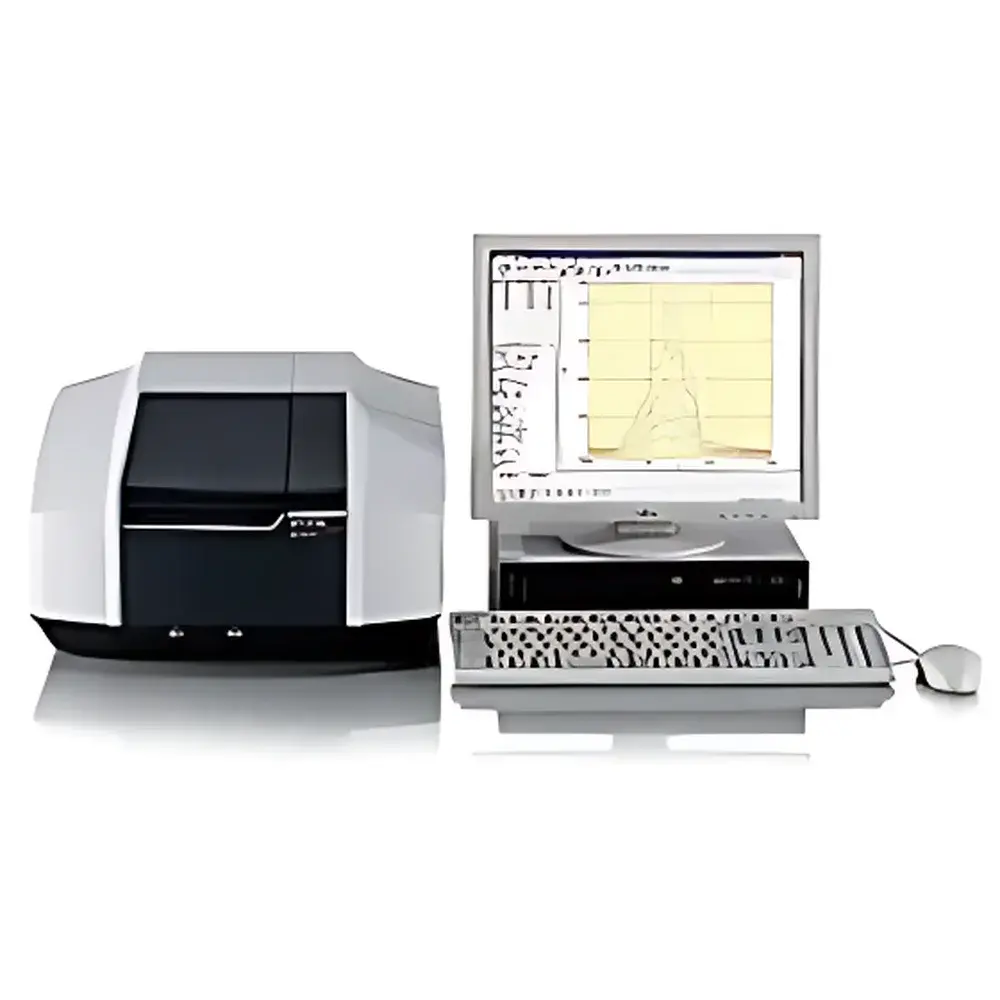
Shimadzu UV-2600 and UV-2700 Ultraviolet-Visible-Near Infrared Spectrophotometers
| Origin | Japan |
|---|---|
| Manufacturer Type | Authorized Distributor |
| Origin Category | Imported |
| Model | UV-2600, UV-2700 |
| Optical Design | Single-beam |
| Detector | Photomultiplier Tube (PMT) |
| Wavelength Range | 190–2600 nm |
| Automation Level | Automatic Wavelength Scanning |
| NIR Extension Capability | Up to 1400 nm (with ISR-2600/ISR-2600Plus integrating sphere) |
| Maximum Absorbance | 8.0 Abs (UV-2700) |
| Stray Light | <0.00008% T at 220 nm (UV-2700, using Lo-Ray-Ligh™ holographic grating) |
Overview
The Shimadzu UV-2600 and UV-2700 are research-grade ultraviolet-visible-near infrared (UV-Vis-NIR) spectrophotometers engineered for high-fidelity molecular absorption analysis across academia, pharmaceutical R&D, materials science, and quality control laboratories. Both instruments operate on the Beer–Lambert principle, measuring sample absorbance, transmittance, and reflectance via single-beam optical architecture with precise wavelength selection through optimized Czerny–Turner monochromators. The UV-2600 delivers extended spectral coverage up to 1400 nm when coupled with the optional ISR-2600 or ISR-2600Plus integrating sphere—enabling quantitative characterization of anti-reflective coatings, silicon wafers, and photovoltaic thin films in the NIR bandgap region (~1000–1200 nm). The UV-2700 employs a dual-monochromator design with Shimadzu’s proprietary Lo-Ray-Ligh™ holographic diffraction grating, achieving ultra-low stray light (<0.00008% T at 220 nm) and linear dynamic range up to 8.0 absorbance units—critical for undiluted high-concentration assays, polarizer transmission evaluation, and trace impurity detection without sample dilution.
Key Features
- Extended spectral range: 190–2600 nm (UV-2600: 190–1400 nm with ISR-2600Plus; UV-2700: 190–2600 nm standard)
- High photometric accuracy: Certified linearity up to 8.0 Abs (UV-2700), validated using KMnO4 aqueous standards per JIS K 0115
- Ultra-low stray light optics: Dual-monochromator configuration and Lo-Ray-Ligh™ grating technology minimize spectral interference in high-absorbance measurements
- Compact footprint: 28% reduction in volume vs. legacy UV-2450/2550 systems; optimized thermal management with isolated fan compartment and 170 W max power consumption
- Integrated hardware validation software: Pre-installed GLP/GMP-compliant performance verification module supporting automated photometric, wavelength, and baseline accuracy checks
- Modular expandability: Compatible with multiple accessories including integrating spheres (ISR-2600/2600Plus), solid-sample holders, temperature-controlled cuvette compartments, and fiber-optic probes
Sample Compatibility & Compliance
The UV-2600/2700 supports liquid, solid, and thin-film samples in standard 10-mm quartz/cuvettes, micro-volume cells, and diffuse-reflectance configurations. With the ISR-2600Plus integrating sphere, absolute and relative reflectance measurements are traceable from deep UV (190 nm) to NIR (1400 nm), meeting requirements for ISO 9050 (glass optical properties), ASTM E903 (solar absorptance), and JIS R 3106 (anti-reflective coating evaluation). Instrument validation adheres to JIS K 0115 “General Rules for Molecular Absorption Analysis”, Japanese Pharmacopoeia (JP) General Tests , European Pharmacopoeia (Ph. Eur.) 2.2.25, and USP spectrophotometric system suitability protocols. All hardware confirmation logs include timestamped audit trails, user authentication, and exportable PDF/CSV reports—fully compliant with FDA 21 CFR Part 11 data integrity requirements when deployed with appropriate IT governance controls.
Software & Data Management
UVProbe software provides a unified platform for method development, real-time spectral acquisition, multi-curve overlay, kinetic analysis, and report generation. It incorporates role-based access control (RBAC), electronic signatures, and full audit trail functionality—including operator ID, parameter changes, raw data modification history, and instrument status flags. Data files (.spc format) retain metadata such as lamp usage hours, grating position, slit width, and detector gain settings. Validation packages support IQ/OQ documentation, and software modules comply with Annex 11 (EU GMP) and ALCOA+ principles (Attributable, Legible, Contemporaneous, Original, Accurate, Complete, Consistent, Enduring, Available). Export options include CSV, XML, and PDF with embedded calibration certificates and uncertainty statements.
Applications
- Pharmaceutical analysis: Quantitative assay of active pharmaceutical ingredients (APIs), excipient compatibility studies, dissolution testing, and stability-indicating methods per ICH Q2(R2)
- Materials science: Bandgap determination of semiconductors (e.g., Si, GaAs), thin-film thickness modeling via interference fringes, and optical density profiling of AR/HR coatings
- Environmental monitoring: Nitrate/nitrite quantification in water matrices, chlorophyll-a extraction analysis, and humic substance characterization
- Food & beverage QC: Color index measurement (CIE L*a*b*), anthocyanin content in juices, and antioxidant capacity (FRAP/DPPH) kinetics
- Nanomaterials: Surface plasmon resonance (SPR) tracking of gold/silver nanoparticle aggregation and size distribution inference
FAQ
What is the difference between the UV-2600 and UV-2700 models?
The UV-2600 is a single-monochromator system optimized for routine and NIR-extended analysis (up to 1400 nm with ISR-2600Plus), while the UV-2700 features a dual-monochromator optical path with Lo-Ray-Ligh™ grating to achieve 8.0 Abs linearity and ultra-low stray light—ideal for high-absorbance applications requiring minimal dilution.
Can the UV-2600 measure beyond 1100 nm without accessories?
No. Standard UV-2600 operation covers 190–1100 nm. Extension to 1400 nm requires the ISR-2600 or ISR-2600Plus integrating sphere with dual-detector configuration.
Is hardware validation software included by default?
Yes. Both UV-2600 and UV-2700 ship with pre-installed Hardware Check software supporting automated wavelength accuracy, photometric linearity, and stray light verification per JIS K 0115.
Does UVProbe support 21 CFR Part 11 compliance?
UVProbe includes configurable electronic signature, audit trail, and data integrity controls; full Part 11 compliance requires deployment within a validated network environment with documented SOPs and administrator oversight.
What calibration standards are recommended for routine performance verification?
NIST-traceable holmium oxide (HoO3) and didymium filters for wavelength accuracy; potassium dichromate (K2Cr2O7) in 0.005 M H2SO4 for photometric accuracy; and neutral density filters for stray light assessment per USP .




