
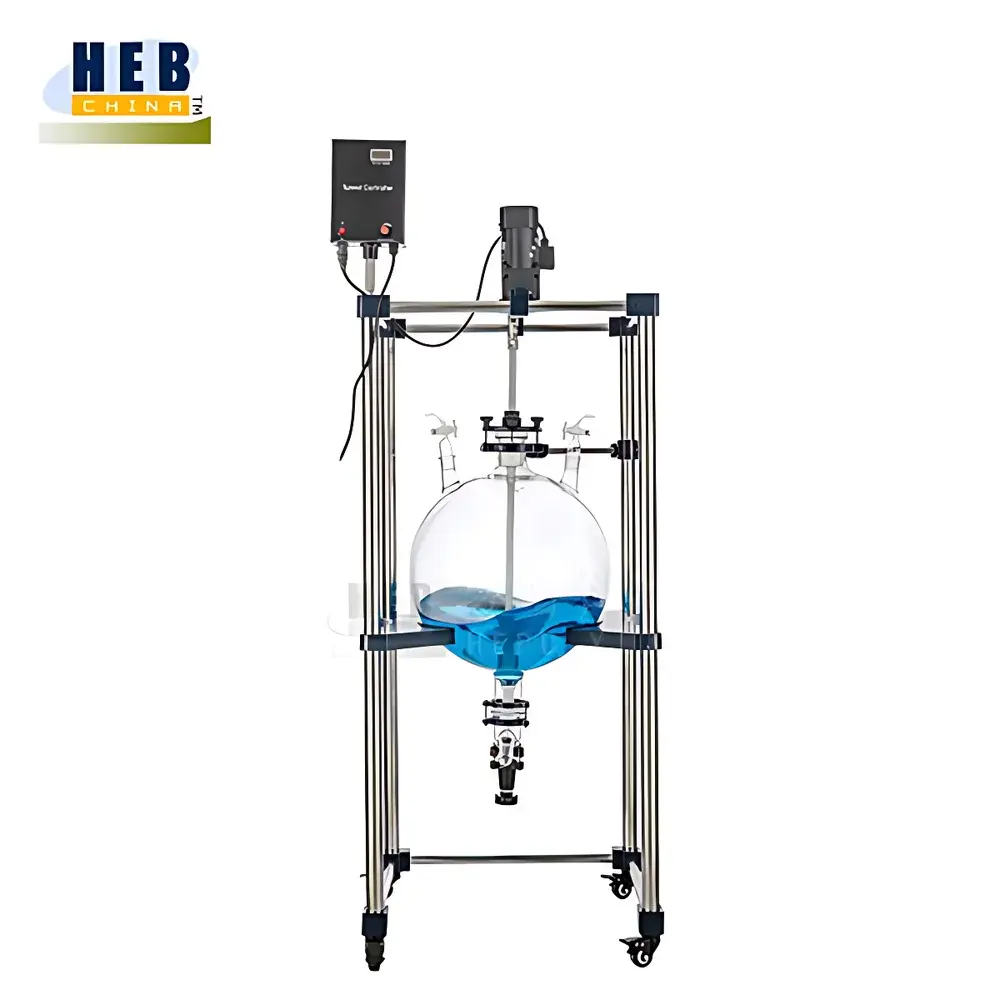
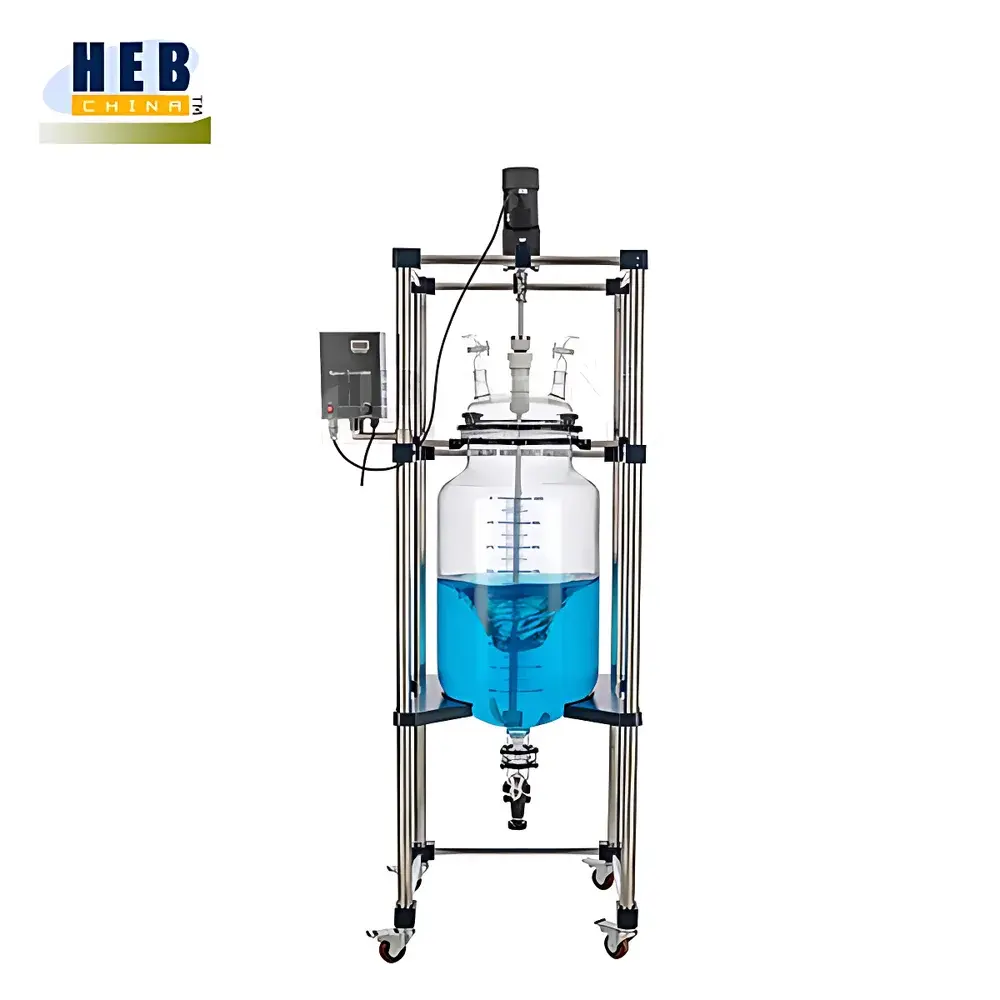
Jihepu FY-20L Borosilicate Glass Separatory Reactor with Integrated Stirring and Vacuum Control
| Brand | Jihepu |
|---|---|
| Origin | Shandong, China |
| Model | FY-20L |
| Capacity | 20 L |
| Material | ASTM E438 Type I, Class A borosilicate glass (3.3 expansion coefficient) + PTFE-sealed components |
| Working Pressure | Low-pressure / vacuum-rated |
| Maximum Vacuum | −0.098 MPa (absolute) |
| Stirring Speed Range | 0–450 rpm |
| Motor Power | 90 W |
| Voltage/Frequency | 220 V / 50 Hz |
| Stirrer Shaft | 304 stainless steel sheathed in PTFE |
| Stirrer Blade | Crescent-shaped, 304 SS core + PTFE coating |
| Sealing | Mechanical seal with ceramic bearing |
| Frame | Anodized aluminum + 304 stainless steel support structure |
| Dimensions (W×D×H) | 530 × 440 × 1580 mm |
| Net Weight | 33 kg |
| Safety | Built-in thermal fuse protection |
Overview
The Jihepu FY-20L Borosilicate Glass Separatory Reactor is an integrated laboratory-scale reaction and phase separation system engineered for controlled synthesis, extraction, and post-reaction liquid–liquid separation under ambient or reduced pressure conditions. It operates on the principle of gravity-driven density-based stratification following homogeneous mixing—enabling precise sequential discharge of immiscible layers without cross-contamination. Designed for applications requiring chemical inertness, visual process monitoring, and moderate vacuum compatibility, the reactor features a spherical 20 L borosilicate glass vessel conforming to ISO 3585 specifications for hydrolytic resistance (Class HGB), ensuring long-term stability against alkalis, organic solvents, and mild acids. Its low-pressure operational envelope (up to −0.098 MPa absolute) supports solvent removal, degassing, and reduced-boiling-point reactions while maintaining structural integrity and optical clarity.
Key Features
- Full-contact wetted parts constructed from ASTM E438 Type I, Class A borosilicate glass (3.3 expansion coefficient) and virgin PTFE—certified non-reactive per USP and ISO 10993-5 biocompatibility screening guidelines.
- Modular four-neck configuration: central Φ80 mm stirring port, two Φ34 standard taper joints (for feed and vacuum lines), and one Φ80 mm bottom discharge flange—compatible with common lab glassware adapters and vacuum traps.
- Variable-speed DC motor (0–450 rpm) with digital RPM display and precision potentiometer control; torque-optimized for viscous media up to 5,000 mPa·s at full load.
- Ceramic-bearing mechanical seal assembly prevents particulate generation and ensures >10,000 hr service life under continuous operation—critical for GMP-aligned pilot processes.
- PTFE-lined crescent impeller (190 mm span, 650 mm total length) delivers axial flow with minimal shear—ideal for emulsion-sensitive extractions and crystallization seeding.
- Side-mounted angled discharge port (Φ34 mm PTFE-tipped宝塔接头) positioned 350 mm above floor level enables drip-free, layer-selective transfer into receiving vessels without repositioning.
- Mobile base with locking casters (two swivel, two fixed) and reinforced aluminum–stainless steel frame allows safe relocation between fume hoods, gloveboxes, and analytical workstations.
Sample Compatibility & Compliance
The FY-20L accommodates heterogeneous reaction mixtures including aqueous–organic biphasic systems (e.g., ethyl acetate/water, DCM/methanol), acid–base extractions, and catalyst-containing suspensions. Its borosilicate construction resists thermal shock (ΔT ≤ 120 °C) and complies with ISO 17777 for laboratory glassware dimensional tolerances. All PTFE components meet FDA 21 CFR 177.1550 for repeated food-contact use. The unit is suitable for GLP-compliant documentation workflows when paired with external data loggers recording RPM, time, and vacuum setpoints—though it does not include built-in electronic audit trail functionality per 21 CFR Part 11.
Software & Data Management
This is a manually operated, analog-controlled reactor with no embedded firmware or digital interface. Process parameters—including stirring speed, vacuum level (monitored externally via Bourdon gauge or digital vacuum meter), and elapsed reaction time—are recorded manually or via external USB data loggers (e.g., Omega OM-DAQPRO-5300). For traceability in regulated environments, users are advised to maintain bound logbooks referencing batch numbers, operator IDs, and environmental conditions (temperature/humidity) per ISO/IEC 17025 clause 7.5.2.
Applications
- Batch-wise liquid–liquid extraction in pharmaceutical intermediate purification (e.g., API isolation after Suzuki coupling).
- Controlled hydrolysis or saponification reactions requiring real-time visual assessment of phase separation kinetics.
- Solvent recovery under mild vacuum during green chemistry workflows (e.g., ethanol removal from botanical extracts).
- Small-scale catalyst recycling studies where metal leaching must be monitored via ICP-MS of successive aqueous layers.
- Teaching laboratories demonstrating Le Chatelier’s principle, partition coefficients (log P), and interfacial tension effects.
FAQ
Is the FY-20L suitable for pressurized reactions?
No. It is rated exclusively for atmospheric and sub-atmospheric operation up to −0.098 MPa absolute. Pressurized applications require ASME-certified jacketed reactors.
Can the glass vessel be autoclaved?
Borosilicate glass components may be autoclaved at 121 °C for 20 min; however, PTFE seals and motor assemblies must be disassembled prior to sterilization.
What maintenance is required for the mechanical seal?
Annual inspection of ceramic stator/rotor alignment and PTFE spring loading is recommended. Replacement kits (part #FY-SEAL-KIT-20L) are available directly from Jihepu authorized distributors.
Does the unit include vacuum pump compatibility fittings?
Yes—the Φ34 standard taper vacuum port accepts common KF-16 or NW16 vacuum hose barbs via optional PTFE adapter sleeves (not included).
Is technical support available outside mainland China?
Jihepu provides remote troubleshooting documentation in English and collaborates with regional service partners in Southeast Asia, the Middle East, and Latin America for calibration and repair—response time typically 5–10 business days.



