
HCP Single Grating / Multiple Grating / Fan-Out Grating Optical Parametric Devices
| Brand | HCP |
|---|---|
| Origin | Taiwan |
| Type | Nonlinear Optical Crystals for Second-Harmonic Generation (SHG), Sum-Frequency Generation (SFG), Difference-Frequency Generation (DFG), and Optical Parametric Oscillation (OPO) |
| Coating | Anti-Reflection (AR) Coated for Specified Wavelength Ranges |
| Crystal Dimensions (X × Z) | Single Grating — 10/25/50 mm × 0.5/1.0/2.0/3.0 mm |
Overview
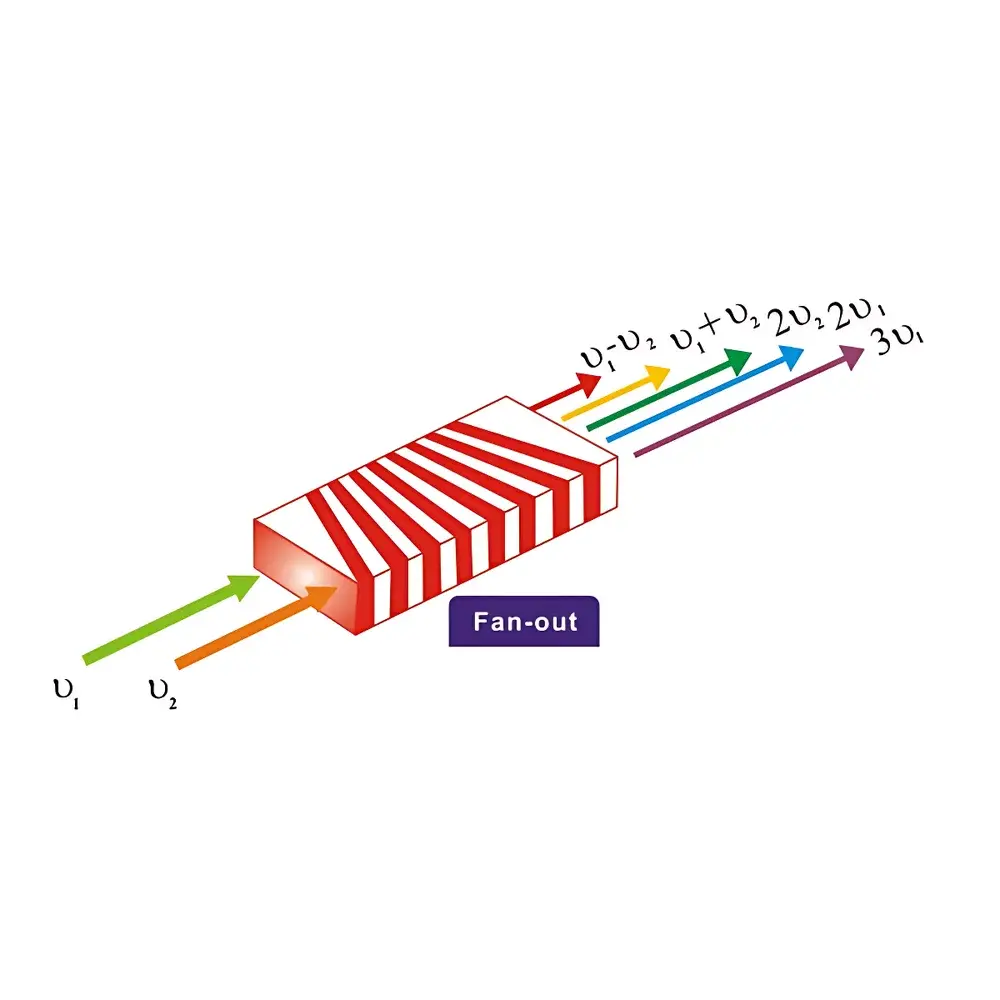
HCP Single Grating, Multiple Grating, and Fan-Out Grating optical parametric devices are precision-engineered nonlinear optical crystals designed for wavelength conversion in ultrafast and continuous-wave laser systems. These periodically poled lithium niobate (PPLN) or lithium tantalate (PPSLT)–based gratings operate on the principle of quasi-phase-matching (QPM), enabling efficient second-harmonic generation (SHG), sum-frequency generation (SFG), difference-frequency generation (DFG), and optical parametric oscillation (OPO). Unlike birefringent phase matching, QPM provides broad spectral tunability, high damage threshold, and design flexibility across UV to mid-IR spectral regions (e.g., 350 nm – 4.5 µm). Each grating type serves a distinct functional role: single-period structures deliver narrowband, high-efficiency conversion at fixed wavelengths; multiple-period gratings support multi-wavelength or broadband operation within a single crystal aperture; fan-out gratings enable spatially resolved, continuously tunable output via translation or beam scanning.
Key Features
- Anti-reflection (AR) coatings optimized for input and output wavelengths—typically <0.2% residual reflectivity per surface across specified bands (e.g., 1064 nm + 532 nm for SHG, or 1550 nm + 3100 nm for DFG)
- High-fidelity periodic poling with sub-micron domain uniformity and edge definition, ensuring consistent nonlinear coefficient (d33) distribution and low spatial walk-off
- Thermally stable crystal mounts compatible with oven-controlled environments (±0.1 °C stability) for temperature-tuned phase matching
- Standard dimensions accommodate standard kinematic mounts and OEM integration into laser cavities or external resonators
- Customizable poling period (Λ), aperture size, crystal orientation (z-cut or x-cut), and AR coating specifications per application requirements
- Manufactured under cleanroom conditions with full traceability of poling parameters, annealing profiles, and post-poling characterization data
Sample Compatibility & Compliance
These gratings are compatible with picosecond and femtosecond Ti:sapphire, fiber, and Nd:YAG-based pump sources operating at repetition rates from single-shot to MHz regimes. Input beam quality requirements include M² < 1.3 and intensity below 1 GW/cm² (for pulsed) or 10 kW/cm² (for CW) to avoid optical damage. All devices comply with ISO 10110-7 surface quality standards (scratch-dig ≤ 10-5) and meet RoHS Directive 2011/65/EU material restrictions. For regulated environments—including pharmaceutical process analytical technology (PAT) or defense-grade laser systems—crystal fabrication records, coating deposition logs, and metrology reports are provided to support GLP/GMP audits and FDA 21 CFR Part 11–aligned documentation workflows.
Software & Data Management
While the gratings themselves are passive optical components, their integration into automated laser systems benefits from interoperability with industry-standard control platforms. HCP provides detailed technical datasheets including calculated phase-matching curves (temperature vs. wavelength), acceptance bandwidths (Δλ and Δθ), and conversion efficiency estimates derived from coupled-wave theory simulations. These files are delivered in CSV and PDF formats compatible with MATLAB, Python (SciPy), and LabVIEW for real-time tuning algorithm development. For OEM customers, HCP supports secure API-accessible metadata exchange (via HTTPS REST endpoints) for batch traceability, calibration history, and thermal drift compensation models—enabling closed-loop wavelength stabilization in spectroscopic or sensing applications.
Applications
- Mid-infrared spectroscopy using DFG-based sources (e.g., 3–5 µm for gas sensing of CH₄, CO₂, NOₓ)
- Ultrafast pulse compression and carrier-envelope phase stabilization via SHG f-to-2f interferometry
- Multi-spectral imaging systems requiring simultaneous generation of discrete wavelengths (e.g., 515 nm, 633 nm, and 780 nm from a single 1560 nm fiber laser)
- Quantum optics experiments involving correlated photon-pair generation via spontaneous parametric down-conversion (SPDC) in fan-out configurations
- OEM integration into portable OPO modules for field-deployable standoff detection or environmental monitoring platforms
- Frequency comb extension and calibration through cascaded SFG processes in multi-grating stacks
FAQ
What is the typical damage threshold for these gratings under femtosecond excitation?
For 100-fs pulses at 1030 nm, the measured bulk damage threshold is ≥ 0.5 J/cm² (tested per ISO 21254-2); surface damage onset occurs above 1.2 GW/cm² peak intensity when AR coatings are intact.
Can I specify non-standard poling periods outside the catalog range?
Yes—HCP supports custom Λ values from 3.5 µm to 35 µm with ±10 nm tolerance, subject to minimum order quantity and qualification testing.
Do you provide temperature-tuning curves for each grating?
Yes—each shipped unit includes a calibrated dT/dλ coefficient and experimentally validated tuning curve referenced to a NIST-traceable thermistor embedded in the mount.
Is vacuum compatibility available for fan-out gratings used in UHV laser systems?
Standard AR coatings are UHV-compatible (<1×10⁻⁹ mbar outgassing rate); optional ion-beam-sputtered coatings are available for extended bake-out cycles up to 200 °C.
How is phase-matching bandwidth affected by crystal thickness in multiple-grating designs?
Thicker apertures increase group-velocity mismatch, narrowing the effective coherence length; optimal Z-dimension balances efficiency and bandwidth—typically 0.5 mm for broadband SFG and 1.0 mm for narrowband OPO seeding.




