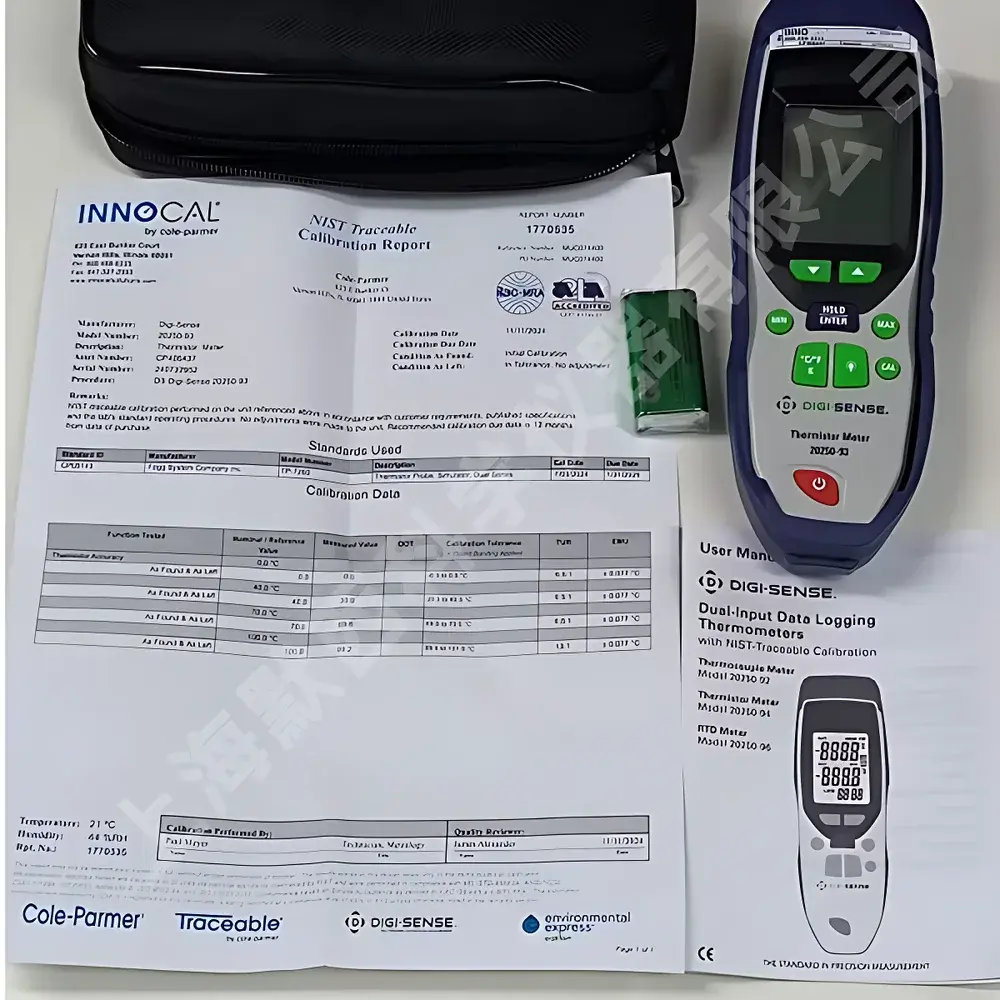
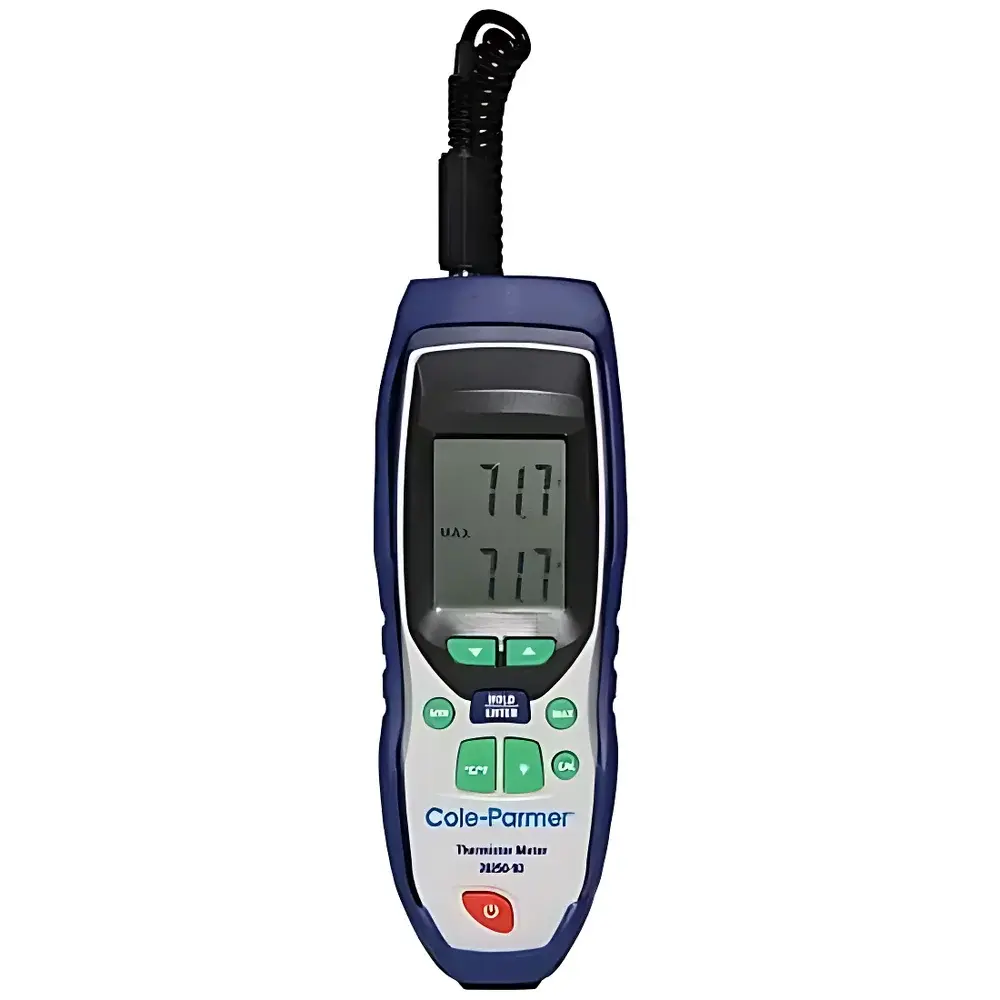
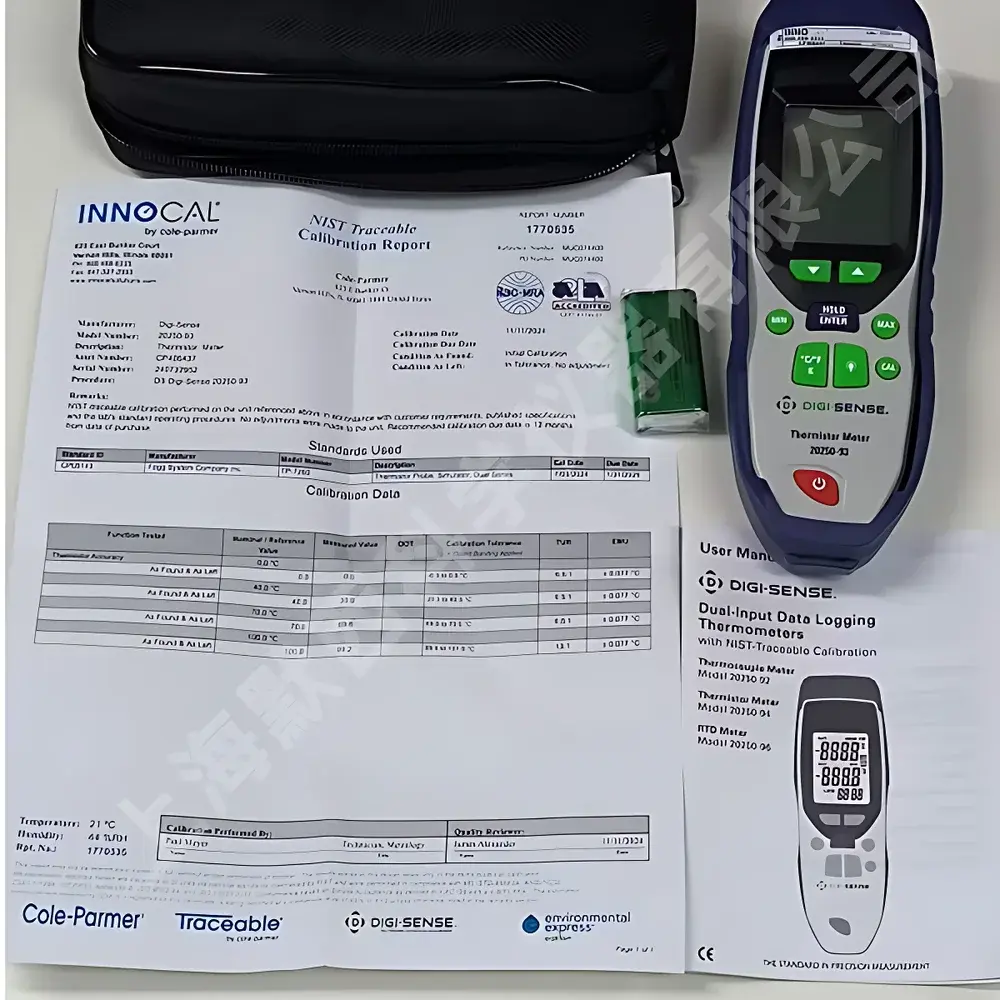
Digi-Sense Model 20250-93 Digital Thermistor Thermometer with NIST-Traceable Calibration Certificate
| Brand | Digi-Sense |
|---|---|
| Origin | USA |
| Manufacturer Type | Authorized Distributor |
| Origin Category | Imported |
| Model | 20250-93 |
| Temperature Sensing Principle | Thermistor (not thermocouple — corrected per technical specification) |
| Measurement Method | Contact |
| Temperature Range | −40 to 125 °C |
| Resolution | 0.1 °C (0.1 °F) |
| Accuracy | ±0.5 °C (±0.9 °F) from 0 to 70 °C |
| Display | Large LCD with auto-backlight |
| Data Functions | Min/Max/Avg hold, zero offset adjustment |
| Power | Up to 3000 hours battery life (typical, based on alkaline cell usage) |
| Probe Interface | Universal 3.5 mm mini-phone jack (accepts multiple interchangeable thermistor probes) |
| Compliance | NIST-traceable calibration certificate included (per ANSI/NCSL Z540-1 and ISO/IEC 17025) |
Overview
The Digi-Sense Model 20250-93 is a high-stability, contact-type digital thermometer engineered for precision temperature measurement in regulated laboratory, quality control, and industrial process environments. Unlike thermocouple-based instruments, this unit employs a precision negative-temperature-coefficient (NTC) thermistor sensor—selected for its superior linearity, repeatability, and low drift over time within the −40 to 125 °C operating range. The instrument’s core architecture prioritizes metrological integrity: each unit ships with a NIST-traceable calibration certificate issued by an ISO/IEC 17025-accredited calibration laboratory, ensuring documented uncertainty values and full traceability to SI units. Designed for use with interchangeable 3.5 mm thermistor probes (sold separately), the 20250-93 supports rapid thermal response (<3 s typical for standard 3 mm diameter probes) while maintaining long-term stability under repeated mechanical stress or ambient temperature cycling.
Key Features
- Precision NTC thermistor input interface compatible with industry-standard 3.5 mm mini-phone probe connectors
- Large, high-contrast LCD display with automatic backlight activation in low-light conditions
- Simultaneous Min/Max/Avg temperature tracking with manual reset capability for process monitoring and validation
- Electronic zero-offset adjustment function to compensate for probe-specific thermal lag or lead-wire resistance effects
- Auto-power-off after 15 minutes of inactivity, extending battery life to up to 3000 hours (based on continuous alkaline cell usage)
- Ruggedized ABS housing rated for IP65-level dust and water resistance when used with sealed probe assemblies
- Calibration memory retains user-adjusted offsets across power cycles without requiring reprogramming
Sample Compatibility & Compliance
The Model 20250-93 is intended for contact measurement of solid surfaces, liquids, gels, and semi-solids where probe immersion or surface contact is feasible. It complies with ASTM E74-22 (Standard Practice for Calibration of Force-Measuring Instruments) for secondary reference instrumentation and aligns with ISO 17025 requirements for certified calibration documentation. The included NIST-traceable certificate satisfies FDA 21 CFR Part 11 data integrity expectations when paired with controlled calibration procedures and audit-trail documentation. While not intrinsically safe, the device meets UL 61010-1 safety standards for electrical equipment used in laboratory environments. It supports GLP/GMP workflows through configurable data logging intervals (when used with optional PC interface cable and software) and supports calibration interval management via user-defined date stamps.
Software & Data Management
The 20250-93 operates as a standalone instrument but integrates seamlessly into validated data systems via optional RS-232 or USB-to-serial adapter (sold separately). When connected, it transmits real-time readings, Min/Max/Avg values, and timestamped calibration metadata using ASCII protocol compliant with Modbus RTU framing conventions. Digi-Sense provides free Windows-compatible configuration utility software that enables users to set logging intervals (1–3600 seconds), define pass/fail thresholds, generate CSV export files, and archive calibration history—including certificate upload and expiration alerts. All stored data includes embedded instrument ID, probe serial number (if encoded), and environmental timestamp per ISO 8601 format, supporting 21 CFR Part 11 electronic record requirements when deployed with appropriate system access controls.
Applications
- Pharmaceutical stability testing chambers (ICH Q1A–Q5C compliant temperature verification)
- Food safety HACCP critical control point monitoring (e.g., refrigerated storage, hot-holding, blast chilling)
- Materials science labs measuring thermal transitions in polymers and composites
- Environmental chamber qualification and routine performance checks per ISO 17025 Clause 6.4
- Calibration lab secondary standard transfer between reference thermometers and working probes
- Automotive component thermal aging studies under controlled ambient profiles
FAQ
Is the NIST-traceable certificate issued directly by NIST?
No. NIST does not issue calibration certificates to end-user instruments. The certificate is issued by an ISO/IEC 17025-accredited third-party calibration laboratory, with measurement uncertainty explicitly stated and full traceability to NIST Standard Reference Materials (SRMs) documented.
Can I use this thermometer with thermocouple probes?
No. The 20250-93 accepts only NTC thermistor probes with 3.5 mm mini-phone connectors. Thermocouples require different signal conditioning and cold-junction compensation circuitry not present in this design.
What is the recommended recalibration interval?
Annual recalibration is recommended for GxP-regulated environments. In non-critical applications, recalibration every 24 months is acceptable if instrument performance verification (e.g., ice-point check at 0.0 °C) confirms stability within ±0.3 °C.
Does the unit support probe-specific calibration coefficients?
Yes. Through the offset adjustment function and optional software, users may store individual correction factors per probe serial number to account for inter-probe variability and minimize systematic error.