
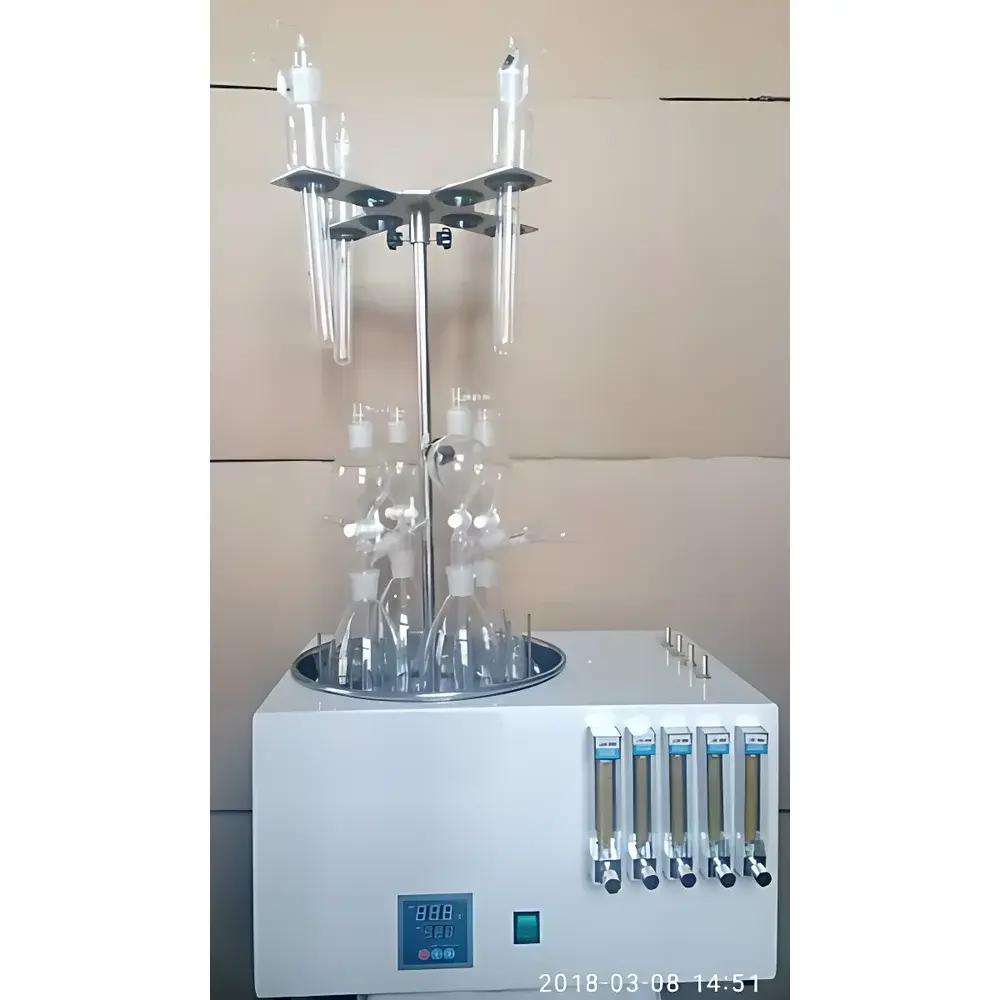
Jihepu GGC-600 Acidification-Gas Purge System for Sulfide Analysis in Water Samples
| Brand | Jihepu |
|---|---|
| Origin | Shandong, China |
| Manufacturer Type | Authorized Distributor |
| Country of Origin | China |
| Model | GGC-600 |
| Instrument Type | Laboratory Benchtop System |
| Sample Capacity | 4 or 6 positions |
| Nitrogen Flow Range | 0–3 L/min (standard) or 0–10 L/min (optional) |
| individual channel control | 0–600 mL/min per port |
| Heating Method | Constant-Temperature Water Bath |
| Heating Power | 1000 W |
| Temperature Range | Ambient to 99 °C |
| Temperature Control Accuracy | ±1 °C |
| Display | Digital LED |
| Construction Material | Full 316 Stainless Steel |
| Acid Addition System | PTFE-coated adjustable valve with ground-glass joint coupling |
| Absorption Tube | Equipped with PTFE drain valve |
| Compliance | Designed to meet GB/T 16489–1996 (equivalent to ISO 10572:1992 and ASTM D4129–17 for sulfide pre-treatment) |
Overview
The Jihepu GGC-600 Acidification-Gas Purge System is a laboratory-grade benchtop instrument engineered for standardized sample preparation in the quantitative determination of dissolved and acid-volatile sulfides (AVS) in aqueous matrices. It operates on the principle of acidification-driven nitrogen purging—where sulfur species (e.g., H₂S, HS⁻, S²⁻) are liberated from solution under controlled acidic conditions and selectively transferred into an absorption medium via inert gas sparging. This method forms the critical front-end step for downstream spectrophotometric analysis per GB/T 16489–1996 (Water Quality – Determination of Sulfide – Methylene Blue Spectrophotometric Method), which aligns closely with internationally recognized protocols including ISO 10572:1992 and ASTM D4129–17. The system is not a standalone analyzer but a dedicated pretreatment platform designed to ensure stoichiometric recovery, minimize analyte loss, and eliminate interferences from suspended solids or organic complexes prior to colorimetric quantification.
Key Features
- Modular 4- or 6-position sample rack with motorized vertical lift and 360° rotation—enabling ergonomic front-access operation without repositioning the instrument.
- Independent nitrogen flow regulation per sample channel (0–600 mL/min) via precision needle valves, coupled with dual-range mass flow indication (0–3 L/min or 0–10 L/min total), allowing method-specific optimization across low- and high-flow applications.
- Constant-temperature water bath (ambient to 99 °C, ±1 °C stability) with 1000 W heating capacity and integrated drain valve for rapid, residue-free bath maintenance.
- Chemically inert fluid path: PTFE-coated acid addition valve mounted directly onto reaction vessel ground-glass joints; absorption tubes fitted with PTFE drain valves to prevent cross-contamination during sequential analysis.
- Full 316 stainless steel chassis and bath housing—resistant to corrosion from HCl, H₃PO₄, and other strong acids commonly used in sulfide liberation protocols.
- No external controllers or software dependencies—fully manual, analog-operated design prioritizing operational transparency, regulatory traceability, and long-term serviceability in GLP-compliant laboratories.
Sample Compatibility & Compliance
The GGC-600 supports a broad range of environmental water samples, including surface water, groundwater, domestic wastewater, and industrial effluents with variable turbidity and salinity. Its modular configuration accommodates standard 100–500 mL borosilicate reaction vessels and 10–25 mL absorption tubes (e.g., 10 mm pathlength cuvettes or gas-washing bottles). All wetted components comply with USP Class VI and FDA 21 CFR Part 11 material suitability guidelines for analytical use. While the instrument itself does not generate analytical data, its operational parameters are fully documentable for audit trails required under ISO/IEC 17025:2017 accreditation and EPA Method 376.1 validation workflows. The system satisfies mandatory pretreatment criteria outlined in GB/T 16489–1996 and serves as a validated alternative to custom-built purge-and-trap assemblies in routine QC/QA labs.
Software & Data Management
The GGC-600 is a hardware-only, non-digital system with no embedded firmware, touchscreen interface, or data logging capability. All operational parameters—including bath temperature, nitrogen flow rates, acid addition volume, and purge duration—are manually set and recorded externally in laboratory notebooks or LIMS-integrated electronic lab notebooks (ELNs). This architecture eliminates cybersecurity risks, firmware obsolescence, and calibration drift associated with embedded microcontrollers. For laboratories subject to 21 CFR Part 11 compliance, the absence of automated data capture necessitates documented procedural controls (e.g., dual-operator verification of flow meter readings, timestamped log entries, and retention of calibration certificates for supporting equipment such as digital thermometers and rotameters).
Applications
- Routine monitoring of sulfide concentrations in municipal wastewater treatment plants (WWTPs) for process control and discharge compliance.
- Environmental site assessment (ESA) and sediment porewater analysis where AVS speciation informs bioavailability modeling under ASTM D6710–01.
- Regulatory testing for industrial effluent permits under China’s GB 8978–1996 and EU Directive 2006/11/EC on toxic substances in water.
- Method development and validation studies requiring reproducible gas-transfer efficiency across heterogeneous sample types.
- Teaching laboratories conducting APHA Standard Methods 4500-S²⁻ training modules on sulfide chemistry and analytical best practices.
FAQ
Is the GGC-600 compatible with automated sulfide analyzers?
Yes—the system outputs purified H₂S gas into standard absorption media (e.g., zinc acetate or NaOH solutions), making it interoperable with UV-Vis spectrophotometers, ion chromatographs, or amperometric detectors compliant with ISO 10572.
Can the water bath accommodate irregularly shaped reaction vessels?
The bath features a removable stainless steel insert with standardized 4- or 6-hole spacing (Ø35 mm), optimized for common cylindrical glassware; custom inserts can be fabricated upon request.
What maintenance is required for long-term nitrogen flow accuracy?
Annual recalibration of rotameters against NIST-traceable flow standards is recommended; needle valves require only periodic cleaning with deionized water and isopropanol.
Does the system support acid addition automation?
No—acid dosing is performed manually using calibrated syringes or burettes per GB/T 16489–1996; this preserves method fidelity and avoids pump-induced pulsation artifacts.
How is temperature uniformity verified across all sample positions?
Users should perform a multi-point validation using calibrated PT100 probes at center and peripheral bath locations before initial qualification and annually thereafter per ISO/IEC 17025 Clause 6.4.6.







