
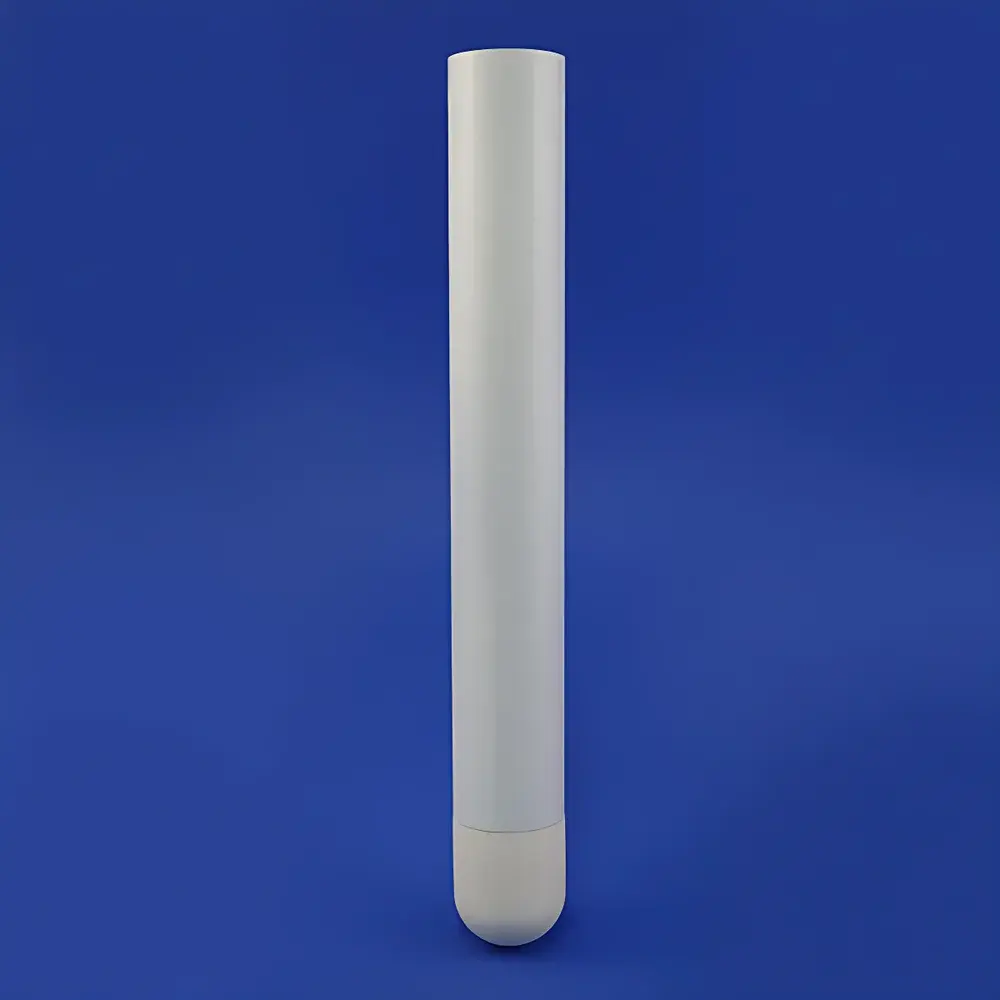
SEC 1900 Soil Solution Sampler
| Origin | USA |
|---|---|
| Manufacturer Type | Distributor |
| Origin Category | Imported |
| Model | 1900 |
| Price Range | USD 700 – 1,400 |
| Sampling Depth Range | 15 cm to 1.8 m |
| Sampler Tube OD | 4.8 cm (PVC) |
| Ceramic Tip Air Entry Value | 2 bar (200 kPa) |
| Sampler Type | High-Capacity Soil Solution Sampler |
Overview
The SEC 1900 Soil Solution Sampler is a precision-engineered suction lysimeter designed for in situ collection of soil pore water under controlled negative pressure. Operating on the principle of vacuum-driven capillary extraction, it enables non-destructive, time-resolved sampling of soil solution from defined horizons without significant soil matrix disturbance. The device integrates a high-strength porous ceramic tip—calibrated to an air entry value of 200 kPa—with a rigid PVC collection tube (4.8 cm outer diameter), allowing reliable equilibration and extraction across a wide range of soil textures and moisture conditions. Its design conforms to established lysimetric methodology described in ASTM D5088-22 (“Standard Practice for Lysimeter Installation and Operation”) and supports compliance with ISO 11274:2022 (“Soil Quality — Determination of Water Retention Characteristics”). The 1900 model is optimized for high-volume, discrete sampling events in field-based environmental monitoring, biogeochemical cycling studies, and contaminant leaching assessments.
Key Features
- Robust 200 kPa ceramic tip ensures consistent pore water extraction across loam, clay, and silty soils while minimizing preferential flow artifacts
- 1.8 m maximum installation depth accommodates shallow-rooting ecosystems and vadose zone profiling down to the capillary fringe
- 4.8 cm OD PVC body provides mechanical stability during insertion and resistance to lateral shear in saturated or compacted layers
- Vacuum-compatible sealing system maintains stable negative pressure (–20 to –80 kPa typical operating range) for reproducible solution yield
- Modular construction allows rapid disassembly, ceramic tip replacement, and sterilization between sampling campaigns
- Compatible with standard vacuum manifolds, digital pressure controllers, and automated sequential samplers for unattended operation
Sample Compatibility & Compliance
The SEC 1900 is validated for use in USDA soil texture classes ranging from sandy loam to heavy clay (USDA Textural Triangle, 2022). It supports collection of analyte-stable pore water for subsequent ion chromatography (IC), inductively coupled plasma mass spectrometry (ICP-MS), and nutrient analysis (NO₃⁻, NH₄⁺, PO₄³⁻, DOC). All wetted components comply with USP Class VI biocompatibility standards and are free of leachable metals or organics that could interfere with trace-element quantification. The system meets GLP documentation requirements for environmental fate studies and is routinely referenced in EPA Method 9060A (soil solution extraction for pesticide mobility assessment) and ISO 10381-7:2019 (field sampling of soil solution).
Software & Data Management
While the 1900 is a manually operated passive sampler, it is fully interoperable with third-party vacuum control platforms such as the Eijkelkamp Vacuum Controller VC-2000 or Decagon’s EM50 data logger ecosystem. When paired with calibrated pressure transducers and time-stamped vacuum logs, sampling events can be linked to soil moisture (θ) and matric potential (ψ) datasets for integrated hydrological modeling. Exported CSV logs support traceability under FDA 21 CFR Part 11 when used in regulated agricultural research settings—provided audit trails, electronic signatures, and version-controlled SOPs are maintained per laboratory quality management system (QMS) protocols.
Applications
- Long-term nitrate leaching monitoring in agricultural watersheds (aligned with EU Nitrates Directive reporting)
- Heavy metal mobility assessment beneath contaminated landfills and industrial brownfields
- Root-zone solute dynamics in controlled-environment rhizotron experiments
- Validation of reactive transport models (e.g., HYDRUS-1D, PFLOTRAN) through direct pore water chemistry verification
- Salinity and boron accumulation studies in arid-zone irrigation systems
- Pre- and post-phytoremediation pore water profiling to quantify contaminant depletion kinetics
FAQ
What vacuum pressure range is recommended for optimal extraction with the 1900 model?
Typical operating vacuum is maintained between –30 and –60 kPa; higher suction (up to –80 kPa) may be applied in coarse-textured soils, but must be validated against soil-specific water retention curves to avoid air entry and sample bias.
Can the ceramic tip be autoclaved?
No—autoclaving exceeds the thermal tolerance of the alumina-based ceramic. Sterilization is achieved via 70% ethanol immersion followed by UV-C exposure or dry-heat treatment at ≤120°C for 2 hours.
Is the 1900 compatible with automated sequential sampling systems?
Yes, when fitted with a multi-port manifold and solenoid valve interface (e.g., Gilson FC204), it supports timed, multi-depth sampling synchronized with meteorological or irrigation events.
How frequently should the ceramic tip be replaced?
Under routine field use, replacement is recommended every 12–18 months or after 200 cumulative extraction cycles—whichever occurs first—to maintain consistent air entry value and hydraulic conductivity.
Does SEC provide calibration certificates for individual units?
Each 1900 sampler ships with a factory-verified ceramic tip air entry value certificate (traceable to NIST SRM 1963), including batch-specific hydraulic conductivity test data measured per ISO 7888.
Related Products







