
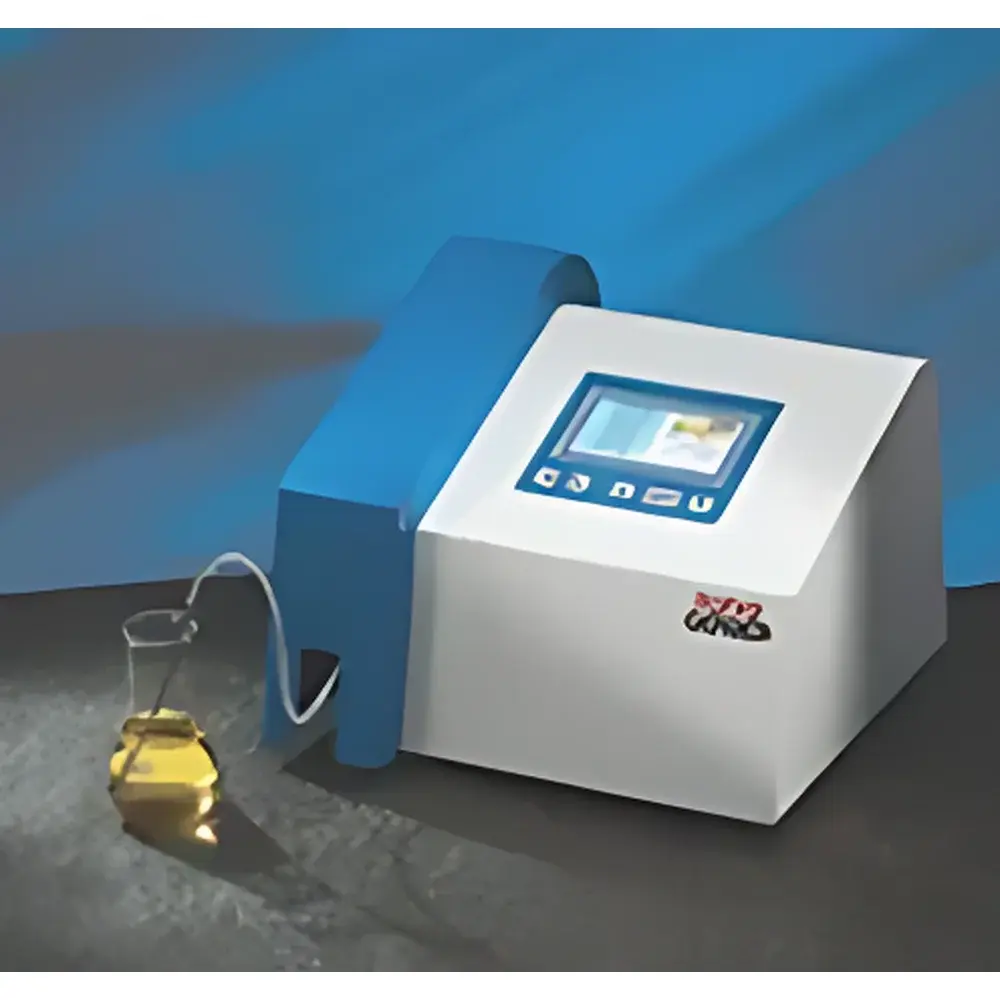
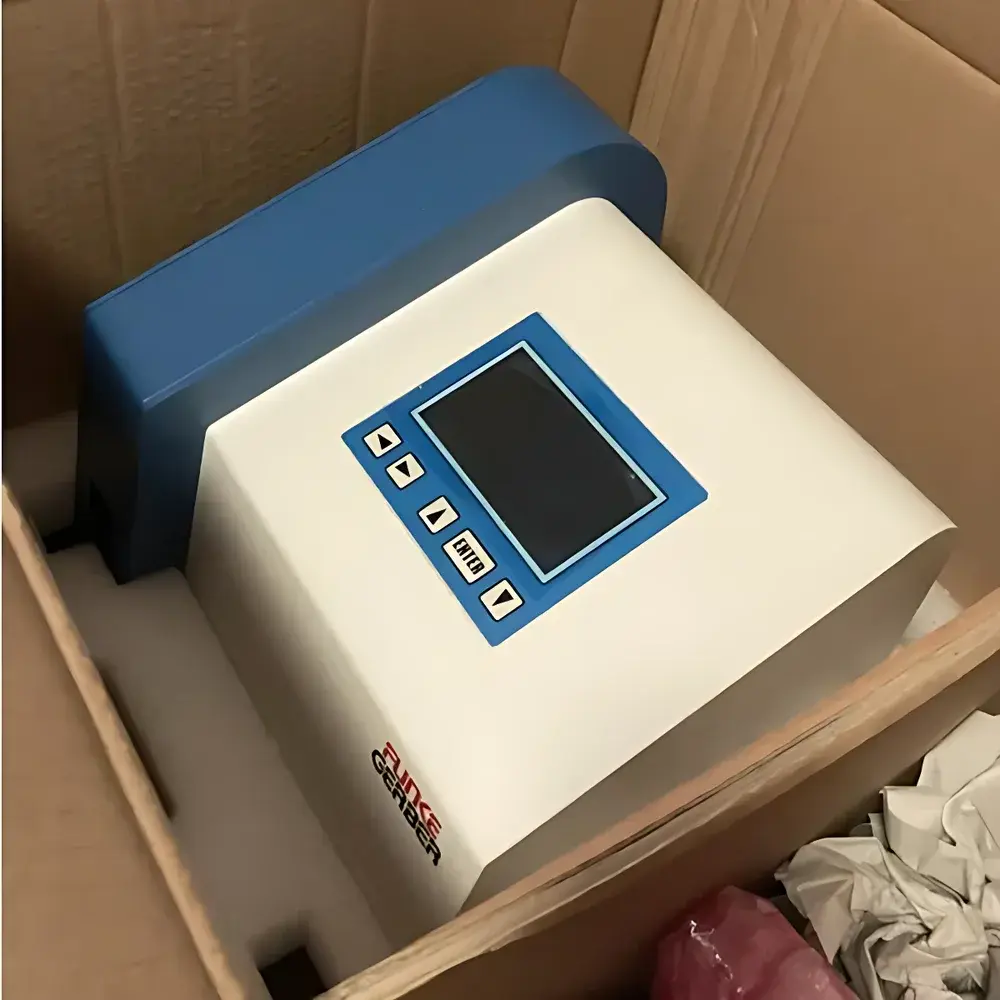
Funke Gerber FermentoFlash Beer Composition Analyzer
| Brand | Funke Gerber |
|---|---|
| Origin | Germany |
| Model | FermentoFlash |
| Instrument Type | Dedicated Beer Analyzer |
| Application | Laboratory Use |
| Measurement Time | ~2 min (including sample loading) |
| Alcohol Content Range | 0.00–15.00 % v/v |
| pH Range | 0–14 |
| Dimensions (L × W × H) | 480 × 380 × 400 mm |
| Weight | 20 kg |
| Sample Volume | 12–20 mL (degassed beer) |
| Density Range | 0.95–1.05 g/cm³ |
| Original Wort Extract Range | 0–20 % w/w |
| Real Extract Range | 0–10 % w/w |
| Apparent Extract Range | 0–10 % w/w |
| Calibration Reference Storage | Up to 20 reference beer profiles |
Overview
The Funke Gerber FermentoFlash Beer Composition Analyzer is a fully integrated, benchtop analytical system engineered for rapid, standardized quantification of key compositional parameters in finished beer and related fermented beverages. Based on dual-mode physical measurement principles—density determination via oscillating U-tube densitometry and pH assessment via calibrated glass electrode—the FermentoFlash delivers simultaneous, traceable results for alcohol content (% v/v), original wort extract (°P), real extract, apparent extract, and density (g/cm³). Its design adheres to internationally recognized brewing metrology standards, including ISO 15514 (beer analysis), EBC Analytica Chapter 9 (alcohol determination), and ASBC Methods of Analysis Section 7 (extract and alcohol). The analyzer operates without reagents or consumables beyond routine calibration references, making it suitable for high-throughput quality control laboratories operating under GLP or brewery-specific QA/QC protocols.
Key Features
- Simultaneous multi-parameter output within ≈2 minutes per sample—including alcohol, original wort extract, real extract, apparent extract, density, and pH—following simple degassing and manual pipetting.
- Large backlit LCD display with intuitive menu navigation; all results visible in real time without external software dependency.
- Integrated thermal printer (standard) provides immediate hardcopy reports with timestamp, sample ID, and operator code fields.
- RS232 serial interface enables direct data export to LIMS, Excel, or custom QA databases; supports ASCII protocol for seamless integration into existing laboratory IT infrastructure.
- Onboard memory stores up to 20 pre-defined reference beer profiles (e.g., Pilsner, Weizen, Stout, Bock), enabling matrix-matched calibration for improved accuracy across diverse beer styles.
- Self-diagnostic routines monitor sensor stability, temperature drift, and cell cleanliness; audible and visual alerts indicate maintenance requirements or out-of-spec conditions.
- Robust mechanical architecture with corrosion-resistant fluid path components ensures long-term reliability in humid, CO₂-rich brewery lab environments.
Sample Compatibility & Compliance
The FermentoFlash is validated exclusively for degassed, clarified beer samples—filtered or centrifuged to remove yeast and particulates. It is not intended for unfermented wort, non-alcoholic malt beverages, or high-viscosity craft variants containing suspended hop oils or haze-stabilizing polymers. All measurements comply with the metrological traceability chain defined in ISO/IEC 17025:2017. Calibration is performed using certified reference beers traceable to national metrology institutes (e.g., PTB Germany). The instrument meets CE marking requirements for electromagnetic compatibility (2014/30/EU) and low-voltage safety (2014/35/EU). While not FDA 21 CFR Part 11–validated out-of-the-box, its audit trail functionality (via printed logs and RS232 timestamps) supports alignment with GMP documentation practices when paired with procedural controls.
Software & Data Management
No proprietary PC software is required for basic operation. All configuration, calibration, and result review occur via the embedded firmware interface. However, raw ASCII output over RS232 includes structured fields: Sample_ID, Date_Time, Alcohol_%, OWE_%, Density_gcm3, pH, Operator_Code, and Calibration_Status. This facilitates automated parsing in third-party QA platforms. Optional CSV log export (via external terminal emulator or Python script) enables batch statistical analysis—e.g., Shewhart X̄-R charts for alcohol consistency across production runs. Audit-ready records include calibration history (date, reference beer ID, deviation values) and system self-test logs, retained for ≥12 months in non-volatile memory.
Applications
- Final product release testing in commercial breweries and contract manufacturing facilities.
- Batch-to-batch consistency monitoring during packaging line validation.
- Raw material verification (e.g., confirming alcohol yield vs. predicted attenuation).
- Research-scale fermentation profiling in pilot brewhouses and university brewing programs.
- Contract lab service reporting compliant with EBC or IOB certification requirements.
- Troubleshooting off-spec batches by cross-referencing alcohol/extract ratios against expected attenuation curves.
FAQ
What sample preparation is required prior to analysis?
Beer must be thoroughly degassed (via vacuum or gentle agitation followed by settling) and filtered (0.45 µm) to eliminate CO₂ bubbles and suspended solids that interfere with density cell oscillation and pH electrode response.
Can the FermentoFlash measure non-beverage alcoholic solutions (e.g., ethanol/water standards)?
No. Its calibration algorithms and density–alcohol correlation models are empirically derived from >200 commercial beer matrices and are not valid for pure ethanol dilutions or spirits.
Is routine recalibration necessary between samples?
No. A single daily calibration using one stored reference beer profile suffices for ≤50 samples, provided ambient temperature remains stable (±2 °C) and the density cell is cleaned after every 10th analysis.
Does the instrument support automatic sample introduction?
No. Sample loading is manual via supplied pipette and connection tube; autosamplers are not compatible with this model.
How is compliance with ISO 15514 verified during operation?
The built-in density module is factory-certified to ±0.0005 g/cm³ accuracy at 20 °C, and alcohol calculation uses the official EBC polynomial (based on density and temperature), ensuring full method equivalence to Clause 5.2 of ISO 15514.



