
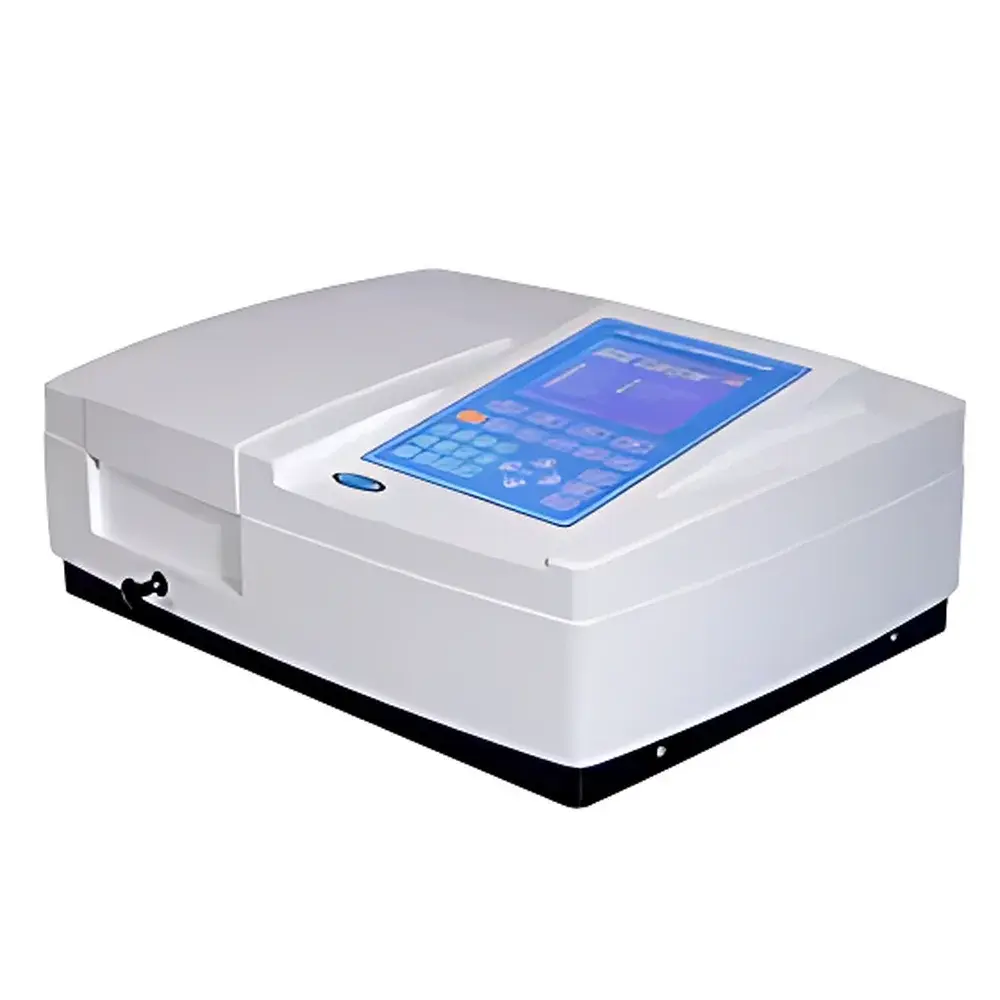
UV-6000PC Ultraviolet-Visible Spectrophotometer by Jihepu
| Brand | Jihepu |
|---|---|
| Model | UV-6000PC |
| Optical System | Double-beam |
| Detector | Photodiode Array (PDA) |
| Wavelength Range | 190–1100 nm |
| Spectral Bandwidth | 1.8 nm |
| Wavelength Accuracy | ±0.5 nm |
| Wavelength Repeatability | ≤0.2 nm |
| Photometric Accuracy | ±0.3% T |
| Photometric Repeatability | ≤0.15% T |
| Stray Light | ≤0.05% T |
| Baseline Flatness | ±0.001 A |
| Drift | ±0.001 A/h at 500 nm |
| Noise Level | ±0.0005 A |
| Photometric Range | 0–200% T, –0.3 to 3 A, 0–9999 C |
| Data Interface | USB |
| Display | 320 × 240 pixel LCD (6-inch high-brightness) |
| Light Sources | Imported long-life tungsten and deuterium lamps |
| Dimensions | 460 × 380 × 180 mm |
| Weight | 20 kg |
| Power Supply | AC 220 V/50 Hz or 110 V/60 Hz |
Overview
The UV-6000PC Ultraviolet-Visible Spectrophotometer is a double-beam, microprocessor-controlled analytical instrument engineered for precision absorbance, transmittance, and concentration measurements across the ultraviolet, visible, and near-infrared spectral regions (190–1100 nm). Its optical architecture employs a suspended optical bench design—rigidly mounted on an 8 mm machined aluminum baseplate—to isolate the light path from mechanical deformation and ambient vibration, ensuring long-term photometric stability essential for regulated laboratory environments. The system utilizes a synchronous sine-bar drive mechanism for wavelength selection, delivering high positional fidelity and repeatability (≤0.2 nm), while a 24-bit high-speed analog-to-digital converter enables fine-resolution signal digitization with low noise (±0.0005 A) and minimal drift (±0.001 A/h at 500 nm). Paired with imported deuterium and tungsten-halogen lamps and a photodiode array detector, the UV-6000PC achieves a stray light level of ≤0.05% T—critical for accurate quantitation of highly absorbing samples and low-transmittance applications in pharmaceutical, environmental, and biochemical analysis.
Key Features
- Double-beam optical configuration with real-time reference beam correction for enhanced baseline stability and reduced lamp intensity drift effects
- Suspended optical system mounted on a precision-machined, vibration-damping aluminum baseplate (8 mm thickness)
- High-fidelity wavelength drive using synchronized sine-bar mechanics, ensuring ≤0.2 nm repeatability and ±0.5 nm absolute accuracy
- Photodiode array (PDA) detection enabling rapid full-spectrum acquisition without moving parts
- 1.8 nm spectral bandwidth optimized for resolution/sensitivity balance per ICH Q2(R2) and USP guidelines
- ARM-based embedded control system with intuitive 320 × 240 pixel, 6-inch high-brightness LCD interface
- Comprehensive onboard functionality: photometric measurement, quantitative analysis (single/multi-point calibration), kinetic scanning, multi-wavelength analysis, DNA/protein A260/A280 ratio calculation, and spectral scanning
- Integrated USB port for data export; parallel port for direct printer connectivity
Sample Compatibility & Compliance
The UV-6000PC accommodates standard 10 mm rectangular quartz or glass cuvettes (including matched pairs for double-beam referencing), as well as optional micro-volume adapters (e.g., 50 µL pathlength) and fiber-optic probes for non-contact or flow-cell applications. Its photometric performance meets key international standards including ISO 9001:2015 (quality management), ASTM E275–22 (standard practices for spectrophotometer characterization), and EU Pharmacopoeia 2.2.25 (UV-Vis spectrophotometric assay validation). While not inherently 21 CFR Part 11 compliant out-of-the-box, the instrument supports audit-trail-capable PC software that can be configured to meet GLP/GMP documentation requirements—including user access control, electronic signatures, and immutable data logging—when deployed within validated laboratory workflows.
Software & Data Management
The UV-6000PC ships with dedicated spectral acquisition and analysis software compatible with Windows OS. This application extends instrument capabilities beyond standalone operation, enabling advanced processing such as spectral subtraction, peak integration, derivative spectroscopy, and custom calibration curve generation (linear, quadratic, or 4-/5-parameter logistic). All raw spectral data are stored in vendor-neutral ASCII format (.csv), facilitating import into third-party platforms (e.g., MATLAB, OriginLab, or LIMS systems). The software maintains full traceability: each measurement record includes timestamp, operator ID, instrument serial number, lamp usage hours, and full parameter metadata. Data backups and versioned method files support revision control aligned with ISO/IEC 17025 clause 7.7 (control of records).
Applications
- Pharmaceutical QC: Assay of active pharmaceutical ingredients (APIs), dissolution testing, excipient compatibility studies, and cleaning validation swab analysis
- Environmental monitoring: Quantification of nitrate, phosphate, COD, and heavy metal complexes (e.g., Cr(VI) via diphenylcarbazide method)
- Life sciences: Nucleic acid quantification (A260), protein concentration (A280, BCA, Bradford), enzyme kinetics (NADH/NADPH assays), and cell culture density estimation
- Food & beverage: Colorimetric determination of antioxidants (e.g., polyphenols), preservatives (sulfites), and adulterants (melamine detection via complexation)
- Academic research: Teaching fundamental spectroscopic principles, method development, and validation per ICH Q2(R2) and AOAC guidelines
FAQ
What is the maximum scan speed supported in spectral scanning mode?
The UV-6000PC acquires full 190–1100 nm spectra in approximately 12 seconds at 1 nm data interval, leveraging its fixed PDA detector and optimized optical throughput.
Can the instrument perform kinetic measurements over extended time periods?
Yes—kinetic mode supports up to 9,999 data points with user-defined time intervals ranging from 0.1 s to 600 s, suitable for monitoring slow enzymatic reactions or degradation profiles.
Is wavelength calibration traceable to NIST standards?
The instrument includes built-in holmium oxide and didymium filters for routine verification; users may perform NIST-traceable recalibration using certified reference materials (e.g., NIST SRM 2034) following ASTM E275–22 procedures.
Does the software support multi-user permission levels?
The PC software allows creation of operator, supervisor, and administrator roles with configurable access rights to methods, results, and system settings—enabling compliance with role-based access control requirements in regulated labs.
What maintenance is required to sustain photometric accuracy?
Routine maintenance includes quarterly lamp alignment verification, biannual cleaning of optical windows and cuvette compartment, and annual performance qualification (PQ) using certified neutral density filters and wavelength standards per ISO/IEC 17025 Annex A.3.





