
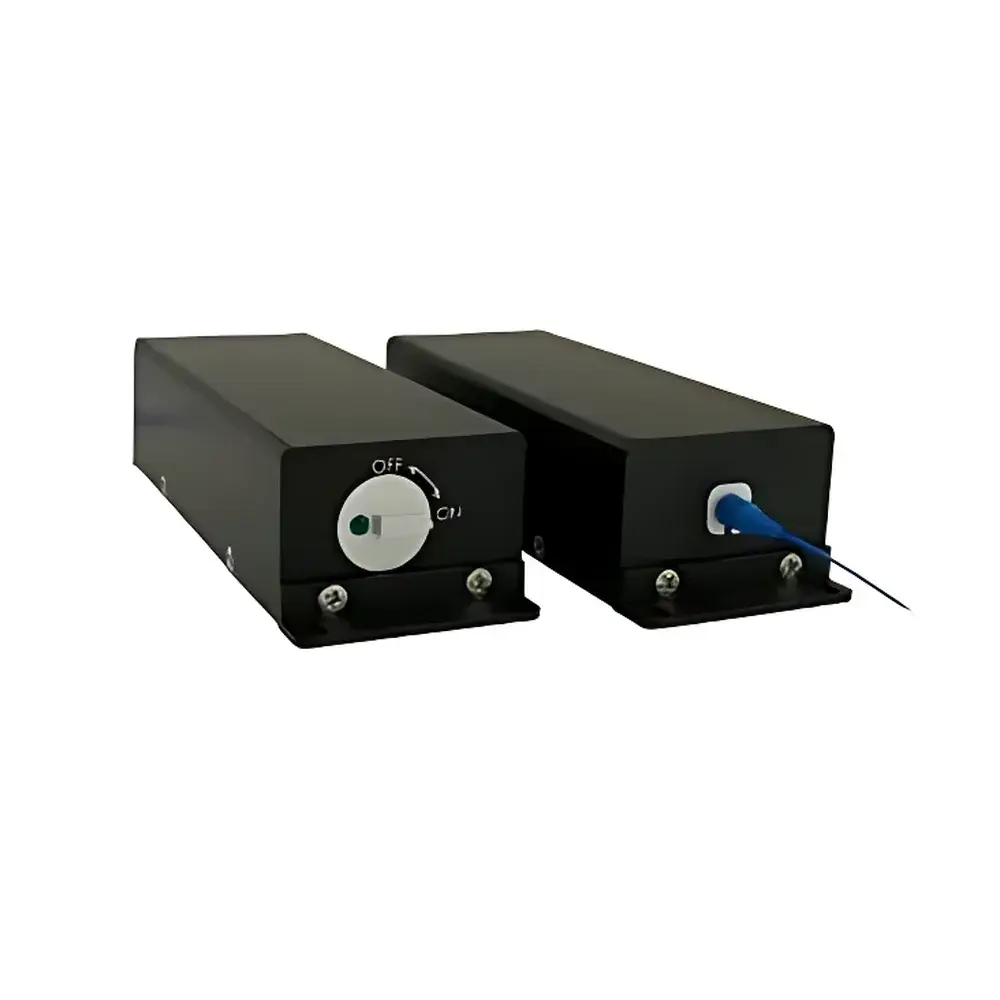
Longcai HCP+PPLN Bulk Frequency Conversion Module
| Brand | Longcai Technology / HCP |
|---|---|
| Origin | Taiwan |
| Manufacturer Type | Authorized Distributor |
| Product Category | Domestic (Taiwan-based) |
| Model | PPLN Bulk Mixers |
| Pricing | Available Upon Request |
Overview
The Longcai HCP+PPLN Bulk Frequency Conversion Module is a turnkey, engineered solution for nonlinear optical frequency conversion based on periodically poled lithium niobate (PPLN) crystal technology. Designed around quasi-phase-matching (QPM) principles, the module enables efficient second-harmonic generation (SHG), sum-frequency generation (SFG), difference-frequency generation (DFG), and cascaded processes (e.g., SHG-SFG for third-harmonic generation) across ultraviolet (UV), visible (VIS), near-infrared (NIR), and mid-infrared (MIR) spectral bands. Unlike discrete crystal mounts requiring alignment-intensive optical setups, this module integrates the PPLN crystal within a thermally stabilized, mechanically rigid housing—optimized for specific pump laser wavelengths, polarization states, and beam parameters. Its core architecture supports both free-space and fiber-coupled configurations, delivering polarization-maintaining (PM) output with high spatial mode fidelity and long-term thermal drift stability. The module is intended for integration into OEM instrumentation—including confocal and multiphoton microscopes, atomic physics apparatus (e.g., magneto-optical traps, optical lattices), quantum optics testbeds, and precision spectroscopy platforms—where compactness, reproducibility, and low maintenance are critical operational requirements.
Key Features
- Optimized single-channel design with >75% typical coupling efficiency into single-mode polarization-maintaining (PM) fiber (SM-PANDA or PM980); higher-efficiency coupling available upon request
- Thermally controlled QPM operation via integrated thermistor and TEC (thermoelectric cooler), enabling precise temperature tuning (±0.1 °C stability) for wavelength fine-adjustment and phase-matching optimization
- Optional built-in photodiode (PD) for real-time output power monitoring and closed-loop automatic power control (APC)
- Flexible input/output interface options: 1×0 (free-space in, free-space out), 1×1 (fiber in, fiber out), 2×0 (dual free-space inputs), 2×1 (dual free-space inputs, fiber output), etc.—with collimated free-space beams configurable to standard beam diameters (e.g., 1.0 mm or 2.0 mm 1/e²)
- Wavelength tolerance ≤ ±0.5 nm for standard SHG configurations; custom phase-matching poling periods and crystal lengths available for non-standard target wavelengths
- Robust aluminum alloy housing with kinematic mounting features, designed for vibration-insensitive operation in laboratory and industrial environments
Sample Compatibility & Compliance
The module accepts continuous-wave (CW) or pulsed pump sources with repetition rates up to 100 MHz and pulse widths ≥100 fs (for ultrafast applications, dispersion compensation may be required upstream). Compatible pump beam qualities include M² 20 dB, and input power ranges from 100 mW to >5 W depending on configuration. All PPLN crystals are fabricated using semiconductor-grade photolithographic poling techniques and undergo full spectral characterization (phase-matching bandwidth, acceptance angle, damage threshold verification) per batch. The module complies with IEC 61000-6-3 (EMC emission limits) and meets RoHS Directive 2011/65/EU material restrictions. For regulated environments (e.g., GLP/GMP-compliant labs), optional documentation packages—including calibration certificates traceable to NIST standards, IQ/OQ protocols, and 21 CFR Part 11–compatible software audit logs—are available upon request.
Software & Data Management
While the base module operates in standalone analog mode, optional digital control interfaces (USB-C or RS-485) enable integration with LabVIEW, Python (PyVISA), or MATLAB environments. Firmware supports programmable temperature setpoints, PD gain scaling, and alarm thresholds for over-temperature or power-drop events. All operational parameters—including actual crystal temperature, setpoint deviation, monitored output power, and TEC current—are logged at user-defined intervals (1–10 Hz) and exportable as CSV or HDF5 files. Audit trails record all parameter changes with timestamps and operator IDs when used with compliant host software—supporting traceability requirements under ISO/IEC 17025 and FDA 21 CFR Part 11.
Applications
- Laser scanning microscopy: Generation of 355 nm (UV), 532 nm (green), and 780 nm (NIR) excitation lines for multi-modal imaging
- Atomic, molecular, and optical (AMO) physics: Precise 765–795 nm tunable output for rubidium D₁-line cooling and trapping
- Quantum photonics: Pump-seed synchronization for SPDC-based entangled photon pair generation
- Gas sensing: DFG-based MIR output (e.g., 3–5 µm) for absorption spectroscopy of hydrocarbons and greenhouse gases
- Industrial metrology: Stable, narrow-linewidth visible sources for interferometric displacement measurement systems
FAQ
What pump laser specifications are required for optimal SHG performance?
Typical requirements include TEM₀₀ spatial mode, linear polarization aligned to the crystal’s extraordinary axis, and M² < 1.2. CW powers from 500 mW to 5 W and pulse energies ≥10 µJ (at 10 kHz–100 MHz) are supported—exact compatibility depends on selected configuration.
Can the module be customized for non-standard wavelengths?
Yes. Custom poling periods, crystal lengths, AR coatings (R < 0.2% per surface), and thermal management profiles can be specified during order placement.
Is vacuum or inert-gas purging supported?
Standard modules operate in ambient air; hermetic sealing with nitrogen purge or vacuum-compatible versions (CF flange interface) are available as engineering options.
What is the expected lifetime under continuous operation?
Based on accelerated aging tests at 40 °C and 80% RH, median operational lifetime exceeds 20,000 hours with <5% degradation in conversion efficiency—subject to proper thermal management and pump beam quality.
Do you provide optical alignment support for integration?
Yes. Comprehensive integration guides—including beam height maps, collimation recommendations, and fiber coupling alignment procedures—are provided with each unit. Remote technical assistance is available during commissioning.



