
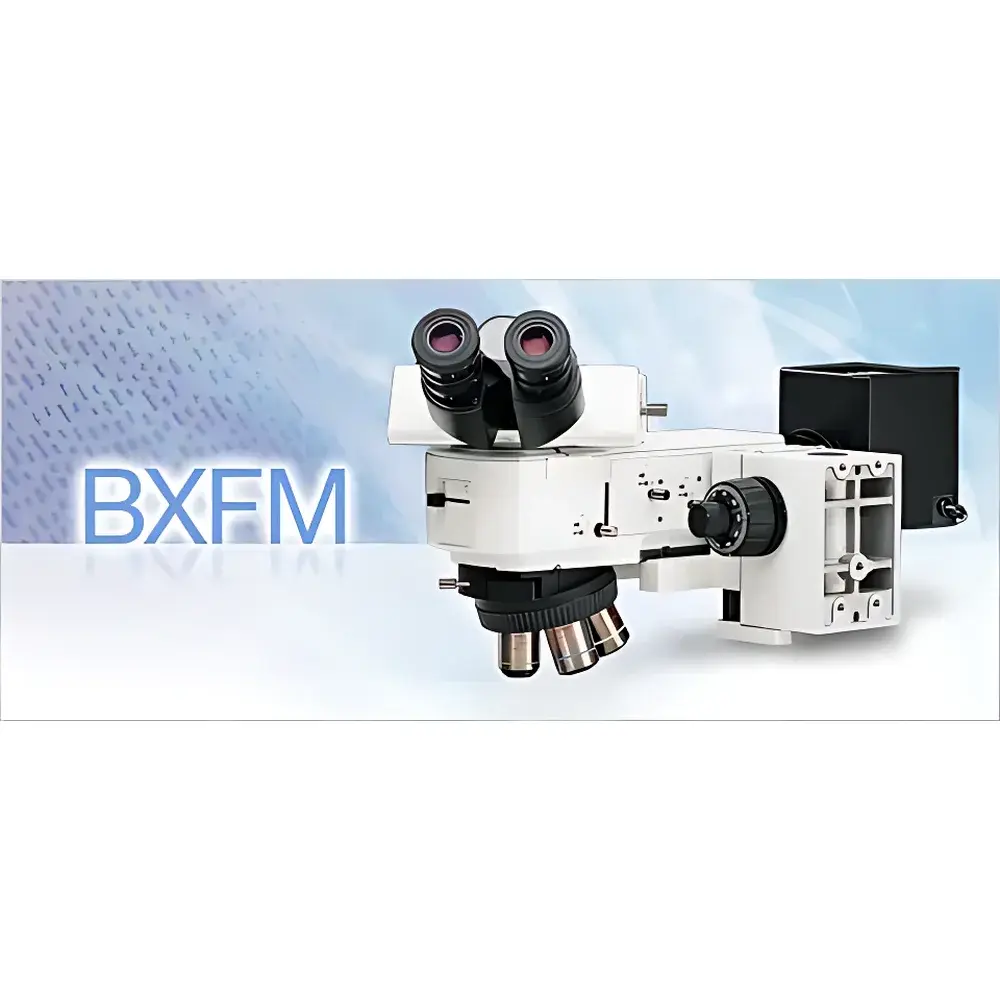
OLYMPUS BXFM Compact System Microscope
| Brand | Olympus |
|---|---|
| Origin | Japan |
| Model | BXFM |
| Light Source Options | Halogen Lamp or Fiber-Optic Illumination |
| Observation Modes | Brightfield, Darkfield, Differential Interference Contrast (DIC), Simple Polarization, Fluorescence |
| Optional Accessories | Motorized Nosepiece, Digital Imaging System |
| Optical Platform | UIS2 Infinity-Corrected Optics |
| Design Type | Compact, Modular System Microscope |
Overview
The OLYMPUS BXFM Compact System Microscope is an engineered solution for laboratories requiring high optical fidelity and multi-modal imaging capability within a space-efficient footprint. Built upon Olympus’ proven UIS2 infinity-corrected optical system, the BXFM delivers consistent wavefront accuracy and chromatic correction across all observation modes—brightfield, darkfield, differential interference contrast (DIC), simple polarization, and fluorescence. Its compact mechanical architecture integrates seamlessly into regulated environments including QC labs, university core facilities, and industrial R&D settings where benchtop real estate is constrained but analytical rigor is non-negotiable. Unlike conventional upright microscopes, the BXFM’s modular design permits functional expansion without compromising mechanical stability or optical alignment integrity. The system adheres to ISO 10934-1 (optical microscopy terminology) and complies with JIS B 7151 (Japanese Industrial Standard for microscope performance testing), ensuring traceable optical performance under routine operational conditions.
Key Features
- UIS2 optical platform delivering high NA, low-aberration imaging across 4× to 100× magnifications with standardized parfocal distance (45 mm)
- Dual illumination pathways: integrated 12 V/100 W halogen illuminator for brightfield/DIC/polarization; fiber-optic coupling port for external cold-light sources in fluorescence and darkfield applications
- Modular nosepiece interface supporting both manual and motorized 6-position objective turrets—enabling automated acquisition workflows and repeatable objective switching
- Pre-aligned condenser system with centerable aperture and field diaphragms optimized for Köhler illumination in brightfield and critical alignment in DIC
- Fluorescence-ready configuration with standardized filter cube slots (e.g., U-MWIB3, U-MWIG3), excitation/emission dichroic compatibility, and optional LED-based illumination modules meeting IEC 62471 photobiological safety requirements
- Stainless-steel mechanical stage with vernier-calibrated X–Y translation (76 × 52 mm travel), ergonomic coaxial controls, and optional motorized stage integration for tiled imaging
Sample Compatibility & Compliance
The BXFM accommodates standard 24 × 60 mm and 26 × 76 mm microscope slides, as well as petri dishes (up to 100 mm diameter) via optional stage adapters. It supports live-cell observation using temperature-controlled stage inserts (20–40 °C range) and CO₂-compatible environmental chambers. All optical components comply with RoHS Directive 2011/65/EU and are manufactured under ISO 9001-certified production processes. For regulated environments, the system supports audit-ready documentation packages aligned with GLP (Good Laboratory Practice) and GMP (Good Manufacturing Practice) frameworks. When integrated with Olympus cellSens software (v3.0+), full 21 CFR Part 11 compliance—including electronic signatures, audit trails, and user access control—is achievable through validated configuration.
Software & Data Management
The BXFM is fully compatible with Olympus cellSens digital imaging software, which provides quantitative image analysis (e.g., particle counting, intensity profiling, Z-stack reconstruction), time-lapse acquisition scheduling, and metadata embedding per DICOM Supplement 146 standards. Raw image data is stored in TIFF or OIR (Olympus Image Repository) format, preserving bit-depth fidelity (12–16 bit) and spatial calibration. Software licenses support network deployment, centralized license management, and role-based permissions. Export functions include CSV reports for measurement logs, PDF annotation exports, and direct integration with LIMS platforms via HL7 or RESTful API adapters. All software updates undergo internal validation per IQ/OQ protocols prior to release.
Applications
- Materials science: Grain boundary analysis in metallurgical samples using polarized light and DIC
- Pharmaceutical QA: Identification of crystalline polymorphs and foreign particulate matter per USP and
- Clinical cytology: Routine cervical smear screening under brightfield and rapid immunofluorescence verification
- Electronics inspection: Solder joint morphology assessment and PCB trace defect mapping at 200×–500× effective magnification
- Academic research: Time-resolved phase-contrast imaging of zebrafish embryogenesis with synchronized motorized Z-drive and multi-channel fluorescence capture
FAQ
Is the BXFM suitable for regulatory submissions in pharmaceutical manufacturing?
Yes—when configured with cellSens software v3.3+, validated accessories, and documented IQ/OQ/PQ protocols, the BXFM meets requirements for analytical instrumentation used in GMP environments.
Can the BXFM be upgraded to support confocal imaging?
No—the BXFM is a widefield platform; confocal functionality requires the Olympus FV series laser scanning systems. However, it serves as an ideal pre-screening tool prior to high-resolution confocal acquisition.
What is the maximum working distance supported for long-working-distance objectives?
The BXFM accepts all UIS2 LWD objectives, including the 20×/0.40 (WD = 8.2 mm) and 50×/0.55 (WD = 7.5 mm) variants, enabling observation of thick or covered samples without stage collision.
Does Olympus provide service contracts with SLA-backed response times?
Yes—global field service coverage includes Platinum, Gold, and Silver tiers with 4-, 8-, or 24-hour on-site response windows, remote diagnostics, and annual preventive maintenance visits.



