
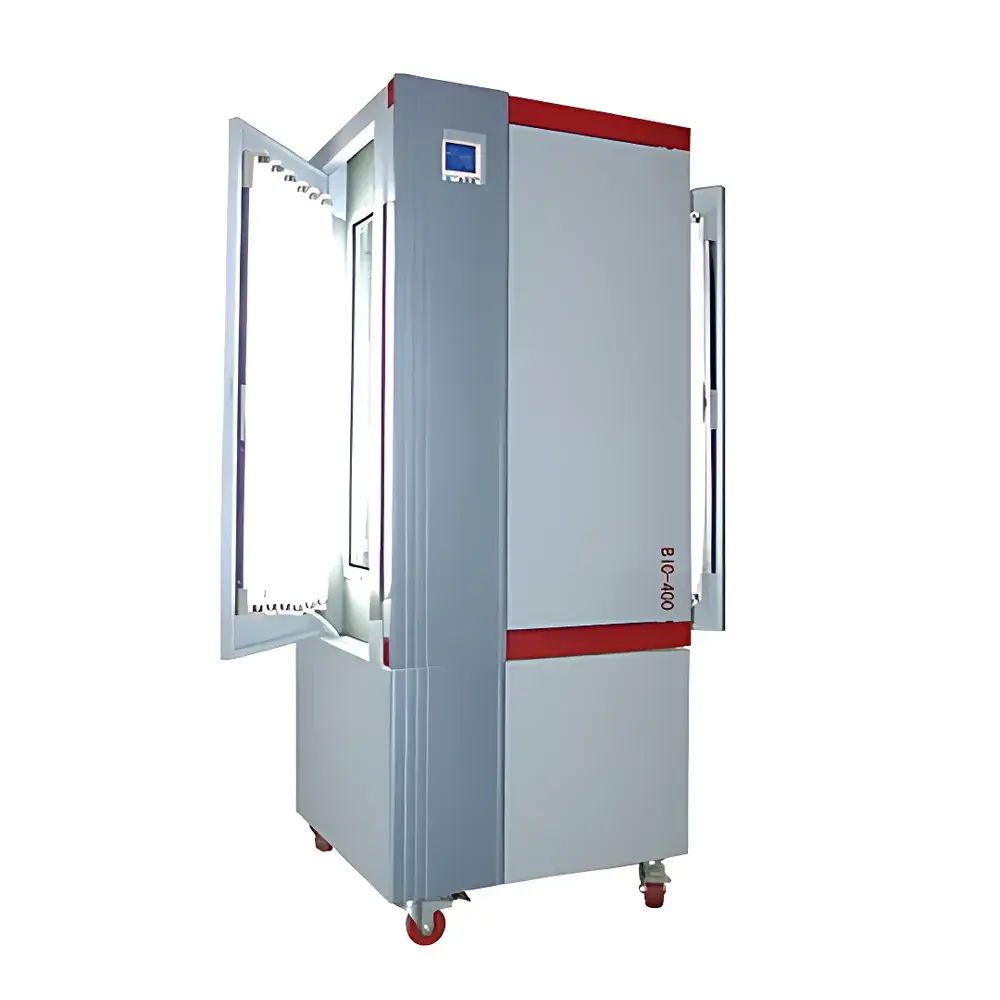
HePu BIC-300 Integrated Drug Stability Testing Chamber (Environmental Stress Chamber for ICH Q1–Q5 Compliance)
| Brand | HePu |
|---|---|
| Origin | Shandong, China |
| Model | BIC-300 |
| Temperature Range (Dark) | 0–60°C |
| Temperature Range (Illuminated) | 10–60°C |
| Temperature Resolution | 0.1°C |
| Temperature Uniformity | ±1°C |
| Temperature Fluctuation | ±0.5°C |
| Humidity Range | 60–90% RH |
| Humidity Fluctuation | ±5% RH |
| Illuminance Range | 0–15,000 lx (6-step adjustable) |
| Airflow Design | Vertical laminar + vertical convection circulation |
| Inner Chamber Dimensions (W×D×H) | 540 × 520 × 1100 mm |
| External Dimensions (W×D×H) | 770 × 815 × 1770 mm |
| Shelf Capacity | 4 adjustable stainless-steel shelves |
| Power Input | 1900 W |
| Timer Range | 0–9999 min |
| Communication Interface | RS-485 |
| Refrigerant | Eco-friendly non-CFC refrigerant |
| Defrost Method | Energy-free automated defrosting |
| Programmability | 30 segments × 99 cycles |
| Data Protection | Power-fail memory retention with auto-recovery |
Overview
The HePu BIC-300 Integrated Drug Stability Testing Chamber is a purpose-built environmental stress chamber engineered to meet the rigorous requirements of pharmaceutical stability testing under ICH Q1A(R2), Q1B, Q1C, Q5C, and related regulatory frameworks. It operates on a dual-mode climate control principle—combining precision thermoelectric regulation, high-fidelity humidity generation via finned electric heating tubes, and spectrally stable illumination—to replicate defined storage conditions including long-term (25°C/60% RH), accelerated (40°C/75% RH), and intermediate (30°C/65% RH) test environments. Unlike general-purpose incubators, the BIC-300 integrates calibrated illumination as a functional parameter—not merely an accessory—enabling photostability assessments per ICH Q5C without external light cabinets. Its structural architecture features a mirror-finish stainless-steel interior, cold-rolled steel outer casing with electrostatic powder coating, and a patented integrated refrigeration system designed for continuous operation over extended durations (>180 days) without performance drift or manual intervention.
Key Features
- Microprocessor-based PID control system with 7-inch color LCD interface (optional upgrade), supporting real-time monitoring of temperature, relative humidity, illuminance, and elapsed time
- Vertical laminar airflow combined with vertical convection circulation ensures spatial uniformity: ≤±1°C temperature deviation and ≤±5% RH deviation across all shelf levels (validated per ISO 14644-1 Class 8 protocols)
- Patented energy-free automated defrosting eliminates thermal disturbance during frost accumulation cycles—critical for uninterrupted stability studies requiring uninterrupted temperature profiles
- Three-stage programmable illumination system (0–15,000 lx, six discrete levels) with three-dimensional lighting layout achieves ≥90% illuminance uniformity across 90% of shelf surface area (per ICH Q5C Annex 2 methodology)
- High-capacity external water reservoir (≥8 L) paired with imported capacitive humidity sensors enables >120 h of unattended humidification at 90% RH
- RS-485 serial interface compliant with Modbus RTU protocol supports integration into centralized laboratory data acquisition networks and LIMS systems
- Power-loss recovery function retains all setpoints and runtime parameters; automatic resumption upon grid restoration without manual reconfiguration
Sample Compatibility & Compliance
The BIC-300 accommodates standard pharmaceutical packaging formats—including blister packs, HDPE bottles, glass vials, and aluminum-laminated pouches—across four independently adjustable stainless-steel shelves (max. load: 25 kg/shelf). Its chamber geometry and airflow dynamics have been validated using ASTM E2234-22 thermal mapping procedures, confirming compliance with USP , EP 2.2.45, and WHO TRS 1010 Annex 7 requirements for stability storage chambers. All firmware and hardware configurations support audit trail generation, electronic signature capability (when paired with compliant third-party software), and full traceability in alignment with FDA 21 CFR Part 11 and EU Annex 11 expectations for GxP-regulated environments.
Software & Data Management
While the BIC-300 operates autonomously via its embedded controller, optional RS-485 connectivity enables bidirectional communication with validated PC-based platforms such as LabArchives ELN or custom SCADA deployments. Data logging intervals are configurable from 1 minute to 60 minutes; logged parameters include chamber setpoint, actual temperature/humidity/illuminance, compressor duty cycle, and alarm event timestamps. Optional printer module supports real-time trend curve output (temperature vs. time, humidity vs. time) on thermal paper compliant with ISO/IEC 17025 documentation standards. For remote oversight, GPRS-enabled alert modules transmit SMS notifications upon threshold breaches (e.g., T > 60.5°C, RH < 55%)—configurable per user-defined severity tiers.
Applications
- ICH-compliant long-term, accelerated, and stress-condition stability studies for APIs and finished dosage forms
- Photostability testing per ICH Q5C under Option 1 (open container) and Option 2 (closed container) protocols
- Excipient compatibility screening under controlled hygrothermal stress
- Package integrity evaluation under cyclic humidity exposure (e.g., 75% RH ↔ 30% RH transitions)
- Biological product storage condition qualification (e.g., 2–8°C hold verification with humidity control)
- Method suitability testing for dissolution, assay, and impurity profiling under variable environmental baselines
FAQ
Does the BIC-300 comply with ICH Q1A(R2) temperature and humidity tolerances?
Yes—the chamber maintains ±0.5°C temperature fluctuation and ±5% RH fluctuation under steady-state conditions, satisfying ICH’s ±2°C and ±5% RH acceptance criteria for stability chambers.
Can humidity be maintained below 60% RH?
No—the BIC-300 is optimized for the 60–90% RH range required by ICH accelerated testing; sub-60% RH operation is not supported due to condensation risk mitigation design.
Is the illumination spectrum documented for photostability testing?
The LED array emits broadband visible light (400–700 nm) with peak intensity at 550 nm; spectral distribution reports are available upon request for Q5C Option 1 validation.
What calibration certificates are supplied with delivery?
Each unit ships with factory calibration certificates for temperature (NIST-traceable Pt100 sensor), humidity (capacitive sensor), and illuminance (calibrated lux meter), valid for 12 months.
How is data integrity ensured during extended stability runs?
All logged data are stored in non-volatile memory with CRC-32 checksum validation; optional audit trail modules record operator actions, parameter changes, and alarm acknowledgments with timestamped digital signatures.





