
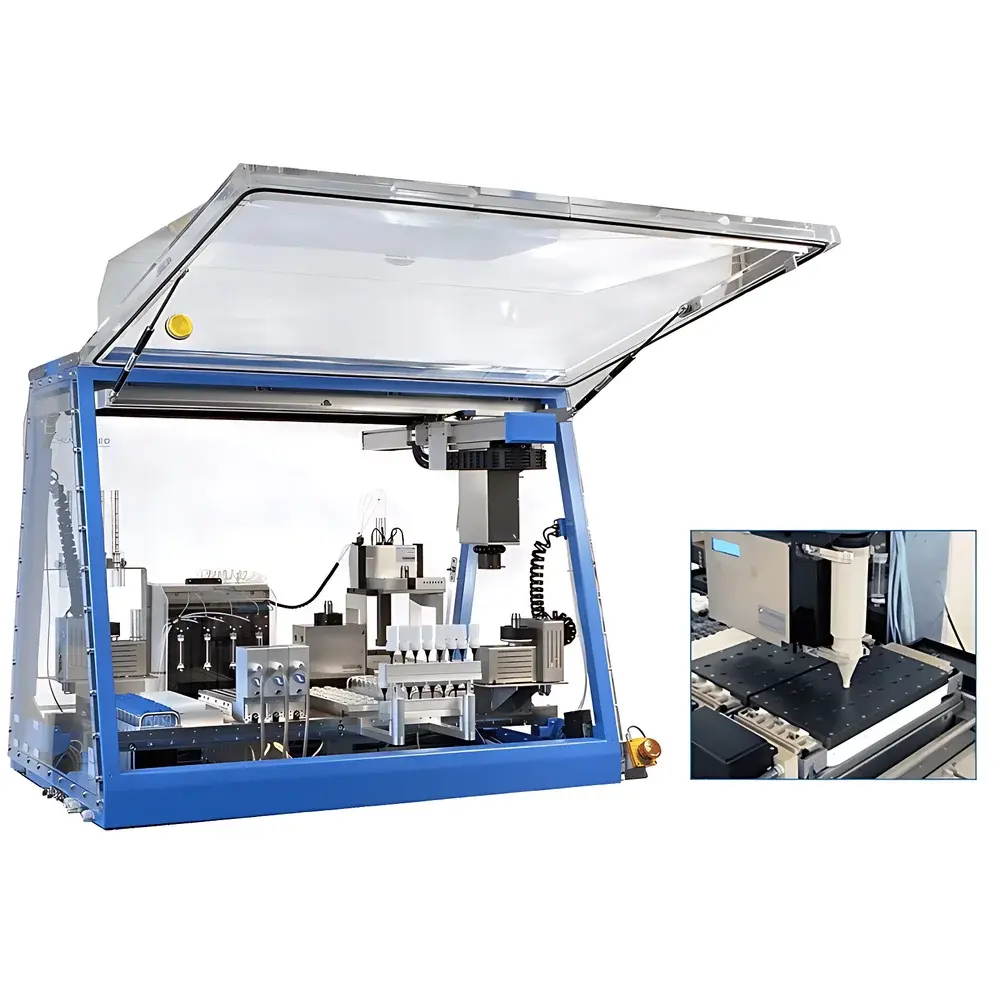
Chemspeed ISYNTH AI Automated Active Pharmaceutical Ingredient (API) Library Synthesis Platform
| Brand | Chemspeed |
|---|---|
| Origin | Switzerland |
| Model | ISYNTH AI |
| Configuration | Fully Integrated Benchtop Synthesis Platform with Inert Atmosphere & Top-Loading Precision Dispensing |
| Compliance | Designed for GLP/GMP-Ready Lab Environments |
| Software | Chemspeed AutoSuite v5.2 (FDA 21 CFR Part 11 Compliant Audit Trail, Electronic Signatures) |
Overview
The Chemspeed ISYNTH AI is a fully automated, benchtop-scale synthesis platform engineered for the parallel construction of diverse, high-value active pharmaceutical ingredient (API) libraries under rigorously controlled reaction conditions. Built upon Chemspeed’s proprietary top-loading gravimetric dispensing architecture, the system executes multi-step synthetic sequences—including reagent addition, heating/cooling, stirring, inert gas purging, reaction monitoring (via optional inline probes), workup, solid-phase or liquid–liquid extraction, filtration, solvent evaporation, and final product transfer to storage vials—without manual intervention. Its core measurement principle relies on real-time mass-based feedback control: solid and liquid reagents are dispensed directly into reaction vessels using high-resolution load cells (10–100 µg readability), eliminating volumetric uncertainty associated with pipetting or syringe-based delivery. This gravimetric approach ensures stoichiometric accuracy across heterogeneous reagent classes (e.g., air-sensitive organometallics, hygroscopic solids, viscous liquids), making it especially suited for C–C and C–N cross-coupling chemistries where precise equimolar control is critical to yield and impurity profile.
Key Features
- Top-loading gravimetric dispensing module with dual-range high-precision load cells (10 µg and 100 µg readability) for direct solid/liquid dosing into sealed or vented reaction vessels
- Integrated inert atmosphere management (N₂ or Ar) with automatic purge cycles, dew point monitoring, and glovebox-compatible chamber sealing for moisture- and oxygen-sensitive transformations (e.g., Grignard, lithiation, Pd-catalyzed couplings)
- Programmable temperature control from –40 °C to +150 °C per vessel using Peltier and resistive heating elements, with independent thermal zoning for parallel reactions under divergent conditions
- Modular reaction station supporting up to 48 parallel 1–20 mL vessels with magnetic stirring, reflux condensers, and optional in-situ FTIR or Raman probe integration
- Automated post-reaction processing: liquid–liquid phase separation, solid-phase extraction (SPE) cartridge handling, vacuum-assisted solvent removal, and precision aliquoting into 96-well plates or individual storage vials
- FDA 21 CFR Part 11–compliant AutoSuite software with electronic lab notebook (ELN) functionality, full audit trail, role-based access control, and SOP-driven workflow templating
Sample Compatibility & Compliance
The ISYNTH AI accommodates a broad spectrum of reagent physical states and reactivity profiles: free-flowing powders, crystalline hydrates, waxy solids, low-volatility oils, pyrophoric organometallic solutions, and cryogenically stabilized intermediates. Vessel materials include borosilicate glass, PTFE-coated stainless steel, and Hastelloy-C276 for corrosion resistance during halogenated or acidic reaction conditions. The platform conforms to ISO 14644-1 Class 5 cleanroom-compatible engineering standards and supports validation documentation packages aligned with ICH Q5, Q7, and USP Analytical Instrument Qualification guidelines. All hardware and software modules are designed to meet GLP and GMP readiness requirements, including instrument qualification (IQ/OQ/PQ), change control logs, and raw data integrity per ALCOA+ principles.
Software & Data Management
Chemspeed AutoSuite serves as the central orchestration engine, enabling graphical workflow design via drag-and-drop protocol builders. Users define reaction steps—including mass-triggered additions, temperature ramps, hold times, quench points, and conditional branching based on real-time weight gain or loss. All raw sensor data (mass, temperature, pressure, stir speed) are timestamped and stored in encrypted SQLite databases with SHA-256 hashing. Reports are exportable in PDF/A-2u or CSV format, and analytical metadata (e.g., HPLC peak area, MS scan IDs) can be linked via API to third-party LIMS or ELN systems (e.g., LabVantage, Benchling). Audit trails record every user action, parameter modification, and system event with immutable timestamps—fully compliant with FDA 21 CFR Part 11 Subpart B requirements for electronic records and signatures.
Applications
- High-throughput exploration of C–C bond-forming reactions: Suzuki, Heck, Stille, Negishi, and Buchwald–Hartwig couplings
- Organometallic synthesis and screening: Grignard, lithium–halogen exchange, and transmetalation protocols requiring strict anhydrous/anaerobic control
- Asymmetric alkylation and conjugate addition under cryogenic conditions (–30 °C to –10 °C)
- Diels–Alder cycloadditions with thermally labile dienophiles or inverse-demand variants
- Catalytic transfer hydrogenation using heterogeneous Pd/C or homogeneous Ru–chiral ligand complexes
- Iterative library expansion for hit-to-lead optimization, including late-stage functionalization and scaffold diversification
FAQ
Does the ISYNTH AI support fully unattended overnight operation?
Yes—once a validated workflow is loaded and vessels are staged, the system executes multi-hour sequences autonomously, including intermediate solid transfers, solvent swaps, and endpoint detection via mass stabilization.
Can it handle air-sensitive reagents such as t-BuLi or DIBAL-H?
Yes—the integrated inert gas manifold maintains <1 ppm O₂/H₂O during dispensing and reaction; all liquid handling paths are pre-purged, and reagent reservoirs feature septum-sealed, pressure-equalized caps.
Is method transfer from manual to automated synthesis straightforward?
AutoSuite includes a “manual mode replay” function that logs operator actions during bench-scale runs and auto-generates scalable digital protocols with mass-equivalent reagent mapping.
What level of analytical integration is supported?
The platform offers bidirectional API connectivity with Agilent OpenLab CDS, Thermo Chromeleon, and Waters Empower for automated injection scheduling and result ingestion; optional UV/Vis or conductivity probes enable real-time reaction progress tracking.
How is calibration traceability maintained?
All load cells are calibrated annually against NIST-traceable weights; temperature sensors are verified using certified dry-block calibrators; calibration certificates and deviation reports are archived within AutoSuite’s document management module.



