
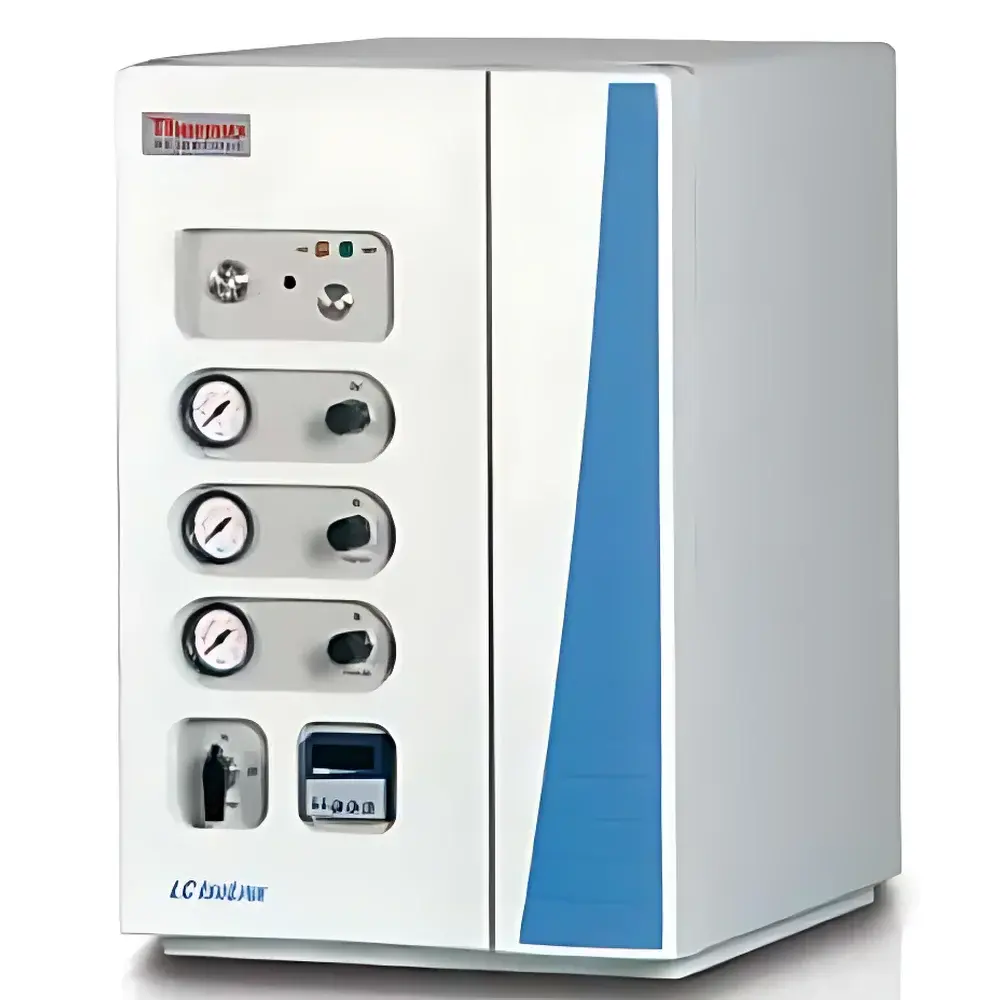
Thermo Fisher LC IsoLink Dedicated Liquid Chromatography Interface for Isotope Ratio Mass Spectrometry
| Brand | Thermo Fisher |
|---|---|
| Origin | Germany |
| Manufacturer Type | Original Equipment Manufacturer (OEM) |
| Import Status | Imported |
| Model | LC IsoLink |
| Instrument Category | Dedicated HPLC–IRMS Interface System |
| Measurement Precision | High-precision isotopic ratio detection (δ¹³C, δ²H, δ¹⁵N, δ¹⁸O achievable with <0.2‰ 1σ reproducibility under optimized conditions) |
Overview
The Thermo Fisher LC IsoLink is the world’s first commercially engineered, high-integrity online interface system designed to couple high-performance liquid chromatography (HPLC) with continuous-flow isotope ratio mass spectrometry (CF-IRMS). It enables compound-specific stable isotope analysis (CSIA) of individual organic analytes—such as carbohydrates, alcohols, amino acids, fatty acids, and organic acids—directly from aqueous-phase HPLC eluents. Operating on the principle of wet chemical oxidation (WCO), the LC IsoLink converts carbon-containing compounds quantitatively into CO₂ gas in real time, which is then transferred via a helium carrier stream to an isotope ratio mass spectrometer for high-sensitivity, high-precision δ¹³C (and optionally δ²H, δ¹⁵N, δ¹⁸O) measurement. Unlike offline derivatization or cryofocusing approaches, this interface preserves chromatographic peak integrity and ensures stoichiometric conversion across a wide dynamic concentration range (5–500 ng C per peak), making it essential for environmental forensics, metabolic flux studies, food authenticity verification, and biogeochemical tracer research.
Key Features
- True online HPLC–IRMS coupling with sub-second temporal alignment between chromatographic retention time and isotopic signal acquisition
- Integrated platinum-catalyzed wet oxidation reactor operating at 100 °C, ensuring >98% quantitative carbon conversion for diverse polar and semi-polar organics
- Low-dead-volume transfer lines and inert fused-silica capillaries minimize isotopic fractionation and peak broadening
- Automated flow control with dual-stage pressure regulation maintains stable helium carrier flow (1.2–1.8 mL/min) and oxidation reagent delivery (0.3–0.6 mL/min 40% H₃PO₄ + 0.5% KMnO₄)
- Rugged stainless-steel and PEEK construction compliant with GLP laboratory infrastructure and compatible with standard Thermo Scientific Delta V Plus, 253 Plus, or EA IsoLink IRMS platforms
- Modular design allows seamless integration into existing HPLC systems (including Thermo Vanquish, UltiMate 3000, or third-party UHPLC configurations) without hardware modification
Sample Compatibility & Compliance
The LC IsoLink supports aqueous mobile phases containing up to 40% acetonitrile or methanol, pH 2–7.5, and is validated for use with common reversed-phase, HILIC, and ion-exchange columns (e.g., Acquity BEH Amide, ZIC-pHILIC, Hypercarb). It meets ISO 17025 requirements for method validation when paired with certified reference materials (e.g., USGS40, IAEA-CH-7, L-Glutamic Acid USGS41). System performance adheres to ASTM D7825–18 guidelines for CSIA of organic compounds in environmental matrices and supports full audit trails required under FDA 21 CFR Part 11 for regulated laboratories conducting food origin testing or pharmaceutical metabolite tracing.
Software & Data Management
Control and synchronization are managed through Thermo Scientific Chromeleon CDS v7.3 or later, with dedicated LC IsoLink driver modules enabling real-time instrument handshake, event-triggered data logging, and automatic assignment of δ¹³C values to corresponding HPLC peaks. Raw isotopic data (m/z 44, 45, 46) are exported in .CDF format for post-processing in Isodat v3.0+; all processing steps—including background subtraction, linearity correction, and drift normalization—are fully traceable and support electronic signatures. Data files retain embedded metadata (column temperature, flow rate, oxidation efficiency logs) to satisfy GLP/GMP documentation standards.
Applications
- Compound-specific δ¹³C profiling of dissolved organic carbon (DOC) in groundwater and riverine systems to identify biodegradation pathways
- Authentication of honey, wine, fruit juice, and vanilla extracts by detecting C3/C4 sugar adulteration
- In vivo ¹³C-glucose tracer studies in mammalian cell cultures to map central carbon metabolism
- Isotopic fingerprinting of microbial fatty acid methyl esters (FAMEs) for soil microbiome source tracking
- Stable isotope analysis of pharmaceutical impurities and degradation products during stability testing
FAQ
Can the LC IsoLink be used with non-Thermo HPLC systems?
Yes—provided the system offers analog/digital output for pump flow and detector signal, and supports external TTL triggering for synchronized data acquisition.
What is the minimum detectable carbon amount per peak?
Typical lower limit of quantitation (LLOQ) is 3 ng C with δ¹³C precision ≤0.3‰ (1σ); optimal performance achieved at ≥10 ng C per peak.
Does the interface require daily calibration?
No routine daily calibration is needed; however, a two-point gas standard (CO₂ reference gases at known δ¹³C) is recommended before each analytical batch to correct for instrumental drift.
Is maintenance of the oxidation reactor complex?
Reactor catalyst (platinum gauze) is replaceable in <15 minutes using standard tools; typical service interval is 6–12 months depending on sample load and matrix complexity.
Can nitrogen or oxygen isotopes be measured simultaneously with carbon?
Yes—when coupled to a multi-collector IRMS (e.g., Thermo Scientific Neptune Plus) with appropriate post-oxidation gas separation (e.g., GC-based N₂O or O₂ traps), sequential δ¹⁵N and δ¹⁸O analysis is supported via software-configurable acquisition sequences.
Related Products





