
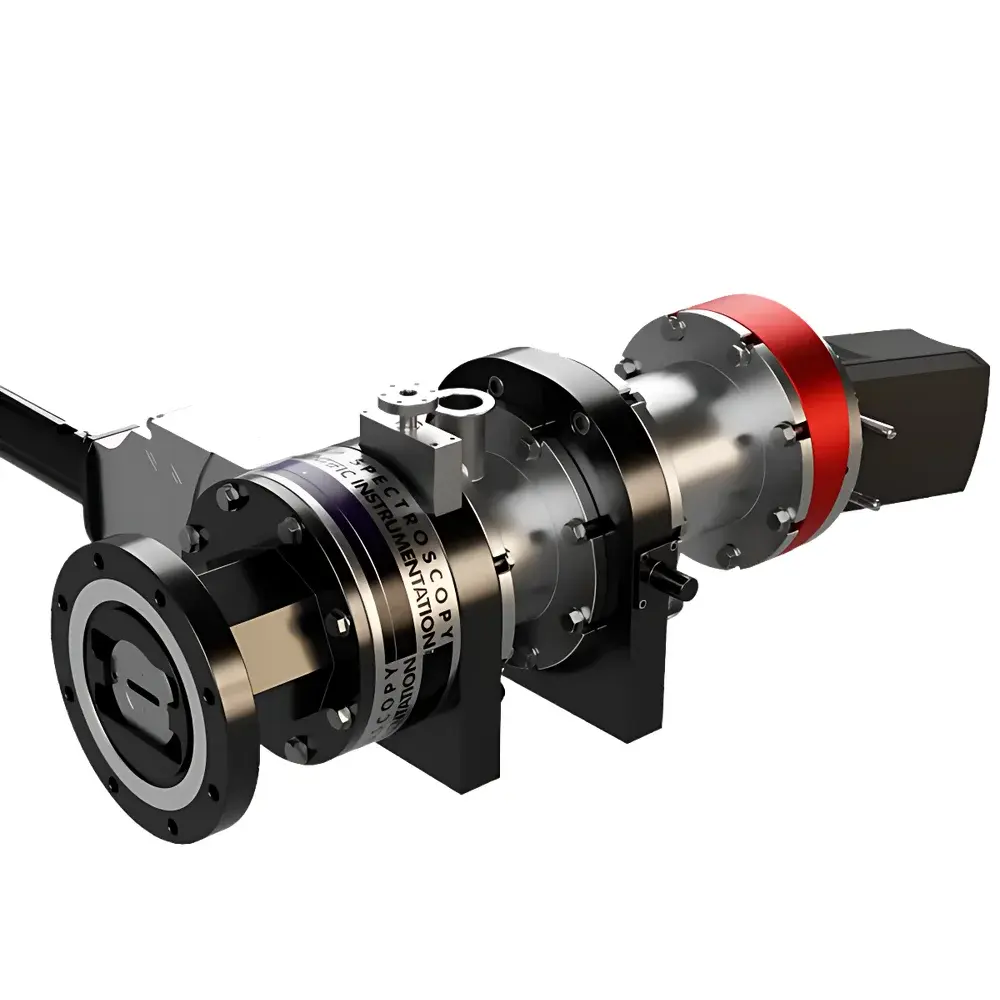
HP Spectroscopy maxLIGHT Seamless Flat-Field XUV Spectrometer and Beam Profiler
| Brand | HP Spectroscopy |
|---|---|
| Origin | Germany |
| Manufacturer Type | Authorized Distributor |
| Origin Category | Imported |
| Model | maxLIGHT |
| Price | Upon Request |
| Wavelength Range | 1–200 nm |
Overview
The HP Spectroscopy maxLIGHT is a high-performance, seamless flat-field extreme ultraviolet (XUV) spectrometer and beam profiler engineered for ultrafast science, attosecond metrology, and high-harmonic generation (HHG) characterization. Unlike conventional Czerny–Turner or Rowland-circle spectrometers, the maxLIGHT employs a proprietary slitless imaging architecture based on direct source-to-detector optical mapping. This eliminates the throughput-limiting entrance slit while preserving spectral fidelity—delivering up to 20× higher photon flux at the detector compared to slit-based systems of equivalent resolution. Its aberration-corrected flat-field design ensures uniform spatial dispersion and minimal astigmatism across the full 1–200 nm range, enabling simultaneous high-resolution spectral acquisition and real-time beam profiling without mechanical reconfiguration.
Key Features
- Slitless optical architecture: Maximizes collection efficiency by eliminating the entrance slit; ideal for low-flux, pulsed XUV sources such as HHG, laser-produced plasmas, and FELs.
- Aberration-corrected flat-field optics: Delivers diffraction-limited imaging performance across the entire operational band (1–200 nm), with optimized variants for SXR (1–2 nm), XUV (5–80 nm), and VUV (40–200 nm).
- Modular, vacuum-compatible platform: Standard UHV-rated (<10⁻⁶ mbar); optional ultra-high-vacuum (UHV) version available with non-magnetic materials and bake-out compatibility.
- Motorized, closed-loop grating positioning: Enables precise, repeatable wavelength selection with sub-pixel encoder feedback and integrated thermal drift compensation.
- Integrated filter insertion unit and slit mount: Supports in-situ spectral filtering, harmonic suppression, and alignment diagnostics without breaking vacuum.
- Flexible detector interface: Compatible with nXUV-optimized CCDs (for high dynamic range and <0.015 nm resolution at 10 nm), MCP/CMOS intensifiers (for gated, time-resolved, or single-shot applications), and custom sensor geometries.
Sample Compatibility & Compliance
The maxLIGHT is designed for integration into ultrafast laser laboratories, synchrotron beamlines, and free-electron laser end stations. It supports both continuous and pulsed sources—including femtosecond Ti:sapphire lasers driving gas- or solid-target HHG, discharge- or laser-generated plasmas, and seeded FEL pulses. All optical components are fabricated from low-outgassing, UHV-grade materials (e.g., OFHC copper mounts, Al/MgF₂-coated gratings). The system complies with ISO 14644-1 Class 5 cleanroom handling protocols during assembly and meets mechanical stability requirements per ISO 10360-2 for optical metrology instrumentation. Optional configurations support GLP/GMP-aligned operation with audit-trail-capable software logging (21 CFR Part 11-ready via LabVIEW SDK extension).
Software & Data Management
The maxLIGHT is controlled via a native Windows GUI application supporting real-time spectrum visualization, wavelength calibration (using known emission lines or He/Ne reference lamps), and beam centroid tracking. A comprehensive SDK is provided for LabVIEW, VB.NET, C, and C++ environments—enabling tight synchronization with pump-probe delay stages, pulse pickers, and gated detectors. All raw frames and processed spectra are saved in HDF5 format with embedded metadata (wavelength calibration coefficients, grating angle, filter ID, vacuum pressure, timestamp). Software supports batch processing of multi-shot HHG datasets, spectral deconvolution using Richardson–Lucy algorithms, and export to ASCII/CSV for third-party analysis (e.g., MATLAB, Python SciPy). Firmware updates and configuration backups are managed over USB 3.0 or Gigabit Ethernet with TLS-secured remote access.
Applications
- High-harmonic generation (HHG) source characterization: Resolving cutoff energies, plateau structures, and CEP-dependent intensity modulations at repetition rates up to 150 kHz.
- Attosecond streaking and RABBITT experiments: Enabling single-shot spectral reconstruction of isolated attosecond pulses through high-S/N, time-gated XUV spectra.
- Laser–matter interaction studies: Analyzing broadband XUV emission from solid-density plasmas, including fine-structure harmonics and non-dipole contributions.
- Free-electron laser (FEL) diagnostics: Monitoring spectral stability, shot-to-shot fluctuations, and seeding efficiency in SASE and seeded FEL configurations.
- Plasma-based XUV sources: Quantifying line emission from pinch discharges, capillary discharges, and laser-ablation plasmas in the 1–200 nm band.
- Coherent diffractive imaging (CDI) beamline commissioning: Providing absolute spectral irradiance calibration and wavefront diagnostics for tabletop XUV interferometers.
FAQ
What vacuum level is required for stable operation?
The standard maxLIGHT operates reliably at pressures ≤10⁻⁶ mbar. For long-term stability in high-flux environments, the optional UHV variant supports bake-out to 150°C and maintains <5×10⁻⁹ mbar after conditioning.
Can the instrument be used for time-resolved measurements?
Yes—when coupled with gated MCP/CMOS detectors and synchronized to laser triggers (via TTL or LVDS inputs), the system achieves sub-100 ps temporal gating resolution.
Is wavelength calibration traceable to NIST standards?
Calibration can be performed using certified He I (58.4 nm), Ne I (73.6 nm), or Ar I (104.8–106.7 nm) emission lines; full traceability documentation is available upon request.
How is stray light suppressed in the slitless design?
Stray light is minimized through multilayer anti-reflection coatings, blackened internal baffles, and order-sorting filters mounted in the integrated filter wheel—reducing out-of-band contributions to <0.1% in typical HHG configurations.
Can the system be integrated into existing beamlines with limited space?
The modular footprint (standard configuration: 320 × 240 × 180 mm) and flexible input arm geometry allow installation in constrained end-stations; optical path length is user-adjustable from 300 mm to 1200 mm.





