
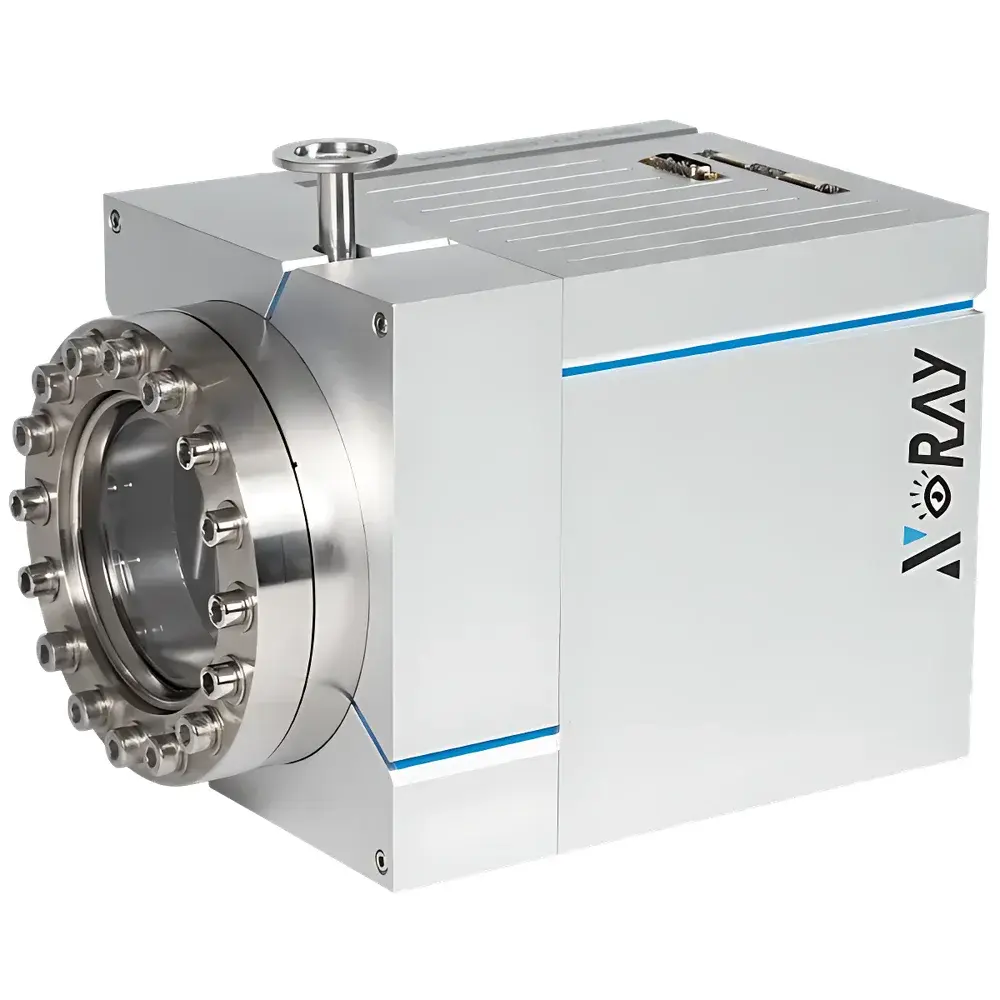
X-rayVision SpotCam-E Back-Illuminated sCMOS Camera
| Brand | X-rayVision |
|---|---|
| Model | SpotCam-E |
| Sensor Type | Back-illuminated scientific CMOS (sCMOS) |
| Detection Range | EUV to soft/hard X-rays (0.05–20 keV) |
| Readout Architecture | Custom low-noise charge-integration + single-photon counting mode (pixel-level event extraction) |
| Operating Environment | External vacuum or fully internal vacuum configurations available |
| Frame Rate | Up to 100 fps at full resolution (depending on region-of-interest and binning) |
| Energy Resolution | FWHM < 200 eV at 5.894 keV (⁵⁵Fe source, 20 °C, no cooling) |
| Pixel Pitch | 6.5 µm |
| Active Area | 12.8 mm × 12.8 mm (2048 × 2048) |
| Interface | Camera Link HS or CoaXPress 2.0 |
| Compliance | RoHS, CE, ISO 9001-manufactured design |
| Software Support | SDK for C/C++, Python, MATLAB |
Overview
The X-rayVision SpotCam-E is a purpose-engineered back-illuminated scientific CMOS (sCMOS) camera designed for high-fidelity detection across the extreme ultraviolet (EUV), soft X-ray, and hard X-ray regimes. Unlike conventional front-illuminated detectors, its back-illuminated architecture delivers quantum efficiency exceeding 80% at 500 eV and maintains >30% QE up to 8 keV—enabling quantitative, low-noise imaging and spectroscopy without cryogenic cooling. The detector operates on a dual-mode principle: high-dynamic-range integrating mode for intensity-resolved imaging, and pixel-level single-photon event extraction for energy-resolved spectroscopy—including X-ray fluorescence (XRF), plasma emission, and particle-induced X-ray emission (PIXE). Its monolithic sensor integration with proprietary readout electronics ensures sub-electron read noise and minimal dark current (<0.005 e⁻/pix/s at 20 °C), supporting both time-resolved experiments and long-exposure spectral mapping.
Key Features
- Modular, plug-in sensor architecture: Enables rapid replacement of the sCMOS die without breaking vacuum—reducing system downtime and extending total cost-of-ownership in synchrotron beamlines, laboratory XRF setups, and plasma diagnostics.
- On-chip single-photon spectroscopy: Embedded real-time algorithm performs per-pixel charge centroiding and pulse-height analysis, delivering calibrated energy spectra directly from raw frames—even under ambient light or at room temperature.
- Vacuum-configurable platform: Available in two variants: external vacuum flange-mount (for integration into existing UHV chambers) and fully sealed internal vacuum (with getter-stabilized pressure <1×10⁻⁶ mbar).
- Multi-radiation compatibility: Validated for direct detection of photons (EUV–20 keV), electrons (1–100 keV), and protons (0.5–5 MeV), with radiation-hardened gate oxide and optional engineering-grade silicon variants for high-fluence applications.
- Fully domestic supply chain: Sensor die, ASIC readout, and firmware stack are developed and manufactured in China under controlled quality protocols aligned with ISO 9001 standards—ensuring traceability and export compliance for dual-use research infrastructure.
Sample Compatibility & Compliance
The SpotCam-E supports non-destructive, in-situ characterization of heterogeneous samples including battery cathode materials (e.g., NMC, LFP), semiconductor wafers (Si, GaN, SiC), thin-film photovoltaic stacks, and metallurgical cross-sections. It complies with ASTM E1558 (standard guide for XRF spectrometry), ISO 21043 (X-ray microanalysis terminology), and IEC 61000-6-3 (EMC emissions). Data acquisition workflows meet GLP audit requirements through deterministic timestamping, hardware-triggered frame synchronization, and optional FDA 21 CFR Part 11-compliant electronic signature modules. All firmware binaries are digitally signed and version-locked to prevent unauthorized modification during regulated QA/QC operations.
Software & Data Management
X-rayVision provides a modular SDK supporting Windows/Linux/macOS, with native bindings for C/C++, Python (via PySpotCam), and MATLAB. The core acquisition engine implements lossless frame compression (Huffman + delta encoding), real-time histogram accumulation, and on-the-fly spectral fitting using Levenberg–Marquardt optimization against user-defined peak libraries (e.g., NIST X-ray Line Database). Raw data exports adhere to HDF5 format with NeXus-compatible metadata schemas (NXdetector, NXdata), enabling seamless ingestion into analysis platforms such as PyMCA, SPEC, or custom Jupyter-based pipelines. Remote operation via RESTful API allows integration into automated test benches and industrial metrology systems governed by OPC UA or MQTT protocols.
Applications
- Materials science: In situ XRF mapping of elemental segregation in solid-state battery interfaces during electrochemical cycling.
- Semiconductor metrology: High-resolution defect inspection via backscatter electron imaging combined with characteristic X-ray line identification.
- Plasma physics: Time-resolved EUV emission spectroscopy from laser-produced plasmas (LPP) and Z-pinch sources.
- Reverse engineering: Non-destructive layer-by-layer compositional analysis of packaged ICs using grazing-incidence XRF.
- Particle beam diagnostics: Direct tracking and energy deposition profiling of MeV protons in scintillator-coupled or direct-conversion modes.
FAQ
Does the SpotCam-E require liquid nitrogen or Peltier cooling to achieve its specified energy resolution?
No. The FWHM < 200 eV at 5.894 keV is achieved at ambient temperature (20 °C) using optimized charge collection depth and correlated double sampling—no active cooling is required for standard operation.
Can the camera be integrated into an existing UHV chamber with CF-100 flange interface?
Yes. The external vacuum variant includes a customizable CF-100 or KF-40 mounting option with differential pumping compatibility and feedthroughs for power, trigger, and data lines.
Is the single-photon spectroscopy algorithm export-controlled under EAR or ITAR?
No. The algorithm operates entirely within the camera’s FPGA and does not perform cryptographic functions or real-time AI inference; it is classified as EAR99 and unrestricted for academic and industrial research use.
What is the maximum sustained frame rate when performing full-frame single-photon event extraction?
At full 2048×2048 resolution, the sustained rate is 22 fps; ROI-binning to 512×512 increases throughput to 85 fps while preserving spectral fidelity.
Do you provide calibration certificates traceable to NIST or PTB standards?
Yes. Each unit ships with a factory calibration report including QE curve (measured at ALS Beamline 11.3.1), energy scale verification using ⁵⁵Fe, ¹⁰⁹Cd, and ²⁴¹Am sources, and spatial uniformity mapping—all traceable to NIST SRM 1262a (X-ray reference filters).
Related Products




