
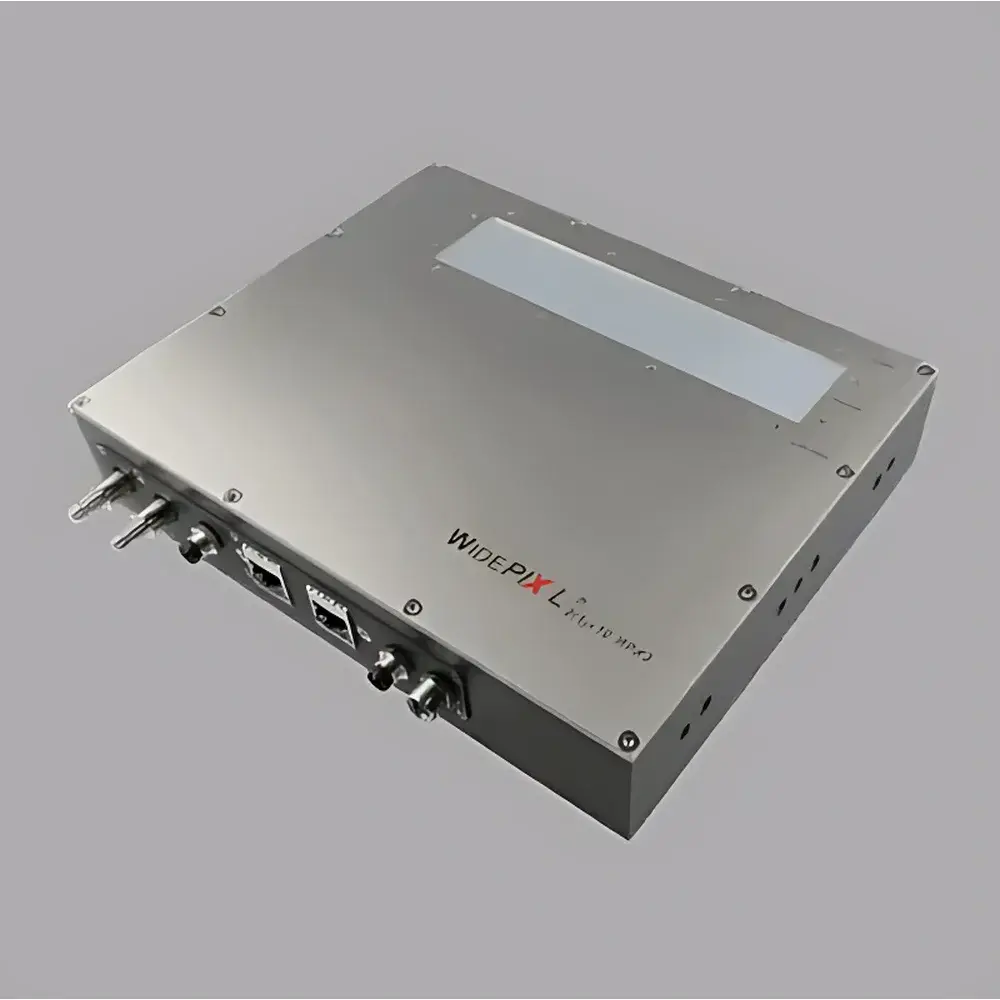
Advacam WidePIX 2(1)x10-MPX3 Photon-Counting X-ray Detector
| Brand | Advacam |
|---|---|
| Origin | Czech Republic |
| Model | WidePIX 2(1)x10-MPX3 |
| Sensor Material | Si or CdTe |
| Sensor Thickness | 300 µm (Si), 1 mm (CdTe) |
| Active Area | 28 (14) × 140.8 mm |
| Pixel Count | 512 (256) × 2560 |
| Pixel Size | 55 µm |
| Spatial Resolution | 9 lp/mm |
| Frame Rate | 170 fps (1×10 configuration), 80 fps (2×10 configuration) |
| Readout Chip | Medipix3 RX |
| Energy Thresholds | 1 or 2 programmable thresholds per pixel |
| Minimum Detectable Energy | 4 keV (Si), 5 keV (CdTe) |
| ADC Resolution | 12-bit or 24-bit (configurable) |
| TDI Support | Hardware-based, enabled in 1×10 mode at 1.5 m/s scan speed |
| Interface | Dual Ethernet RJ-45 |
| Dimensions | 210 × 190 × 42 mm (L × W × H) |
| Edgeless Tiling | Yes |
Overview
The Advacam WidePIX 2(1)x10-MPX3 is a high-performance, photon-counting X-ray detector engineered for quantitative, energy-resolved imaging across industrial, scientific, and biomedical applications. Built upon the Medipix3RX readout ASIC—a radiation-hardened, zero-noise, single-photon counting chip—the detector operates on hybrid pixel detector architecture, where each 55 µm pixel integrates two independent 12-bit analog-to-digital converters (ADCs) and two programmable energy discrimination thresholds. This dual-threshold capability enables real-time spectral binning and material decomposition without pile-up distortion, even at high flux densities. The system supports configurable 12-bit or cascaded 24-bit digitization per pixel, significantly extending dynamic range while preserving sub-keV energy resolution. Its edgeless sensor tiling—using either silicon (300 µm thick) for soft X-ray sensitivity (4–30 keV) or cadmium telluride (1 mm thick) for hard X-ray spectroscopy (5–200 keV)—ensures seamless, gap-free active area coverage across modular assemblies. Designed for integration into line-scan and area-scan systems, the detector delivers deterministic timing, hardware-accelerated Time-Delay Integration (TDI), and deterministic frame synchronization—critical for metrology-grade NDT and synchrotron beamline instrumentation.
Key Features
- Photon-counting operation with zero readout noise and no dark current—enabling true digital X-ray imaging with intrinsic contrast linearity
- Dual 12-bit ADCs per pixel with programmable low/high energy thresholds, supporting multi-energy binning and K-edge imaging
- Edgeless sensor tiling technology: Si or CdTe tiles abut with <1 µm mechanical gap, eliminating dead zones between modules
- Hardware-based TDI mode optimized for 1×10 configuration, enabling synchronized scanning at up to 1.5 m/s with full spatial fidelity
- Dual Gigabit Ethernet (RJ-45) interface delivering sustained 170 fps (1×10) or 80 fps (2×10) frame rates—eliminating USB bandwidth bottlenecks of prior generations
- Radiation-tolerant Medipix3RX ASIC with per-pixel energy calibration, threshold tuning, and charge-sharing correction logic
- Compact, fanless mechanical housing (210 × 190 × 42 mm) rated for continuous operation in industrial environments (IP52 equivalent)
Sample Compatibility & Compliance
The WidePIX 2(1)x10-MPX3 is compatible with laboratory X-ray sources (microfocus and rotating anode), synchrotron beamlines, and industrial linear accelerators (LINACs). Its Si sensor variant meets ASTM E2737-21 requirements for digital radiographic system performance in weld inspection, while the CdTe configuration complies with ISO 17636-2:2022 for thickness-dependent sensitivity in high-energy radiography. The detector’s deterministic frame triggering, timestamped metadata embedding, and non-volatile configuration storage support GLP/GMP-aligned workflows. All firmware and acquisition software adhere to IEC 62304 Class B medical device software standards and provide audit-trail-ready logging compliant with FDA 21 CFR Part 11 when deployed in regulated QA/QC environments.
Software & Data Management
Acquisition and analysis are managed via the open-source, cross-platform ADVacam Acquisition Software (v5.3+), which provides real-time spectral histogramming, ROI-based energy windowing, and HDF5-based raw data export. The SDK includes C/C++, Python, and MATLAB APIs supporting integration into custom pipelines (e.g., TomoPy, ASTRA Toolbox). Raw frames embed precise timestamps, sensor temperature, HV bias, and per-frame threshold settings—enabling traceable post-processing. Data integrity is enforced through CRC-32 checksums per frame and optional AES-256 encryption for network transmission. Batch processing workflows support automated calibration (flat-field, energy response, charge sharing correction) and conform to DICOM-SR and NeXus/HDF5 file standards for long-term archival.
Applications
- Non-destructive testing (NDT): High-speed inline inspection of composite laminates, battery electrodes, and additive-manufactured parts using spectral contrast enhancement
- Preclinical small-animal imaging: Multi-energy CT reconstruction for iodine/gadolinium quantification and bone mineral density mapping
- Cultural heritage analysis: Layer-by-layer pigment identification in paintings and frescoes via Kα/Kβ ratio mapping
- Mineralogical sorting: Real-time elemental classification (Fe, Cu, Zn, Pb) in ore streams using dual-threshold spectral gating
- Synchrotron XRF/XRD mapping: Sub-50 µm spatial resolution fluorescence tomography with simultaneous diffraction pattern capture
- Electron microscopy correlative imaging: Bridging SEM-EDS and X-ray microtomography datasets via shared coordinate referencing
FAQ
What distinguishes the WidePIX 2(1)x10-MPX3 from earlier WidePIX models?
It replaces legacy USB 2.0 interfaces with dual Gigabit Ethernet, doubling maximum frame rate and enabling hardware TDI—critical for high-throughput scanning applications.
Can the detector operate in both energy-integrating and photon-counting modes?
No—it is exclusively a photon-counting detector; Medipix3RX does not support integrating mode. All measurements are event-driven and threshold-gated.
Is CdTe sensor calibration traceable to national standards?
Yes—factory calibration includes NIST-traceable X-ray reference sources (⁵⁵Fe, ¹⁰⁹Cd, ²⁴¹Am) with uncertainty budgets documented per ISO/IEC 17025.
Does the system support external trigger synchronization?
Yes—TTL-compatible input/output ports enable precise master-slave timing with motion stages, X-ray generators, or laser pulse sources.
What operating systems are supported for real-time acquisition?
Linux (Ubuntu 20.04/22.04 LTS, CentOS Stream 9), Windows 10/11 (64-bit), and bare-metal real-time OS deployments via PXIe carrier.





