
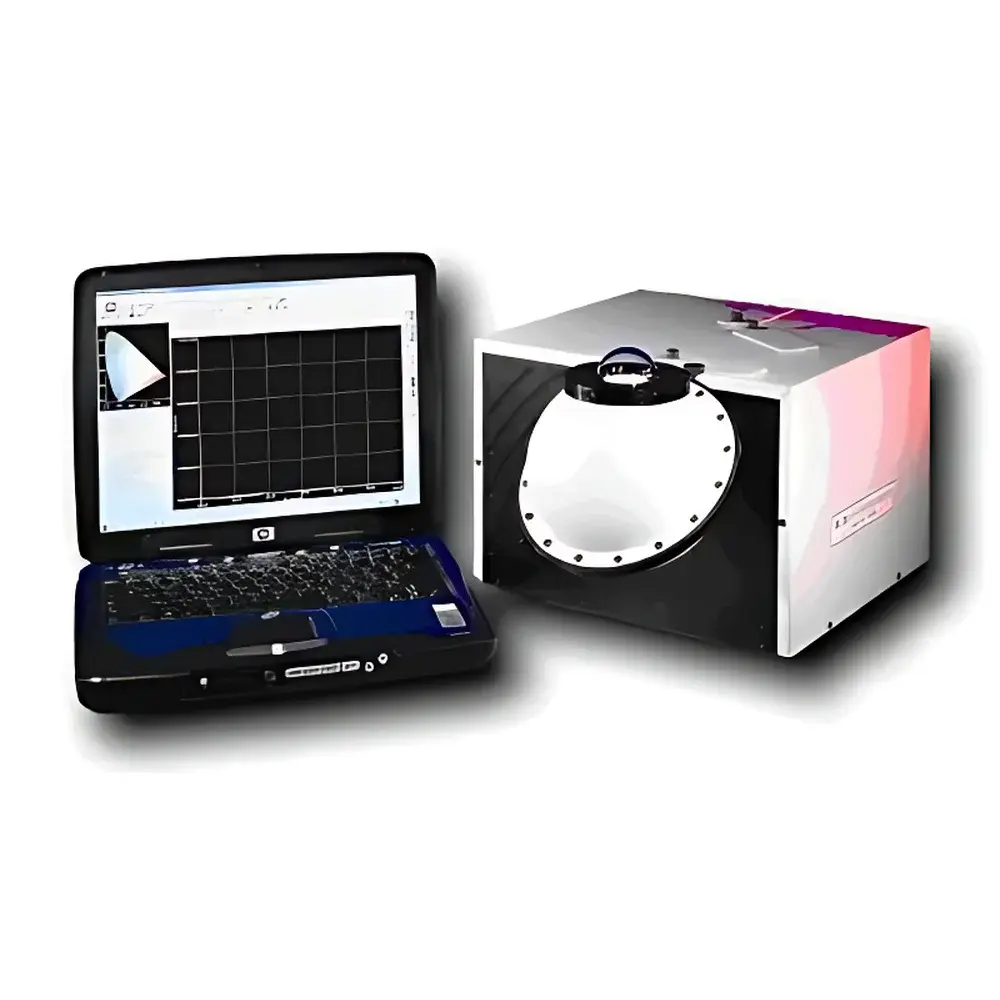
Optronic Laboratories OL756 Portable Spectroradiometer
| Brand | Optronic Laboratories |
|---|---|
| Origin | USA |
| Model | OL756 |
| Wavelength Range | 200–800 nm |
| Wavelength Accuracy | ±0.15 nm |
| Wavelength Resolution | 0.025 nm |
| Wavelength Repeatability | ±0.05 nm |
| FWHM | 0.4–10 nm |
| Stray Light | <1×10⁻⁸ @ 285 nm (typ.) |
| Dynamic Range | 10⁷ |
| Spectral Radiance Accuracy | ±1% (UVA–Vis), ±3% (UVB–UVC) |
| Scan Speed | 200 nm/s |
| Radiometric Noise (Irradiance Equivalent) | 1.7×10⁻⁷ W·m⁻²·nm⁻¹ @ 300 nm, 1×10⁻⁷ W·m⁻²·nm⁻¹ @ 500 nm |
| Power Supply | 12 VDC |
| Portability | Sum of L+W+H ≤ 85 cm |
Overview
The Optronic Laboratories OL756 is a high-precision, double-monochromator-based portable spectroradiometer engineered for absolute spectral radiometric measurements across the ultraviolet to near-infrared spectrum (200–800 nm). Unlike filter-based or single-monochromator instruments, the OL756 employs a tandem Czerny-Turner optical architecture with two independently aligned diffraction gratings, delivering exceptional stray light suppression and spectral fidelity—critical for low-signal UV-C and solar-blind applications. Its measurement principle relies on calibrated, NIST-traceable detector responsivity combined with thermally stabilized grating drives and precision slit mechanics, enabling traceable spectral irradiance, radiance, reflectance, and transmittance quantification. Designed for field-deployable metrology, the system achieves full solar spectrum acquisition in under 6.5 seconds while maintaining laboratory-grade accuracy—making it suitable for outdoor photometric validation, lamp spectral characterization, and regulatory compliance testing where portability and metrological rigor must coexist.
Key Features
- Double monochromator optical design with optimized grating alignment and vacuum-compatible housing for long-term wavelength stability
- Wavelength accuracy of ±0.15 nm and repeatability of ±0.05 nm—validated against mercury and deuterium line standards per ISO/IEC 17025-accredited procedures
- Stray light performance <1×10⁻⁸ at 285 nm (typical), enabling reliable UVC (200–280 nm) radiometric measurements without spectral contamination
- Adjustable spectral bandwidth (FWHM: 0.4–10 nm) via motorized slits, supporting both high-resolution line profiling and throughput-optimized broadband scans
- 12 VDC power input with integrated thermal management, permitting operation from battery packs, vehicle ports, or regulated lab supplies without AC conversion noise
- USB 2.0 interface with deterministic data acquisition timing, supporting synchronized triggering with external sensors or illumination sources
- Compact mechanical envelope: sum of length + width + height ≤ 85 cm, compliant with IATA carry-on dimensions for international deployment
Sample Compatibility & Compliance
The OL756 accommodates diverse optical geometries via interchangeable input optics—including cosine-corrected irradiance probes, collimated radiance telescopes, integrating spheres (2″, 4″, and 6″ options), and fiber-coupled accessories. It supports both absolute and relative spectral measurements per ASTM E308, CIE S 014, ISO/CIE 13406-2, and JIS Z 8722. Calibration certificates include NIST-traceable spectral irradiance responsivity data with expanded uncertainties (k=2) reported for each wavelength point. The instrument meets electromagnetic compatibility requirements per FCC Part 15 Class B and IEC 61326-1 for industrial environments. For regulated laboratories, raw data export formats (ASCII, CSV, and binary .SPE) support audit trails compliant with FDA 21 CFR Part 11 when used with validated software configurations.
Software & Data Management
The OL756 operates with Optronic’s SpectraWin™ v5.x software suite, which provides real-time spectral visualization, automated calibration application, and multi-channel arithmetic (e.g., reflectance = sample / reference ratio). All acquired spectra retain embedded metadata including date/time stamp, integration time, slit width, grating position, detector gain, and ambient temperature. Exported datasets include full uncertainty propagation per GUM (JCGM 100:2008) methodology. Software supports batch processing for inter-instrument comparison studies and includes built-in routines for CIE colorimetric calculations (x,y,Y; u’,v’; D65, A, F-series illuminants). Raw spectral files are compatible with third-party platforms including MATLAB, Python (via NumPy/Pandas), and LabVIEW through documented API libraries.
Applications
- Outdoor solar spectral irradiance monitoring for PV module spectral mismatch correction and atmospheric transmission modeling
- UV disinfection lamp spectral power distribution (SPD) verification per IEC 62471 and ANSI/IES RP-27.3
- LED and OLED display spectral quality assessment—including blue hazard evaluation (ICNIRP 2020) and TM-30-20 fidelity metrics
- Material optical property characterization: bidirectional reflectance distribution function (BRDF) sampling, thin-film interference analysis, and pigment spectral signature mapping
- Calibration transfer between primary standards labs and field service teams using matched spectral reference lamps (e.g., FEL, QTH, deuterium)
- Environmental photobiological safety assessments in healthcare, horticulture lighting, and aerospace cabin illumination systems
FAQ
Is the OL756 suitable for UV-C radiometric measurements below 220 nm?
Yes—the double monochromator architecture and fused silica/vacuum UV optics enable stable, low-stray-light operation down to 200 nm. For sub-200 nm work, optional nitrogen purge or vacuum coupling is recommended.
Can the OL756 be used in GLP or GMP-regulated environments?
Yes—when deployed with SpectraWin™ in validated configuration and paired with documented calibration history, it supports audit-ready workflows including electronic signatures, change control logs, and raw data integrity per ALCOA+ principles.
What is the typical warm-up time required before achieving specified wavelength accuracy?
Less than 15 minutes after power-on, assuming ambient temperature stabilization within ±2 °C of calibration conditions.
Does the system support automated scanning with external motion stages or goniometers?
Yes—TTL trigger input/output ports and programmable scan sequencing allow synchronization with motorized rotation stages, robotic arms, or environmental chambers.
How frequently must the instrument be recalibrated to maintain stated accuracy specifications?
Annual recalibration is recommended; however, user-performed verification using internal Hg/D₂ line sources can be conducted daily or per-shift to confirm wavelength and photometric stability.







