
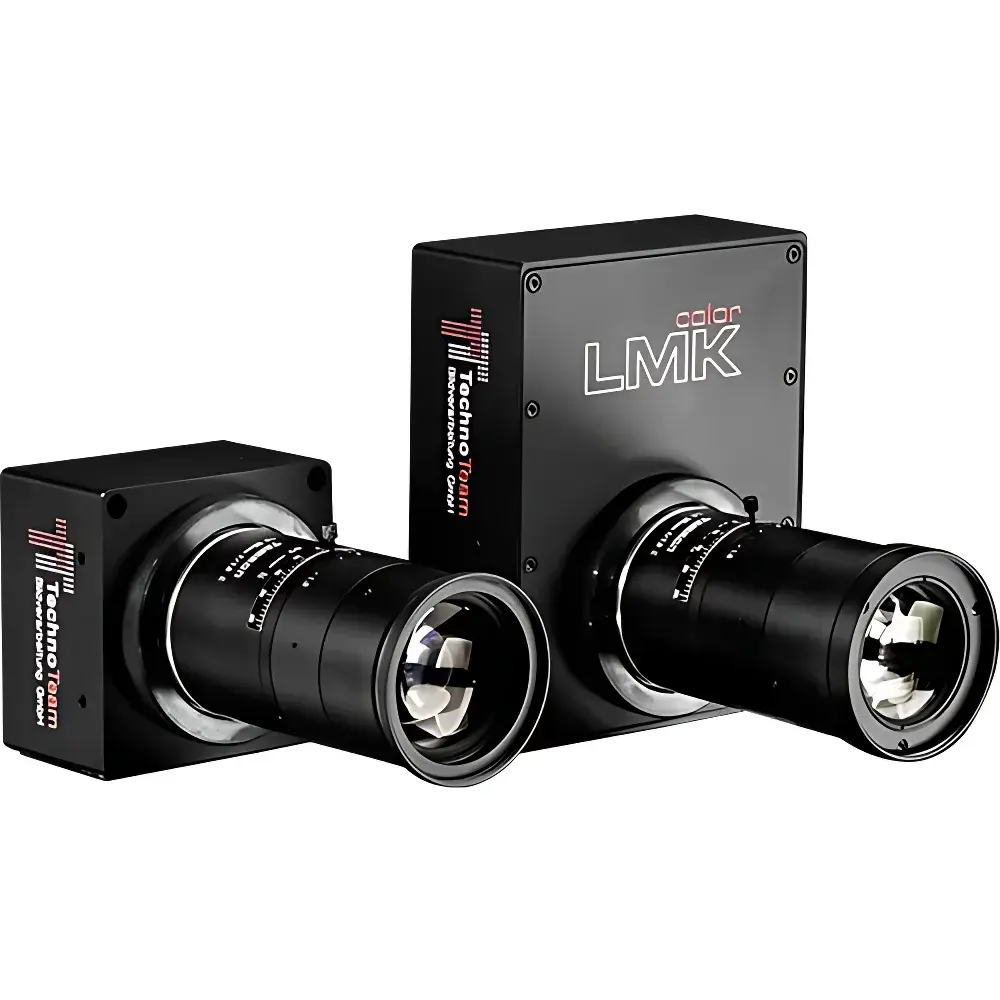
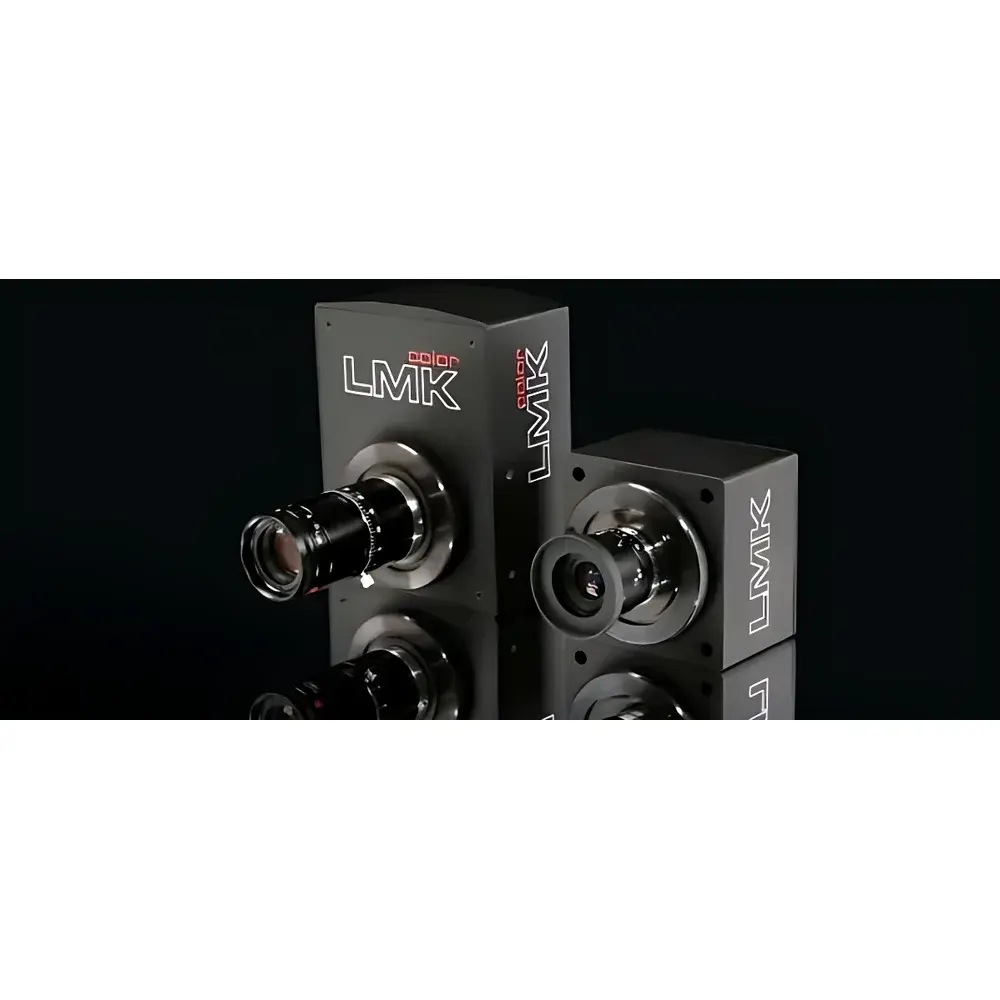
TechnoTeam LMK 6 Imaging Luminance and Colorimeter
| Brand | TechnoTeam |
|---|---|
| Origin | Germany |
| Model | LMK 6 |
| Sensor Type | Scientific-grade CCD |
| Field of View | 2° (CIE 1931 Standard Observer) |
| Spatial Resolutions | 2464 × 2056 (LMK 6-5) |
| Dynamic Range | ~140 dB |
| Luminance Repeatability | < 0.1% |
| Chromaticity Repeatability (x,y) | < 0.0001 |
| Luminance Accuracy (A-source) | < ±3% |
| Chromaticity Accuracy (x,y, A-source) | < ±0.0020 |
| Trigger Support | Yes (for pulsed light sources) |
| Filter Options | CIE V′(λ) scotopic, C(λ) circadian, IR (780–1000 nm), BLH (blue-light hazard) |
Overview
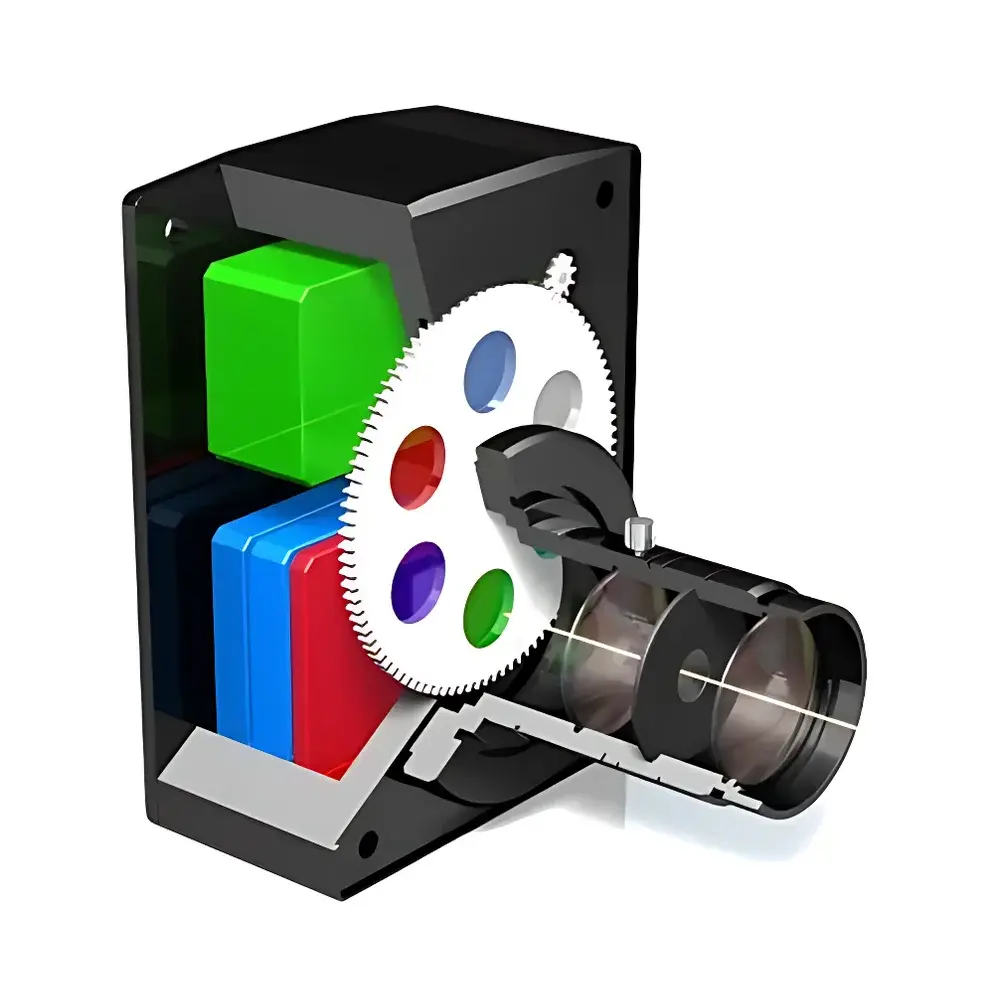
The TechnoTeam LMK 6 Imaging Luminance and Colorimeter is a high-resolution, scientific-grade CCD-based imaging photometer engineered for spatially resolved photometric and colorimetric analysis of light-emitting surfaces and luminaires. Unlike traditional spot-measurement instruments, the LMK 6 captures full-field two-dimensional data—simultaneously quantifying luminance (cd/m²), chromaticity coordinates (CIE x,y or u′,v′), correlated color temperature (CCT), dominant wavelength, excitation purity, and ΔE* color difference—across the entire field of view in a single exposure. Its optical design incorporates a precisely calibrated 4-filter wheel system aligned to the CIE 1931 2° standard observer spectral sensitivity functions, ensuring metrological traceability to international photometric standards. The instrument operates without warm-up time—a critical advantage for production environments requiring rapid cycle times—and delivers laboratory-grade stability and repeatability under ambient thermal and electrical conditions typical of R&D labs and manufacturing floors.
Key Features
- Zero warm-up operation: Fully stabilized photometric response achieved immediately after power-on, eliminating downtime associated with thermal drift stabilization.
- High spatial fidelity: Available sensor resolutions up to 6480 × 4860 pixels (LMK 6-30), enabling sub-millimeter luminance uniformity mapping on large-area displays and automotive lighting modules.
- Multi-spectral filter architecture: Interchangeable, NIST-traceable interference filters support specialized measurement modes—including scotopic vision (V′(λ)), circadian photobiological action (C(λ)), infrared radiance (780–1000 nm), and blue-light hazard (BLH) assessment per IEC/TR 62778 and IEC 62471.
- Robust trigger synchronization: Hardware-level external trigger input enables precise capture of transient emissions from PWM-driven LEDs, OLEDs, and flash-based signaling devices.
- Compact and vibration-resistant mechanical design: Aluminum alloy housing with passive thermal management ensures long-term dimensional stability and minimal focus drift during extended acquisition sequences.
Sample Compatibility & Compliance
The LMK 6 supports direct measurement of self-luminous and transmissive samples including OLED and LCD displays, automotive headlamps and DRLs, architectural LED panels, signage, backlight units (BLUs), and road lighting fixtures. It complies with key international standards for photometric instrumentation, including DIN 5032-7 (Class L photometers), ISO/CIE 11664-1–6 (colorimetry), and CIE Publication 127:2007 (LED measurement guidelines). When configured with circadian or scotopic filters, measurements align with CIE S 026/E:2018 (photobiological safety) and EN 12464-1:2021 (lighting of indoor workplaces). Data integrity meets GLP/GMP requirements through Labsoft’s audit-trail-enabled workflow logging and user-access controls compliant with FDA 21 CFR Part 11 principles.
Software & Data Management
Labsoft—the native application suite for the LMK platform—provides an integrated environment for instrument control, real-time visualization, automated reporting, and advanced image analytics. It supports batch processing of multi-frame sequences (e.g., temporal uniformity, motion blur analysis), region-of-interest (ROI) masking, false-color overlay generation, and statistical mapping (min/max/mean/std dev per pixel group). Export formats include TIFF (16-bit linear), CSV (tabular photometric metadata), and XML (structured measurement reports compatible with MES and SPC systems). Optional Labsoft Automation API enables integration into robotic test cells, allowing synchronized positioning, exposure control, and pass/fail decision logic via digital I/O or Ethernet/IP protocols.
Applications
- Display characterization: Luminance and chromaticity uniformity, viewing angle dependence, grayscale tracking, and residual image evaluation for smartphones, tablets, and medical monitors.
- Automotive lighting validation: Near-field intensity distribution, glare index calculation (UGR, TI), dynamic beam pattern verification, and adaptive driving beam (ADB) functional testing.
- LED module homogeneity analysis: Pixel-level defect detection, binning support, and thermal derating correlation across operating temperatures.
- Human-centric lighting (HCL) research: Circadian stimulus (CS) and melanopic EDI quantification using C(λ)-weighted irradiance integrals derived from calibrated spectral radiance maps.
- Regulatory compliance testing: Blue-light hazard classification (RG0–RG3), photobiological safety assessment, and flicker metrics (Pst, SVM) when coupled with temporal sampling accessories.
FAQ
Does the LMK 6 require calibration traceable to national standards?
Yes—each unit ships with a factory calibration certificate traceable to PTB (Physikalisch-Technische Bundesanstalt) or equivalent NMIs. Optional annual recalibration services include spectral responsivity verification and geometric distortion correction.
Can the LMK 6 measure pulsed or modulated light sources?
Yes—via hardware-triggered exposure synchronization with jitter < 1 µs. Supports duty-cycle-dependent luminance averaging and frame-stacking for low-SNR conditions.
Is Labsoft compatible with third-party automation platforms?
Yes—Labsoft exposes COM and TCP/IP interfaces for integration with PLCs, robotic controllers (e.g., Universal Robots, KUKA), and MES systems such as Siemens Opcenter or Rockwell FactoryTalk.
What is the maximum working distance for accurate measurements?
Measurement distance depends on lens configuration and required spatial resolution. With standard f/2.8 lenses, optimal working distances range from 0.3 m to 3 m; telecentric and macro optics extend this range while preserving photometric linearity.
How does the LMK 6 handle ambient light interference during measurement?
The system employs synchronized dark-frame subtraction, narrowband optical filtering, and configurable integration time (10 µs to 60 s) to suppress stray light. Optional motorized lens caps and ambient-light rejection algorithms further enhance outdoor or unshielded lab use.



