
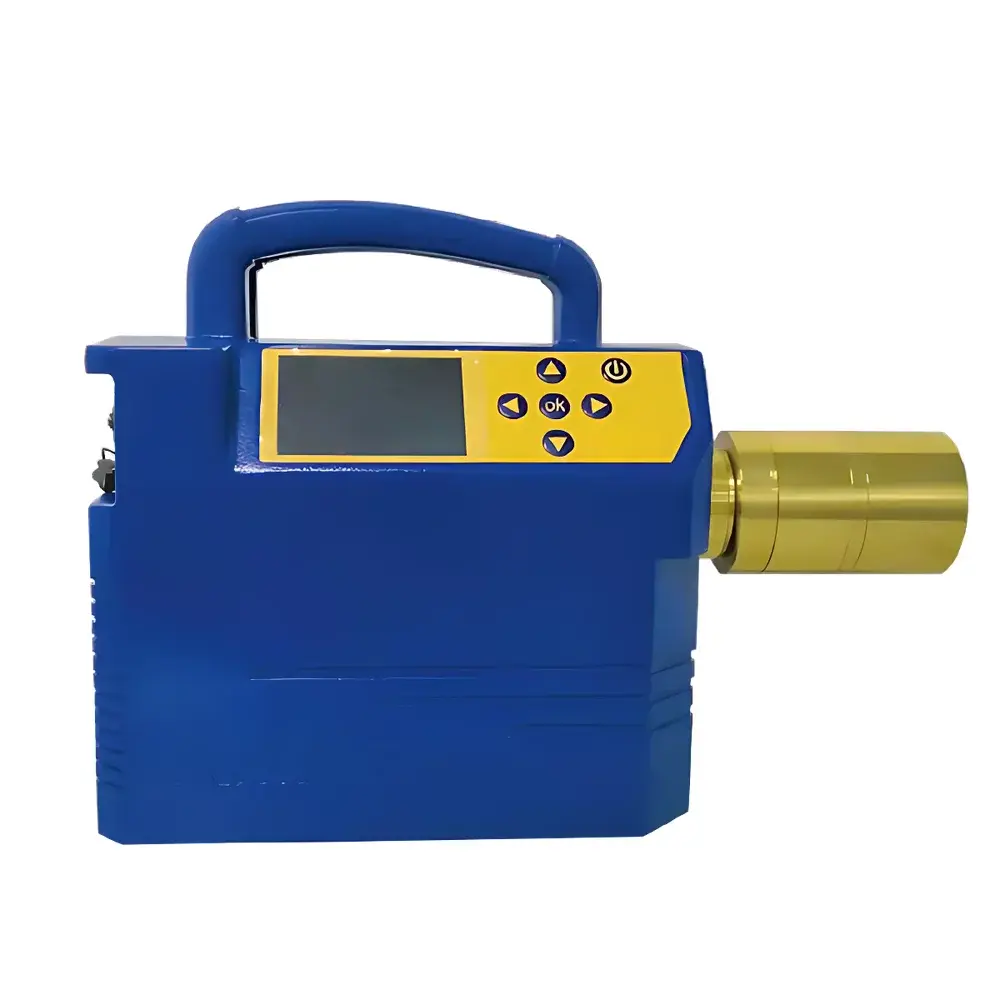
AMAE CCZ30 Intrinsically Safe Mining Dust Sampler
| Brand | AMAE |
|---|---|
| Model | CCZ30 |
| Type | Personal/Stationary Intrinsically Safe Dust Sampler |
| Flow Range | 3–30 L/min |
| Flow Resolution | 0.01 L/min |
| Compliance | GBZ 159-2004, GBZ/T 192.1–192.2, GB 16238-1996, GB 16248-1996, GBZ/T 300 (Dust), GBZ 2.1-2019 |
| Sampling Modes | Manual, Timed, Volume-Controlled, Cyclic |
| Data Logging | Internal Storage with Export (USB) & Optional Thermal Printout |
| Power | Rechargeable Li-ion Battery (High-Capacity, Extended Runtime) |
| Pump Type | Imported Brushless Electromagnetic Diaphragm Pump |
| Flowmeter | Imported Straight-Through Electronic Mass Flow Sensor |
| Accessories Included | Total Dust & Respirable Dust Sampling Heads (Φ40 mm), Filter Holders, Calibration Orifice, Tripod, Charger |
Overview
The AMAE CCZ30 Intrinsically Safe Mining Dust Sampler is a certified, field-deployable instrument engineered for quantitative airborne particulate collection in hazardous underground and surface mining environments. It operates on the principle of isokinetic or gravimetric sampling—drawing ambient air through standardized filter media at precisely controlled volumetric flow rates to capture total dust (TD) and respirable dust (RD) fractions for subsequent laboratory analysis (e.g., gravimetric mass determination, elemental analysis via ICP-MS). Designed to meet stringent occupational hygiene requirements, the CCZ30 delivers stable, traceable, and metrologically defensible sampling performance under variable pressure, temperature, and humidity conditions typical of mine shafts, conveyor zones, crushing plants, and tunneling faces. Its intrinsic safety certification (Class I and II) ensures operational compliance in methane-rich or combustible-dust-laden atmospheres without risk of ignition—making it suitable for continuous personal monitoring or fixed-point environmental surveillance.
Key Features
- Brushless electromagnetic diaphragm pump: Eliminates carbon brush wear, achieves ultra-low acoustic emission (35 kPa), and ensures >10,000 hours of service life under continuous operation.
- High-stability electronic mass flow sensor: Straight-through design minimizes flow disturbance and particle deposition; delivers ±2% full-scale accuracy across 3–30 L/min range with 0.01 L/min resolution and real-time digital compensation for barometric and thermal drift.
- Multi-mode sampling logic: Supports manual start/stop, programmable timed cycles (up to 999 min per segment), volume-triggered termination (e.g., 1000 L total), and repeat-loop sequences—enabling alignment with OEL-based exposure assessment protocols.
- Standardized respirable fraction separation: Compatible with BMRC (British Medical Research Council) cyclone heads meeting ISO 7708:1995 specifications for aerodynamic cut-point at 4 µm (50% efficiency), ensuring regulatory-compliant respirable dust collection.
- Integrated environmental correction: Automatically calculates standard-condition volume (at 25°C, 101.325 kPa) using real-time temperature, pressure, and humidity inputs—essential for reporting in accordance with GBZ/T 192.1–192.2 and ISO 8518.
- Robust data integrity architecture: Local storage retains ≥10,000 sampling records with timestamps, flow logs, battery status, error flags, and calibration metadata; supports USB export in CSV format for audit-ready traceability.
Sample Compatibility & Compliance
The CCZ30 is validated for use with standard 40 mm diameter membrane filters (mixed cellulose ester, PVC, or polycarbonate) conforming to GBZ/T 192.1–192.2 filter specifications. It accommodates both total dust sampling heads (non-selective, open-face) and respirable dust cyclones meeting BMRC aerodynamic response curves. The instrument satisfies national occupational exposure limit (OEL) frameworks defined in GBZ 2.1-2019 and aligns with international sampling methodology principles referenced in ISO 7708, ISO 8518, and ACGIH TLV® documentation. All firmware and calibration procedures adhere to GLP-aligned internal quality control protocols—including documented calibration interval management, flow verification using primary-standard rotameters, and annual performance verification per GBZ 159-2004 Annex B.
Software & Data Management
Data acquisition and configuration are managed via an embedded real-time operating system with password-protected parameter access. The device supports secure export of raw sampling logs—including flow stability metrics (CV ≤ 3%), duration-weighted average (TWA) calculations, and deviation alerts—to external PCs via USB 2.0. While no proprietary desktop software is required for basic data retrieval, optional companion tools provide batch validation reports, trend visualization, and integration with enterprise EHS platforms (CSV/API-compatible). Audit trails include operator ID entry (optional), calibration certificate reference numbers, and tamper-evident timestamps—all compliant with data integrity expectations under Chinese GMP Annexes and aligned with FDA 21 CFR Part 11 principles for electronic records.
Applications
The CCZ30 serves as a core tool for occupational health and safety professionals conducting routine industrial hygiene surveys in coal, metal, and non-metal mining operations. It is routinely deployed for baseline exposure assessments, engineering control verification (e.g., effectiveness of local exhaust ventilation), regulatory compliance audits against GB 16248-1996 (coal dust) and GB 16238-1996 (cement dust), and epidemiological cohort studies tracking cumulative respirable crystalline silica (RCS) exposure. Its compatibility with Andersen cascade impactors (at 28.3 L/min) extends utility to bioaerosol characterization—supporting fungal spore or endotoxin monitoring in ventilation systems and processing areas. Field validation studies confirm consistent performance across altitudes up to 3,000 m and ambient temperatures from –10°C to +50°C.
FAQ
What certifications does the CCZ30 hold for hazardous area use?
It carries formal Class I (Group IIA, IIB, IIC) and Class II (Group IIIA, IIIB, IIIC) explosion protection certification per GB 3836 series standards, verified by nationally accredited testing laboratories.
Can the CCZ30 be used for both personal and area sampling?
Yes—its lightweight form factor (≤1.2 kg) and belt-mount design support personal sampling; its stable flow control and long battery runtime also enable unattended area monitoring for up to 8 hours at 5 L/min.
How is flow calibration maintained over time?
Users perform periodic verification using a NIST-traceable primary flow calibrator; the device stores calibration history and prompts scheduled recalibration based on usage hours or elapsed time.
Does the instrument support remote monitoring or IoT integration?
No built-in wireless module is included; however, exported CSV files are compatible with third-party cloud EHS platforms via scripted ingestion pipelines.
What filter types are recommended for heavy metal analysis?
Quartz fiber or PTFE membrane filters are advised for subsequent acid digestion and ICP-OES/ICP-MS quantification—compatible with all standard Φ40 mm holders supplied.







