
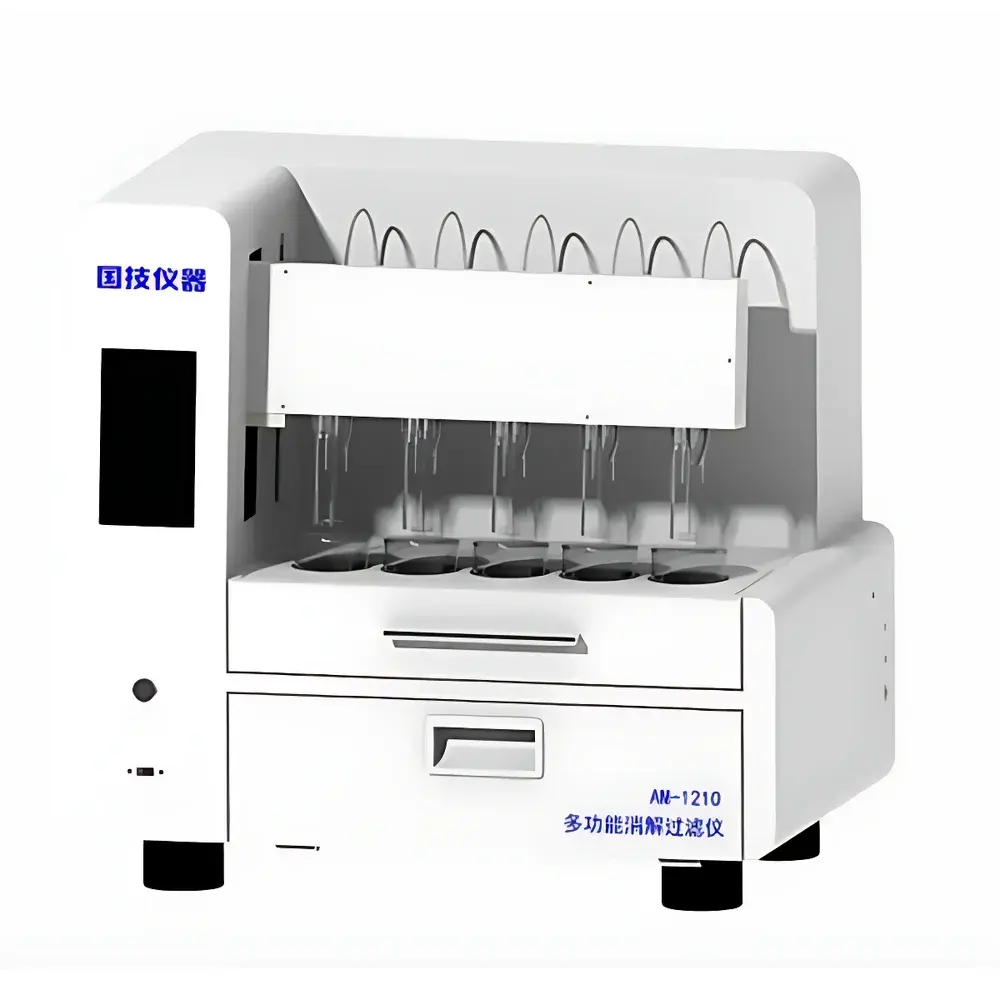
AMAE AM-1210 Multi-Function Digestion and Filtration Workstation
| Brand | AMAE |
|---|---|
| Origin | Guangdong, China |
| Model | AM-1210 |
| Display | 7-inch high-resolution color touchscreen |
| Sample throughput | 5 parallel channels |
| Temperature control accuracy | ±1 °C (resolution: 0.1 °C) |
| Integrated process | automated digestion, liquid transfer, dilution, acid/water washing, vacuum filtration |
| Compliance | designed for ASTM D7521 (determination of free silica by pyrophosphoric acid method), ISO 13791, and OSHA Method ID-142 |
| Software audit trail | GLP-compliant event logging with timestamped operator actions |
| Power supply | 220 V AC, 50/60 Hz |
Overview
The AMAE AM-1210 Multi-Function Digestion and Filtration Workstation is an integrated, programmable sample preparation system engineered for the standardized quantitative determination of crystalline free silica—specifically quartz, cristobalite, and tridymite—in airborne dust, bulk industrial powders, and geological samples. It implements the pyrophosphoric acid digestion method (per ASTM D7521, ISO 13791, and OSHA ID-142) with full automation of thermal digestion, reagent transfer, post-digestion dilution, multi-stage washing (acid followed by deionized water), and vacuum-assisted membrane filtration. Unlike conventional benchtop workflows requiring manual pipetting, crucible transfers, and external oven drying, the AM-1210 executes all steps within a sealed, temperature-stabilized reaction chamber using contactless peristaltic fluid handling and precisely synchronized thermal management. This architecture minimizes analyte loss due to splashing, adsorption, or incomplete transfer—critical factors affecting recovery accuracy in low-concentration silica analysis.
Key Features
- Five independent, thermally isolated reaction channels—each equipped with individual PTFE-coated heating blocks, magnetic stirrers, and real-time dual-point temperature monitoring (heating surface + sample vessel)
- Automated reagent delivery system with calibrated peristaltic pumps for precise metering of pyrophosphoric acid (85%), hydrochloric acid (1 M), and ultrapure water
- Integrated vacuum manifold with pressure-regulated filtration control (0–80 kPa adjustable), supporting standard 47-mm diameter mixed cellulose ester (MCE) or polycarbonate membranes
- Self-cleaning cycle with sequential acid rinse (HCl) and DI water flush between runs to prevent cross-contamination and maintain filter integrity
- 7-inch capacitive touchscreen interface with intuitive workflow navigation, real-time status visualization (temperature curves, pump actuation, vacuum level), and password-protected method editing
- Onboard data storage (≥10,000 run logs) with USB export capability; supports CSV-formatted output compatible with LIMS integration
Sample Compatibility & Compliance
The AM-1210 accommodates filter-collected air samples (e.g., PVC, polyvinyl chloride; or mixed cellulose ester filters), bulk powders (cement, coal dust, foundry sand), and soil digests within defined mass ranges (0.5–50 mg total suspended solids per channel). All wet chemistry steps comply with the procedural constraints of ASTM D7521: digestion at 245 °C for 90 minutes under reflux, controlled cooling to ≤100 °C prior to dilution, and final filtration at ≤40 °C to avoid silica polymerization artifacts. The system’s thermal uniformity (±1 °C across all five zones) and closed-loop temperature feedback ensure reproducible decomposition kinetics. Hardware design meets IEC 61010-1 safety standards for laboratory equipment; software architecture supports 21 CFR Part 11–compliant user authentication, electronic signatures, and immutable audit trails for GLP/GMP environments.
Software & Data Management
The embedded firmware provides method-based operation: users select pre-validated protocols (e.g., “OSHA ID-142 Full Sequence” or “ISO 13791 Rapid Screening”) or build custom sequences via stepwise parameter assignment (temperature setpoint, dwell time, stir speed, pump volume, vacuum ramp rate). Each run generates a timestamped log containing operator ID, start/stop times, thermal profiles per channel, pump actuation counts, and vacuum stability metrics. Exported data files include raw sensor readings and calculated intermediate values (e.g., post-dilution volume, wash cycle duration). No cloud dependency—the system operates offline with local storage redundancy and optional network-enabled remote diagnostics (via Ethernet port).
Applications
- Occupational hygiene laboratories performing routine compliance testing for respirable crystalline silica (RCS) under OSHA 1910.1053 and EU Directive 2017/2398
- Environmental testing facilities analyzing mine tailings, construction debris, and ceramic manufacturing effluents
- Research institutions studying silica phase transformation kinetics during thermal treatment
- Reference material producers validating certified silica content in NIST-traceable dust standards (e.g., SRM 1878a)
- Contract testing labs requiring high-throughput batch processing (up to 25 samples per 8-hour shift with minimal hands-on time)
FAQ
Does the AM-1210 support alternative digestion methods beyond pyrophosphoric acid?
No—the hardware and validated protocols are specifically optimized for ASTM D7521 and ISO 13791. Hydrofluoric acid or alkaline fusion workflows require different material compatibility and safety controls not implemented in this platform.
Can the system be integrated into a laboratory information management system (LIMS)?
Yes—CSV exports contain structured metadata (sample ID, method name, date/time, channel-specific results) and are compatible with common LIMS ingestion modules. Custom API integration is available under OEM agreement.
What maintenance is required for long-term operational reliability?
Quarterly calibration of temperature sensors and annual verification of peristaltic pump volume accuracy using gravimetric dispensing checks are recommended. Filter manifolds require cleaning every 200 runs; consumables include disposable PTFE digestion tubes and certified 47-mm membrane filters.
Is method validation documentation provided with the instrument?
Yes—each unit ships with a Factory Validation Report including IQ/OQ documentation, temperature uniformity mapping across all five channels, and performance verification data against NIST SRM 1878a reference material.



