SurfaceTech PLD-Workstation Pulsed Laser Deposition System
| Brand | SurfaceTech |
|---|---|
| Origin | Germany |
| Model | PLD-Workstation |
| Excimer Laser | Coherent COMPexPro 201F or 205F (248 nm) |
| Laser Gas | 20 L premixed KrF gas + 10 L He |
| Process Gases | 2× Mass Flow Controllers (MFC) |
| Substrate Heater | 2" up to 850 °C or 1"/3" up to 1000 °C |
| Substrate Rotation | 0–50 RPM |
| Target Carousel | 4×2" targets, rotation 0–50 RPM |
| Vacuum Chamber | Modular flanged design with multiple CF/NW ports |
| Control System | PC-based LabVIEW software with integrated TFT display |
| Dimensions | ~2200 × 850 × 1600 mm |
| Power Supply | 3×400 VAC/50 Hz or 3×208 VAC/60 Hz |
| Cooling | Integrated chiller unit |
| Compliance | CE-marked, Class 1 laser enclosure per IEC 60825-1 |
Overview
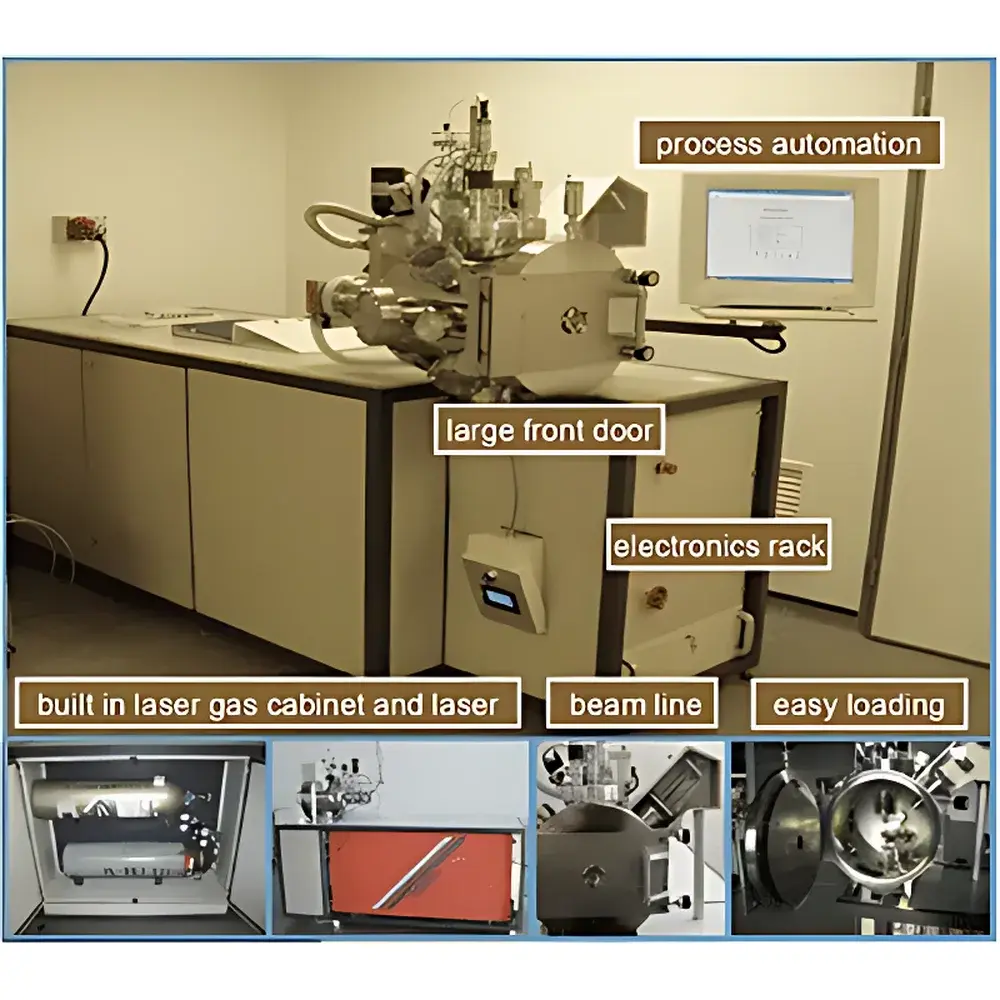
The SurfaceTech PLD-Workstation is a fully integrated, research-grade pulsed laser deposition (PLD) system engineered for precise, reproducible thin-film synthesis—particularly of complex oxides, nitrides, and multilayer heterostructures. Operating on the fundamental principle of laser ablation, the system uses high-energy 248 nm KrF excimer pulses to vaporize stoichiometric target material, generating a transient plasma plume that condenses onto a heated, rotating substrate under controlled vacuum and reactive gas environments. Unlike conventional PLD setups requiring external laser integration and extensive optical alignment, the PLD-Workstation embeds the Coherent COMPexPro 201F or 205F excimer laser—including sealed gas handling, beam delivery optics, and purge management—within a single, self-contained frame. Its all-enclosed UV optical path eliminates operator exposure risk and meets IEC 60825-1 Class 1 laser safety requirements without auxiliary interlocks. Designed explicitly for academic and industrial R&D labs, it supports rapid process iteration, in situ diagnostics, and scalable parameter mapping—making it ideal for exploratory materials science where compositional fidelity, interfacial sharpness, and crystalline phase control are critical.
Key Features
- Integrated excimer laser platform: Coherent COMPexPro 201F/205F with factory-aligned, maintenance-optimized beam train and internal KrF/He gas management (20 L premix + 10 L He).
- Modular ultra-high vacuum (UHV)-compatible chamber: Stainless steel construction with multiple CF40 and NW63 flanges for flexible integration of in situ diagnostics (RHEED, OES, FTIR, quadrupole mass spectrometry) or auxiliary sources (e-beam evaporation, RF sputtering, plasma assistance).
- Precision thermal and mechanical control: Substrate heater capable of stable operation up to 1000 °C (1″ or 3″ configuration) or 850 °C (2″), coupled with independent 0–50 RPM rotation; 4-position motorized target carousel with synchronized 0–50 RPM rotation for uniform ablation and reduced cratering.
- Dual-channel MFC-controlled reactive gas dosing: Enables precise partial pressure regulation of O₂, N₂, Ar, or custom mixtures during growth—critical for oxidation state control in transition metal oxides (e.g., LSMO, YBCO, STO).
- Full-system automation via LabVIEW-based PLD Control Software: Supports multi-step recipes (laser firing, temperature ramp, gas switching, shutter sequencing), real-time parameter logging (pulse count, energy, pressure, temperature), and export in CSV/HDF5 formats compliant with FAIR data principles.
Sample Compatibility & Compliance
The PLD-Workstation accommodates standard semiconductor and oxide substrates including Si, SrTiO₃, MgO, Al₂O₃, LaAlO₃, and flexible metallic foils (e.g., Ni-based tapes). Its chamber geometry and flange layout support wafer sizes from 10 mm to 76 mm (3″), with optional holders for patterned or suspended membranes. All vacuum components meet ISO-KF and CF sealing standards; base pressure reaches ≤5×10⁻⁸ mbar with turbomolecular pumping. The system complies with EU Machinery Directive 2006/42/EC, Electromagnetic Compatibility Directive 2014/30/EU, and Low Voltage Directive 2014/35/EU. Laser safety certification follows IEC 60825-1:2014 (Class 1 enclosure); electrical grounding and ESD protection conform to IEC 61340-5-1. For regulated environments, audit trails, user access levels, and electronic signature functionality can be enabled to align with GLP and FDA 21 CFR Part 11 requirements.
Software & Data Management
The native PLD Control Software runs on Windows 10/11 and provides an intuitive GUI with live visualization of laser pulse energy, chamber pressure, substrate temperature, and gas flow rates. Each deposition run generates timestamped metadata (operator ID, recipe version, hardware calibration flags) alongside raw sensor streams. Data export supports SI-traceable units and is compatible with MATLAB, Python (via Pandas/H5Py), and laboratory LIMS platforms. SURFWARE—a remote support suite—enables secure, encrypted TeamViewer-based diagnostics and real-time screen sharing with SurfaceTech application engineers. Software updates are delivered over LAN with version-controlled changelogs and backward-compatible binary deployment. Optional API modules allow integration with Python-based experiment orchestration frameworks (e.g., QCoDeS) for closed-loop optimization workflows.
Applications
- Growth of high-Tc superconducting films (YBa₂Cu₃O₇₋δ, Bi₂Sr₂CaCu₂O₈₊δ) with atomic-layer precision and low defect density.
- Synthesis of ferroelectric and multiferroic oxides (Pb(Zr,Ti)O₃, BiFeO₃) for memory and sensor applications.
- Deposition of transparent conducting oxides (In₂O₃:Sn, ZnO:Al) and wide-bandgap semiconductors (GaN, AlN) on lattice-mismatched templates.
- Development of artificial heterostructures (e.g., LaAlO₃/SrTiO₃ interfaces) to probe emergent 2D electron gases.
- Rapid screening of composition–structure–property relationships in perovskite solar cell absorbers (e.g., CsPbBr₃, MAPbI₃ derivatives) under inert or controlled-atmosphere conditions.
FAQ
What vacuum level can the PLD-Workstation achieve, and what pump configuration is used?
The system achieves a base pressure of ≤5×10⁻⁸ mbar using a combination of a dry scroll backing pump and a 700 L/s turbomolecular pump with active vibration isolation. Optional cryo-pumping upgrades are available for ultra-low partial pressure control of reactive species.
Is the laser alignment serviceable by the user, or does it require factory recalibration?
All optical components—including beam expanders, turning mirrors, and focusing lenses—are pre-aligned and sealed within the Class 1 enclosure. No user-accessible alignment is required; periodic energy calibration is performed automatically via internal photodiode feedback.
Can the PLD-Workstation be upgraded with in situ RHEED later?
Yes—the chamber includes two dedicated 63 mm CF viewports with UHV-compatible quartz windows and kinematic mounts, enabling straightforward RHEED integration without breaking vacuum or modifying structural welds.
Does the software support automated recipe transfer between instruments?
Yes—recipes are stored in XML format with embedded hardware abstraction layers, allowing seamless migration across SurfaceTech PLD platforms (e.g., from PLD-Workstation to industrial-scale PLD-Factory systems) with minimal parameter remapping.
What is the typical lead time for spare parts such as laser gas cartridges or targets?
Standard KrF laser gas cartridges (20 L premix) and He refills are stocked in SurfaceTech’s European distribution hub; delivery to EU labs averages 3–5 business days. Custom target fabrication services (oxide, nitride, metallic) are coordinated through certified partners with 4–6 week turnaround.