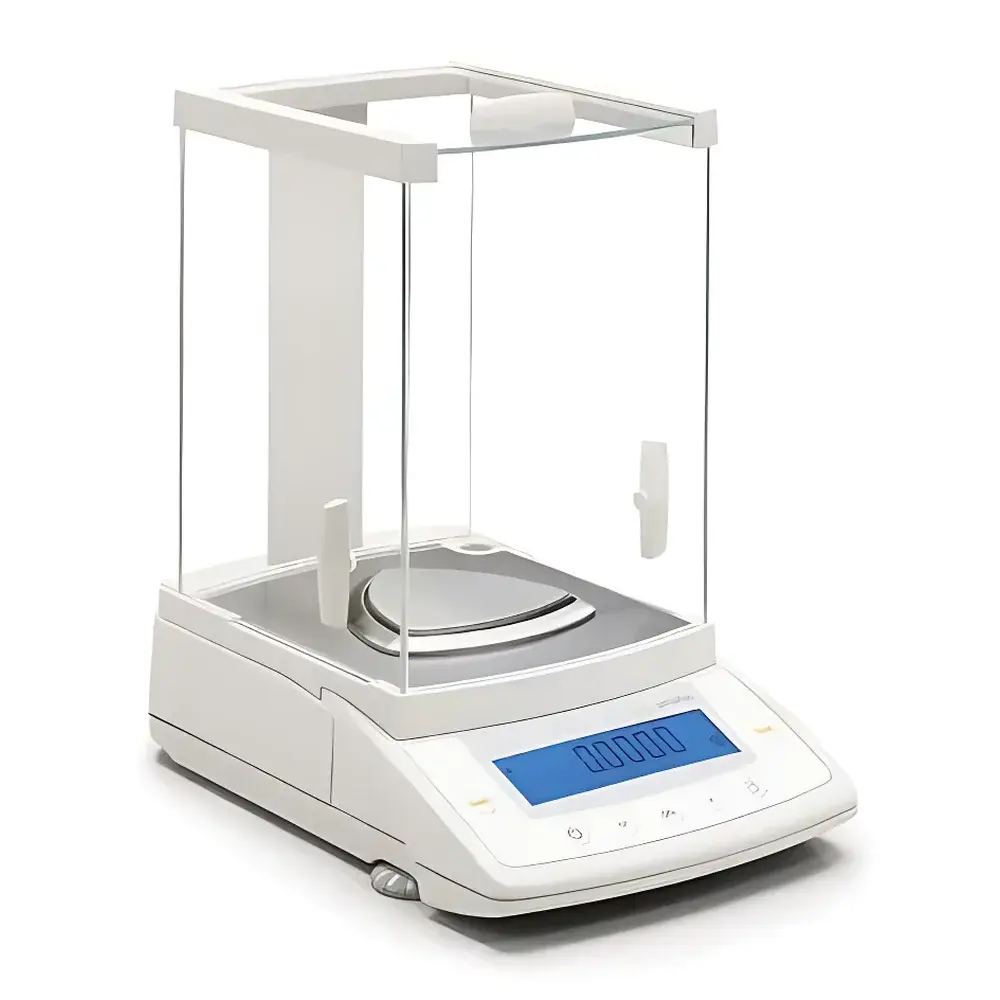
Sartorius CPA124S Analytical Balance
| Brand | Sartorius |
|---|---|
| Origin | Germany |
| Model | CPA124S |
| Readability | 0.1 mg |
| Capacity | 120 g |
| Calibration | Internal, isoCAL |
| Repeatability | ≤ ±0.1 mg |
| Linearity | ≤ ±0.2 mg |
| Pan Diameter | Ø 80 mm |
| Display | Backlit LCD (16 mm digit height) |
| Interface | RS-232C |
| Compliance | ISO/GLP-compliant data output |
| Sensor Technology | Monolithic weighing sensor |
| Application Modes | Percentage weighing, net/gross summation, animal weighing, unit conversion, piece counting |
| Optional Accessories | YDP03-0CE printer, external calibration weights |
Overview
The Sartorius CPA124S Analytical Balance is a high-precision laboratory instrument engineered for demanding quantitative analysis in regulated and research-intensive environments. Operating on electromagnetic force compensation (EMFC) principle, it delivers traceable mass measurement with 0.1 mg readability across a 120 g capacity range. Designed and manufactured in Germany, the CPA124S belongs to Sartorius’ CP series—renowned for metrological stability, mechanical robustness, and long-term repeatability under continuous laboratory use. Its monolithic weighing sensor architecture eliminates micro-vibrational coupling and thermal drift pathways common in segmented load cell designs, thereby enhancing signal integrity and reducing warm-up time. The balance meets fundamental requirements of analytical workflows where accuracy, auditability, and operational consistency are non-negotiable—particularly in pharmaceutical quality control, academic research, reference material preparation, and method validation laboratories.
Key Features
- Internal motor-driven calibration system with isoCAL technology: enables fully automated, temperature-compensated calibration and adjustment at user-defined intervals or upon environmental shift detection—ensuring continuous traceability without manual intervention.
- Backlit LCD display with 16 mm high digits: optimized for rapid, unambiguous reading under variable ambient lighting conditions; glare-resistant polarized screen minimizes parallax error.
- Large-diameter draft shield (Ø 80 mm pan, spacious chamber): facilitates handling of volumetric glassware, crucibles, and multi-component samples while enabling efficient cleaning and minimizing static accumulation.
- RS-232C bidirectional serial interface: supports direct connection to Sartorius YDP03-0CE printers or host computers for real-time data capture, eliminating transcription errors and supporting 21 CFR Part 11–compliant electronic records when integrated with validated software.
- Built-in application functions: percentage weighing, net/gross summation, animal weighing (dynamic averaging), unit conversion (g, oz, ct, etc.), and piece counting—all accessible via intuitive soft-key navigation without external programming.
- GLP/ISO-compliant reporting: automatic timestamping, operator ID entry (via optional keypad or software integration), and metadata tagging (e.g., calibration status, ambient temperature, humidity) embedded in printouts and exported datasets.
Sample Compatibility & Compliance
The CPA124S accommodates standard laboratory containers—including weighing boats, vials, beakers, and filter papers—within its open-access draft enclosure. Its wide pan diameter and low-profile chamber geometry support stable placement of tall or irregularly shaped vessels. All models comply with international metrological standards including OIML R76-1 (2006), EN 45501, and USP . For regulated environments, the balance supports full GLP documentation workflows and integrates seamlessly into GMP-aligned quality systems when paired with Sartorius LabX or third-party LIMS platforms. Internal calibration satisfies ISO 9001 and ISO/IEC 17025 internal verification requirements; external calibration using NIST-traceable weights (optional) enables full uncertainty budgeting per ISO/IEC 17025 Clause 6.5.
Software & Data Management
Data export is natively supported via ASCII-formatted RS-232C transmission, compatible with Excel, LabWare, STARLIMS, and custom SCADA systems. When connected to Sartorius LabX software (sold separately), the CPA124S enables role-based user management, electronic signature enforcement, automated report generation, and full audit trail logging—including all calibration events, weight readings, parameter changes, and operator actions. The system maintains immutable timestamps synchronized to network time protocol (NTP) servers, fulfilling FDA 21 CFR Part 11 Subpart B requirements for electronic records and signatures. Raw data files are stored in .csv or .txt format with embedded metadata headers for traceability.
Applications
This balance is routinely deployed in pharmaceutical QC labs for assay standardization, active pharmaceutical ingredient (API) quantification, and dissolution testing sample preparation. It serves as a primary mass comparator in metrology labs performing uncertainty analysis of secondary standards. Academic chemistry departments utilize it for stoichiometric reagent dispensing, gravimetric titration endpoint determination, and nanoparticle yield calculation. Environmental testing facilities rely on its repeatability for filter weighing in PM2.5/PM10 analysis, while food safety labs apply it to moisture content determination and nutritional labeling compliance. Its isoCAL functionality makes it especially suitable for environments subject to diurnal temperature fluctuations or HVAC cycling.
FAQ
Does the CPA124S support external calibration?
Yes—while internal isoCAL calibration is standard, optional external calibration using Class E2 or F1 weights is supported via dedicated calibration mode.
Is the RS-232C interface compatible with modern Windows/macOS systems?
Yes—when used with a USB-to-serial adapter and appropriate driver, the interface maintains full ASCII protocol compatibility with current operating systems.
Can the balance store multiple user profiles locally?
No—the CPA124S does not feature onboard user memory; user identification must be entered manually per session or managed externally via LabX or LIMS integration.
What is the warm-up time required for optimal performance?
Sartorius recommends a minimum 30-minute stabilization period after power-on under stable ambient conditions (20–25 °C, <60 % RH) before initiating critical measurements.
Is the monolithic sensor susceptible to overload damage?
The sensor incorporates mechanical overload protection up to 200 % of rated capacity; however, repeated overloading above 150 % may degrade long-term linearity and requires recalibration verification.