
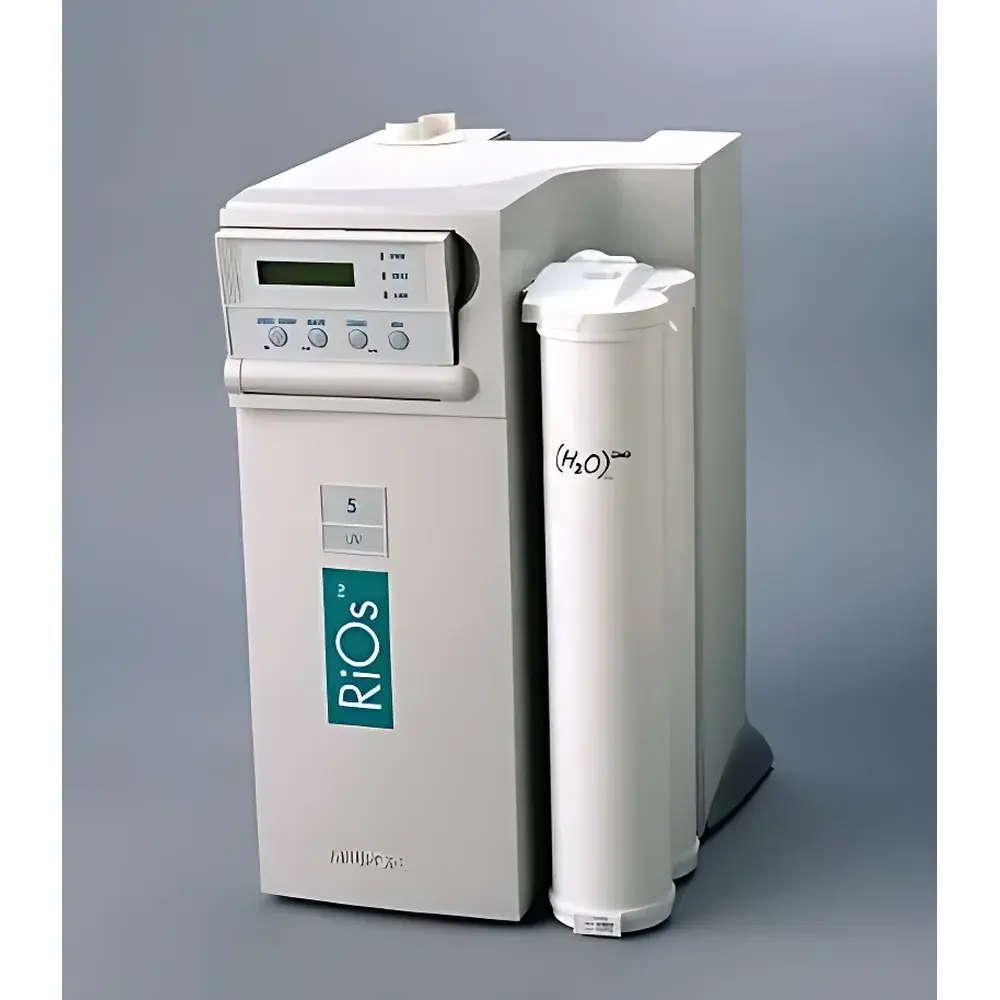
Millipore RiOs 8 Ultra Pure Water System
| Brand | Millipore |
|---|---|
| Origin | France |
| Model | RiOs 8 |
| Flow Rate | 8 L/h (±15%) |
| Recovery Rate | 28% |
| Dimensions | 45.7 × 25.5 × 31.5 cm |
| Operating Weight | 14 kg |
| Inlet Water Requirement | 80–160 L/day |
| Ion Rejection | 94–99% |
| Organic & Particle & Microbial Reduction | ≥99% |
| Compliance | UL/cUL E216983, UL 61010, CE (89/336/CEE & 73/23/CEE), ISO 9001 & ISO 14001 |
Overview
The Millipore RiOs 8 Ultra Pure Water System is a compact, integrated laboratory water purification platform engineered to deliver consistent Type III (ISO 3696 / ASTM D1193 Grade III) purified water directly from municipal tap feed water. Utilizing a multi-stage purification architecture—comprising pre-filtration, high-efficiency reverse osmosis (RO), and optional UV irradiation—the system achieves robust removal of ions, organic contaminants, particulates, and microorganisms. Its design emphasizes operational stability, low total cost of ownership, and seamless integration into routine lab workflows where reliable, low-conductivity water is required for non-critical applications such as glassware rinsing, autoclave and humidifier feed, and as pretreatment for downstream Milli-Q® ultrapure water systems.
Key Features
- Plug-and-play installation with integrated pre-filter cartridge housing three distinct purification media (sediment, carbon, and scale inhibitor) for optimized feed water conditioning.
- Self-maintainable RO membrane module with advanced high-recovery circuitry—reducing wastewater generation by up to 50% compared to conventional RO-based systems.
- Stable, calibrated flow rate of 8 L/h (±15%), maintained across variable inlet pressure and temperature conditions typical in institutional laboratory environments.
- Optional 185/254 nm dual-wavelength UV lamp for enhanced microbial control and TOC reduction—critical for applications sensitive to bacterial regrowth or organic leaching.
- Intuitive user interface featuring a backlit LCD screen and compact membrane keypad for real-time monitoring of system status, filter life, conductivity, and maintenance alerts.
- Compact footprint (45.7 × 25.5 × 31.5 cm) and lightweight chassis (14 kg) enable flexible benchtop deployment without dedicated utility infrastructure.
Sample Compatibility & Compliance
The RiOs 8 is validated for continuous operation with standard municipal potable water meeting local regulatory requirements (e.g., WHO Guidelines for Drinking-water Quality). It meets international safety and electromagnetic compatibility standards including UL 61010-1 and its Canadian counterpart cUL (File E216983) under the “Laboratory Use Electrical Equipment” classification. The system bears CE marking per Directive 89/336/EEC (EMC) and 73/23/EEC (Low Voltage Directive). Manufacturing adheres to ISO 9001:2015 (Quality Management) and ISO 14001:2015 (Environmental Management) certified processes. While not intended for GMP-regulated final product preparation, its consistent performance supports GLP-aligned documentation practices when paired with optional audit-trail-capable software modules.
Software & Data Management
The RiOs 8 operates autonomously without external PC connectivity; however, its embedded firmware logs key operational parameters—including runtime hours, filter saturation indicators, conductivity trends, and UV lamp usage—for internal diagnostics and preventive maintenance scheduling. For laboratories requiring electronic record retention compliant with FDA 21 CFR Part 11 or EU Annex 11 principles, integration with third-party LIMS or Millipore’s legacy LabManager™ software (via RS232 or analog output) enables export of timestamped quality metrics. All calibration and service events are traceable through the onboard event log, supporting internal QA audits and equipment qualification protocols (IQ/OQ).
Applications
- Routine laboratory glassware washing and final rinse cycles where residual ion content must remain below 5 µS/cm.
- Feed water supply for steam autoclaves, laboratory sterilizers, and industrial washers requiring low-mineral input to prevent scaling and extend component lifetime.
- Pretreatment source for Milli-Q® IQ series or other ultrapure water generators—ensuring stable RO feed quality and extending upstream deionization cartridge life.
- Humidification systems for environmental chambers and controlled-atmosphere enclosures where mineral deposition could compromise sensor accuracy or chamber integrity.
- General-purpose buffer and reagent preparation for non-quantitative assays, histology processing, and plant tissue culture media dilution.
FAQ
What type of feed water is required for optimal RiOs 8 performance?
Municipal tap water meeting local drinking water standards is sufficient; inlet pressure should be 2–6 bar (29–87 psi), temperature between 5–35°C, and chlorine concentration ≤ 5 mg/L. Pre-treatment is recommended if feed water exceeds 500 ppm TDS or contains high iron/manganese levels.
Can the RiOs 8 be connected to a central water distribution loop?
No—the RiOs 8 is designed exclusively as a point-of-use system. It lacks built-in recirculation pumps or loop-compatible hydraulics; connecting it to a closed-loop network may compromise flow stability and void warranty coverage.
How often must consumables be replaced?
Pre-filter cartridges require replacement every 6 months or after 1,000 L of processed water (whichever occurs first); RO membranes typically last 2–3 years depending on feed water quality and daily usage volume.
Is conductivity monitoring performed continuously?
Yes—integrated inline conductivity sensors provide real-time measurement at the outlet, with automatic alarm thresholds configurable via the front-panel interface to alert users upon deviation from the 1–5 µS/cm specification range for Type III water.
Does the system support remote monitoring or IoT integration?
The base RiOs 8 model does not include Ethernet/Wi-Fi connectivity or cloud telemetry. Remote data access requires external analog-to-digital conversion hardware and integration with facility-wide SCADA or building management systems.



