
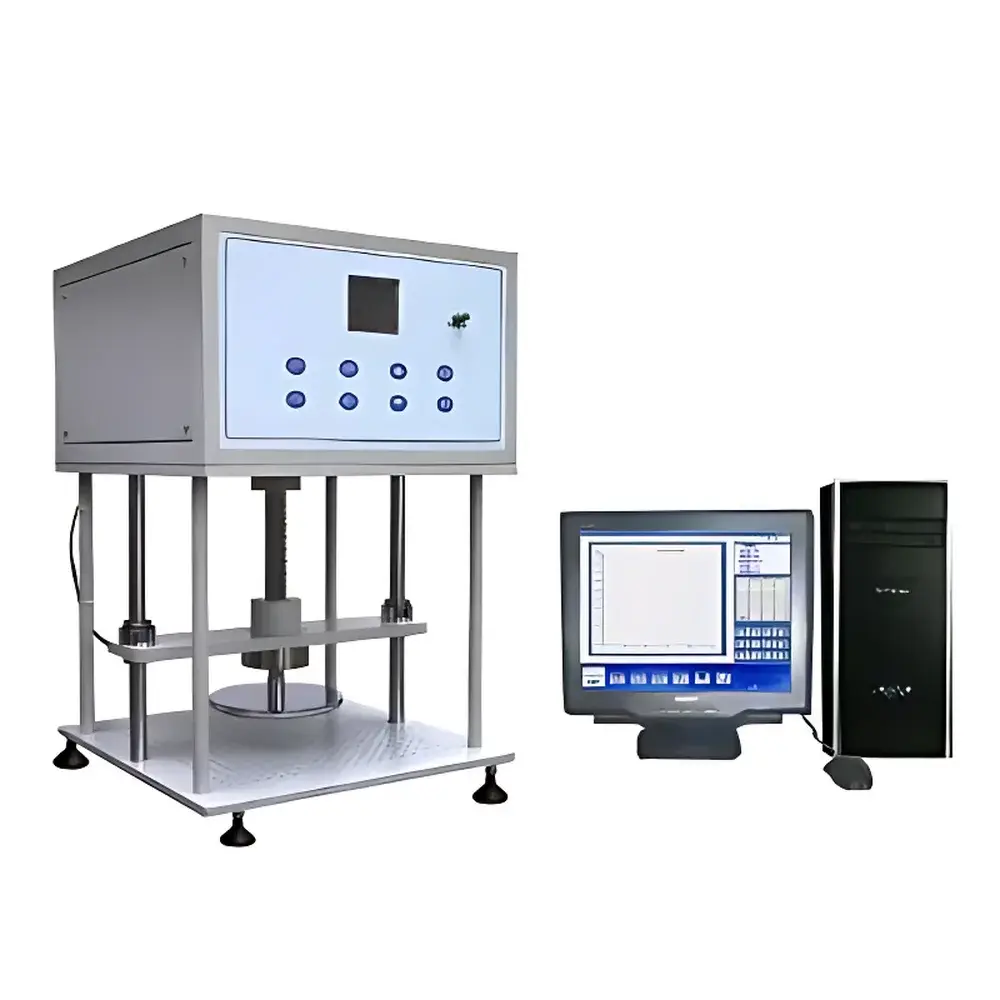
Beiguang Jingyi HYX-2000 Foam Indentation Hardness Tester
| Brand | Beiguang Jingyi / All Precision Instrument |
|---|---|
| Origin | Beijing, China |
| Manufacturer Type | Direct Manufacturer |
| Product Category | Domestic |
| Model | HYX-2000 |
| Max Test Force | 2000 N |
| Frequency Range | 50 Hz |
| Host Weight | 100 kg |
| Test Speed | 100 mm/min ±20 mm |
| Force Resolution | 0.25 N |
| Measurement Accuracy | <1% FS |
| Max Stroke | 3500 mm (customizable) |
| Indenter Diameter | 200 mm |
| Test Platform Dimensions | 500 × 600 mm |
| Vent Hole Pattern Diameter | 250 × 250 mm |
| Overall Dimensions | 500 × 600 × 800 mm |
| Power Supply | 220 V / 50 Hz |
Overview
The Beiguang Jingyi HYX-2000 Foam Indentation Hardness Tester is a precision-controlled mechanical testing system engineered for standardized evaluation of indentation hardness in flexible polyurethane foams and other compliant polymeric foam materials. It operates on the principle of controlled quasi-static compression—applying a defined indenter at a regulated speed to a specimen of standard dimensions, measuring the force required to achieve specified indentation depths (e.g., 25%, 40%, or 65% of original thickness), as prescribed by ISO 2439, ASTM D3574, and GB/T 10807–2006. Designed for compliance with national and international soft foam testing protocols, the instrument supports all three standardized test methods (Method A, B, and C), enabling reproducible determination of load-deflection behavior critical for quality assurance in automotive seating, furniture cushioning, mattress manufacturing, and packaging material development.
Key Features
- Triple-method compliance: Fully configurable for Method A (constant-rate indentation), Method B (force-controlled dwell), and Method C (multi-stage indentation with hold periods), per GB/T 10807–2006 and ISO 2439.
- High-fidelity force measurement: Equipped with a 200 kg capacity wheel-spoke load cell offering 0.25 N resolution and <1% full-scale accuracy, calibrated traceable to national metrological standards.
- Programmable motion control: Precise servo-driven actuation enables repeatable test speeds from 10 to 100 mm/min (±20 mm positional tolerance), with programmable stroke limits up to 3500 mm for oversized or layered specimens.
- Dual-control architecture: Supports both embedded CPU-based standalone operation and PC-integrated control via RS232, USB, or optional Ethernet interface—ensuring flexibility in lab environments with or without networked data infrastructure.
- Integrated safety logic: Automatic overload shutdown, dual-mode (electronic + mechanical) end-stop limiting, and real-time force/stroke monitoring prevent hardware damage and ensure operator safety during high-cycle fatigue or long-duration creep tests.
- Modular indenter configuration: Standard 200 mm diameter flat circular platen; optional custom platens (e.g., contoured, segmented, or perforated) available for non-standard geometries such as automotive seat backs or irregularly shaped foam components.
Sample Compatibility & Compliance
The HYX-2000 accommodates specimens up to 500 × 600 mm on its rigid test platform, with vent hole patterns (250 × 250 mm) facilitating air escape during rapid compression—minimizing pneumatic resistance artifacts common in low-density open-cell foams. It meets requirements for GB/T 10802 (flexible polyurethane foam specifications), GB/T 10807–2006 (indentation hardness test methods), and aligns with the dimensional and procedural constraints of ISO 2439:2021 and ASTM D3574–22. While not certified to ISO/IEC 17025 for accredited testing, its calibration protocol supports GLP-compliant documentation when used with validated software and traceable reference weights. The system is suitable for R&D labs, QC departments, and third-party testing facilities requiring auditable, repeatable soft-material mechanical characterization.
Software & Data Management
The included Windows-based control and analysis software provides real-time graphical display of force–displacement curves, automatic peak detection, multi-curve overlay, and export to CSV, PDF, or XML formats. All test parameters—including method selection, speed, target indentation depth, dwell time, and return velocity—are fully scriptable and stored with timestamped metadata. Audit trail functionality logs user actions, parameter changes, and calibration events—supporting FDA 21 CFR Part 11 readiness when deployed with electronic signature modules and secure user authentication. Data files are structured for direct import into LIMS platforms or statistical process control (SPC) tools. Firmware updates and calibration coefficient management are performed locally without cloud dependency.
Applications
- Quality control of flexible polyurethane foams in furniture and bedding manufacturing.
- Development and validation of automotive interior components (seat cushions, headrests, door panels).
- Material specification verification against customer technical data packages (TDPs) referencing ISO 2439 or GB/T 10807.
- Comparative analysis of foam aging effects (compression set, hysteresis loss) under cyclic loading protocols.
- Supporting formulation optimization in polymer R&D labs through correlation of hardness metrics with chemical composition and crosslink density.
- Testing of composite foam-laminates, viscoelastic memory foams, and bio-based alternative foams where indentation response reflects bulk resilience and energy absorption characteristics.
FAQ
What standards does the HYX-2000 comply with?
It supports GB/T 10807–2006 (Chinese national standard), ISO 2439:2021, and ASTM D3574–22 for indentation hardness testing of flexible foams.
Can the system perform cyclic or fatigue testing?
Yes—the programmable motion controller allows repeated indentation–recovery sequences at fixed frequencies up to 50 Hz, enabling basic fatigue profiling within the 2000 N force range.
Is the software compatible with Windows 10/11 and 64-bit systems?
Yes, the latest firmware and software package are validated for Windows 10 (v22H2) and Windows 11 (v23H2), including driver support for USB 3.0 and modern HID-compliant peripherals.
How is force calibration verified?
Calibration is performed using NIST-traceable deadweight standards; the system stores calibration coefficients with date/time stamps and supports multi-point linearity verification across the full 0–2000 N range.
Does the instrument support custom test protocols beyond A/B/C methods?
Yes—through the scripting interface, users may define proprietary ramp-hold-return profiles, conditional triggers (e.g., force threshold activation), and real-time pass/fail logic based on user-defined tolerances.



