
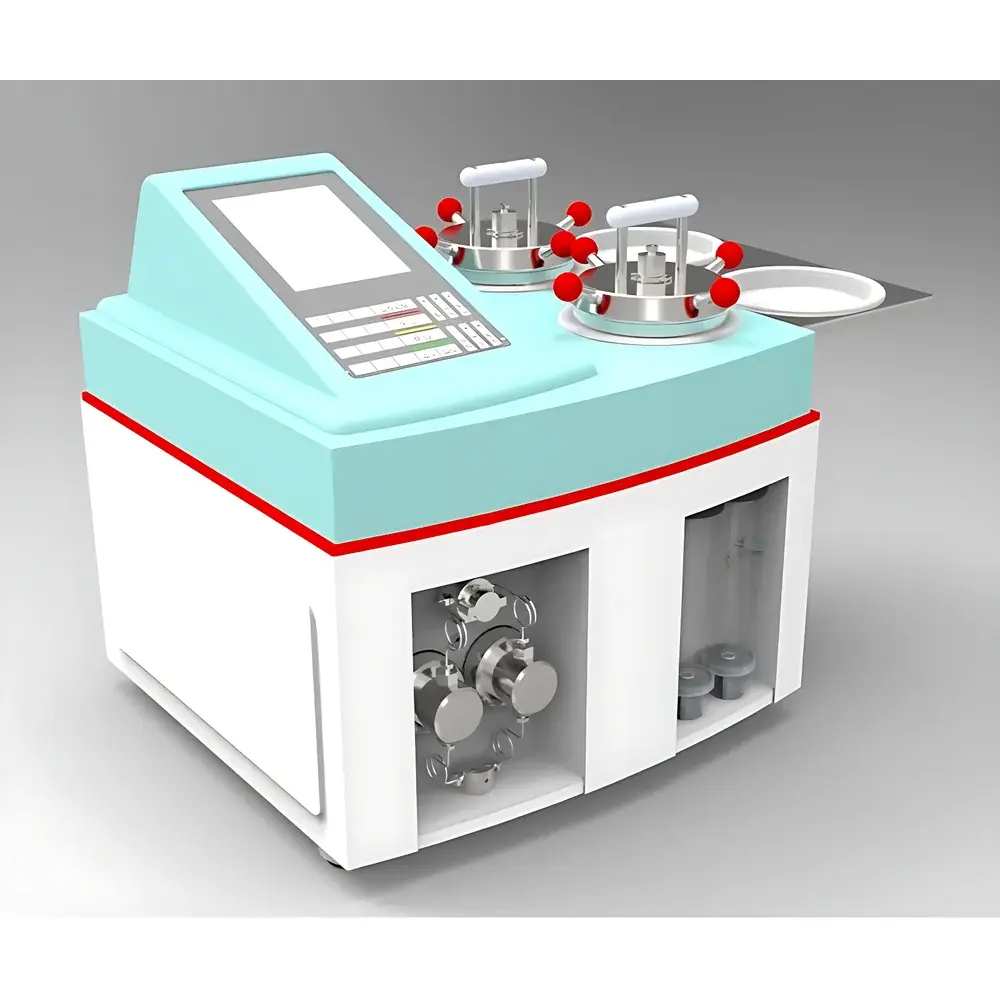
Shanghai Spectrum SP-200QSE Automated Accelerated Solvent Extractor
| Brand | Shanghai Spectrum |
|---|---|
| Origin | Shanghai, China |
| Model | SP-200QSE |
| Extraction Type | Solid-Liquid Extraction |
| Automation Level | Fully Automated |
| Compliance Context | Designed for GLP-compliant laboratories |
| Software Interface | Touchscreen GUI with method storage and audit trail capability |
| Safety Features | Pressure-relief valves, temperature/pressure real-time monitoring, leak detection |
| Sample Throughput | Batch processing with programmable sequence execution |
| Solvent Compatibility | Compatible with common organic solvents (e.g., hexane, acetone, dichloromethane, methanol, ethyl acetate) |
| System Architecture | Modular solvent delivery, heated extraction cell, cooled collection module |
Overview
The Shanghai Spectrum SP-200QSE Automated Accelerated Solvent Extractor is an engineered solution for high-efficiency solid-liquid extraction in analytical laboratories. It operates on the principle of accelerated solvent extraction (ASE®), a technique standardized under ASTM D7631 and EPA Method 3545A, which leverages elevated temperature and pressure to enhance solvent penetration into solid matrices and accelerate analyte desorption. By maintaining solvent below its boiling point under controlled pressure (typically up to 20 MPa), the system enables rapid, reproducible extractions while preserving thermally labile compounds. The SP-200QSE is specifically designed for routine analysis of environmental soils, foodstuffs, pharmaceuticals, polymers, and botanical materials—where quantitative recovery of target analytes (e.g., PAHs, PCBs, pesticides, lipids, alkaloids) is critical prior to downstream chromatographic or spectroscopic analysis.
Key Features
- Fully automated operation with pre-programmable extraction sequences, including rinse, static extraction, flush, and purge steps—minimizing manual intervention and operator variability.
- Independent fluidic pathways between extraction cells and collection vials eliminate cross-contamination, supporting strict trace-level analysis requirements.
- Integrated thermal management system ensures precise temperature control during static extraction (range: ambient to 200 °C, typical operational range 80–150 °C), with real-time feedback and overtemperature cutoff.
- Modular solvent handling architecture supports dual-solvent selection and gradient elution protocols, enabling method development for complex matrices.
- Self-diagnostic firmware monitors pressure transients, flow consistency, and valve actuation status, logging fault codes for maintenance traceability.
- Compact benchtop footprint with front-access service panels facilitates integration into regulated QC/QA environments with limited floor space.
Sample Compatibility & Compliance
The SP-200QSE accommodates standard ASE-compatible extraction cells (1–100 mL volume range, stainless steel or inert polymer variants), allowing flexibility across sample mass (0.5–20 g dry weight) and matrix types—including clay-rich soils, fatty tissues, powdered herbs, and composite polymers. Cell loading is performed externally; sealed cells are robotically indexed into the heating chamber. All wetted components comply with USP Class VI and FDA 21 CFR Part 11 readiness—audit trail functionality records user ID, timestamp, method parameters, and run completion status. The system meets essential design criteria referenced in ISO/IEC 17025:2017 for method validation support, including repeatability assessment, spike recovery testing, and blank evaluation workflows.
Software & Data Management
The embedded touchscreen interface runs proprietary extraction control software with intuitive wizard-driven method setup, parameter locking for SOP enforcement, and encrypted local storage for ≥1,000 method files. Export options include CSV-formatted extraction logs and PDF summary reports compatible with LIMS integration via USB or Ethernet. Audit trail records are immutable and time-stamped, satisfying GLP/GMP documentation requirements for regulatory submissions. Remote monitoring is supported through optional SNMP-enabled network configuration, allowing centralized oversight in multi-instrument facilities.
Applications
- Environmental testing: Extraction of persistent organic pollutants (POPs) from sediment, sludge, and airborne particulates per EPA SW-846 Methods 3545A and 3546.
- Food safety: Determination of pesticide residues in fruits, vegetables, and cereals following AOAC Official Method 2007.01.
- Pharmaceutical R&D: Recovery of active pharmaceutical ingredients (APIs) and excipients from solid dosage forms for dissolution profiling and stability studies.
- Natural products: Isolation of bioactive terpenoids, flavonoids, and polyphenols from plant biomass without degradation.
- Materials science: Leaching studies of plasticizers, flame retardants, or stabilizers from polymer composites under simulated aging conditions.
FAQ
What solvent types are compatible with the SP-200QSE?
Commonly used solvents include hexane, acetone, dichloromethane, methanol, ethyl acetate, and their binary mixtures—provided vapor pressure and chemical compatibility with stainless steel and fluoropolymer seals are verified.
Is method validation support included?
Yes—the system enables systematic optimization of temperature, pressure, static time, and flush volume; built-in replicate scheduling and blank tracking facilitate ICH Q2(R2)-aligned validation protocols.
Can the SP-200QSE be integrated into an existing LIMS?
CSV and PDF report exports are LIMS-ready; optional API-based integration is available through Shanghai Spectrum’s certified middleware package.
What maintenance intervals are recommended?
Routine inspection of O-rings, pressure transducers, and solvent filters is advised every 200 runs or quarterly—whichever occurs first—per the manufacturer’s Preventive Maintenance Guide.
Does the instrument meet international safety standards?
It conforms to IEC 61010-1:2010 for electrical safety and includes CE marking for EMC and low-voltage directive compliance.



