
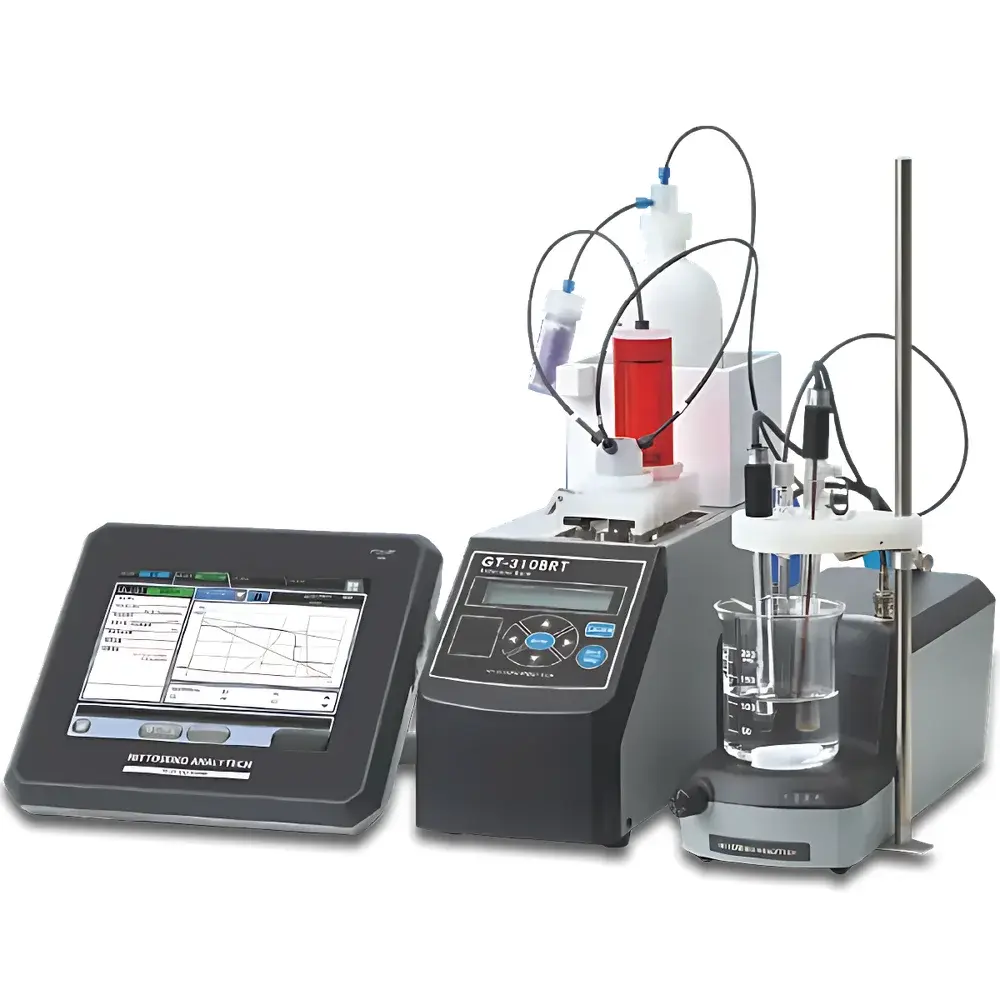
MITSUBISHI CHEMICAL GT-310 Advanced Automatic Potentiometric Titrator with Integrated Karl Fischer Moisture Detection
| Brand | MITSUBISHI CHEMICAL |
|---|---|
| Origin | Japan |
| Model | GT-310 |
| Display | 8.4-inch color touchscreen |
| Channels | up to 4 simultaneous potentiometric and/or Karl Fischer titration channels |
| Modularity | supports solvent dispensers, autosamplers, analytical balances, and printers |
| Compliance | Designed for GLP/GMP environments |
| Pricing | Available upon request |
Overview
The MITSUBISHI CHEMICAL GT-310 is a high-precision, modular automatic potentiometric titrator engineered for laboratories requiring rigorous, reproducible quantitative analysis of acid-base, redox, precipitation, and complexometric reactions — alongside integrated coulometric or volumetric Karl Fischer moisture determination. Unlike conventional single-function titrators, the GT-310 implements a dual-capability architecture that unifies potentiometric endpoint detection (based on Nernstian potential measurement across a reference–indicator electrode pair) with standardized water content quantification per ASTM E203 and ISO 760. Its core design prioritizes metrological integrity: all titration modules employ calibrated burettes with precision piston-driven dosing systems, temperature-compensated electrode signal conditioning, and real-time potential slope monitoring to ensure robust endpoint recognition under variable sample matrices.
Key Features
- 8.4-inch high-resolution color touchscreen interface with intuitive graphical navigation and multi-language support (English, Japanese, Chinese, German)
- Simultaneous operation of up to four independent titration channels — configurable as any combination of potentiometric and Karl Fischer units (e.g., 2× pH + 2× KF, or 3× redox + 1× KF)
- Preloaded method library compliant with pharmacopeial standards (USP , EP 2.5.1, JP 2.05) and industrial protocols (ASTM D664, D4739, ISO 8289)
- Automatic electrode and reagent identification via RFID-tagged consumables, minimizing operator error and enabling audit-ready traceability
- Modular expansion architecture supporting seamless integration of external peripherals: 12-position autosamplers (model AS-310), solvent delivery modules (SDM-310), analytical balances (0.01 mg resolution), thermal printers, and LIMS-compatible data export ports
- Real-time dual-channel display showing titration curve (E vs. V), first derivative (dE/dV), and moisture content (ppm or %) side-by-side for cross-validated interpretation
Sample Compatibility & Compliance
The GT-310 accommodates liquid, semi-solid, and solid samples across diverse sectors — including pharmaceutical active pharmaceutical ingredients (APIs), petrochemical lubricants, food-grade acids, battery electrolytes, and polymer stabilizers. Sample introduction methods include direct syringe injection, automated vial-based sampling, and flow-cell configurations for process stream monitoring. All hardware and firmware comply with IEC 61000-4 electromagnetic compatibility standards and meet essential requirements of the EU Machinery Directive 2006/42/EC. Data integrity features align with FDA 21 CFR Part 11 requirements, including electronic signatures, role-based user access control, and immutable audit trails for method changes, calibration events, and result exports.
Software & Data Management
Control and analysis are executed via the proprietary TITRAVISION™ software suite (v4.2+), installed on an embedded industrial-grade ARM processor. The software provides full method development capabilities — including dynamic equivalence point algorithms (first-derivative, second-derivative, fixed potential, Gran plot), customizable titration parameters (dosing increments, pause times, stability thresholds), and automatic blank correction. Raw data (potential, volume, temperature, time stamps) are stored in vendor-neutral .CSV and .XML formats. Secure export options include encrypted USB transfer, Ethernet-based SFTP upload, and direct ODBC connectivity to enterprise LIMS or ELN platforms. All calibration records, validation reports (IQ/OQ), and system suitability tests are auto-generated and timestamped for regulatory submissions.
Applications
- Pharmaceutical QC: Quantification of residual titratable bases in amine-containing APIs; assay of chloride impurities in sodium heparin per USP monographs
- Fuel analysis: Total acid number (TAN) and total base number (TBN) determination in engine oils and biodiesel blends (ASTM D974, D2896)
- Food & beverage: Titration of free fatty acids in edible oils; determination of SO₂ in wine using iodometric back-titration
- Electrolyte R&D: Precise measurement of LiPF₆ concentration and HF contamination in lithium-ion battery electrolytes
- Environmental testing: Alkalinity profiling of wastewater effluents; cyanide quantification via silver nitrate potentiometric titration (ISO 6703-1)
FAQ
Can the GT-310 perform both potentiometric and Karl Fischer titrations in the same run?
Yes — each channel operates independently, allowing concurrent execution of different titration types with synchronized timing and unified data logging.
Is method validation support included with the instrument?
Yes — the system ships with pre-validated IQ/OQ documentation templates and a comprehensive validation guide aligned with ASTM E2500 and ICH Q2(R2).
What electrode types are supported for potentiometric measurements?
Standard combinations include Ag/AgCl reference electrodes paired with glass pH, platinum redox, silver halide, or ion-selective electrodes (e.g., fluoride, calcium); all feature auto-recognition via embedded RFID.
Does the GT-310 meet GLP compliance requirements for regulated laboratories?
Yes — full audit trail, electronic signature capability, and secure user authentication satisfy GLP principles as defined in OECD Series on Principles of Good Laboratory Practice.
How is reagent consumption monitored and managed?
Integrated burette level sensors and reagent RFID tags track usage in real time; low-reagent alerts trigger automated notifications and optional pause commands to prevent incomplete titrations.







