
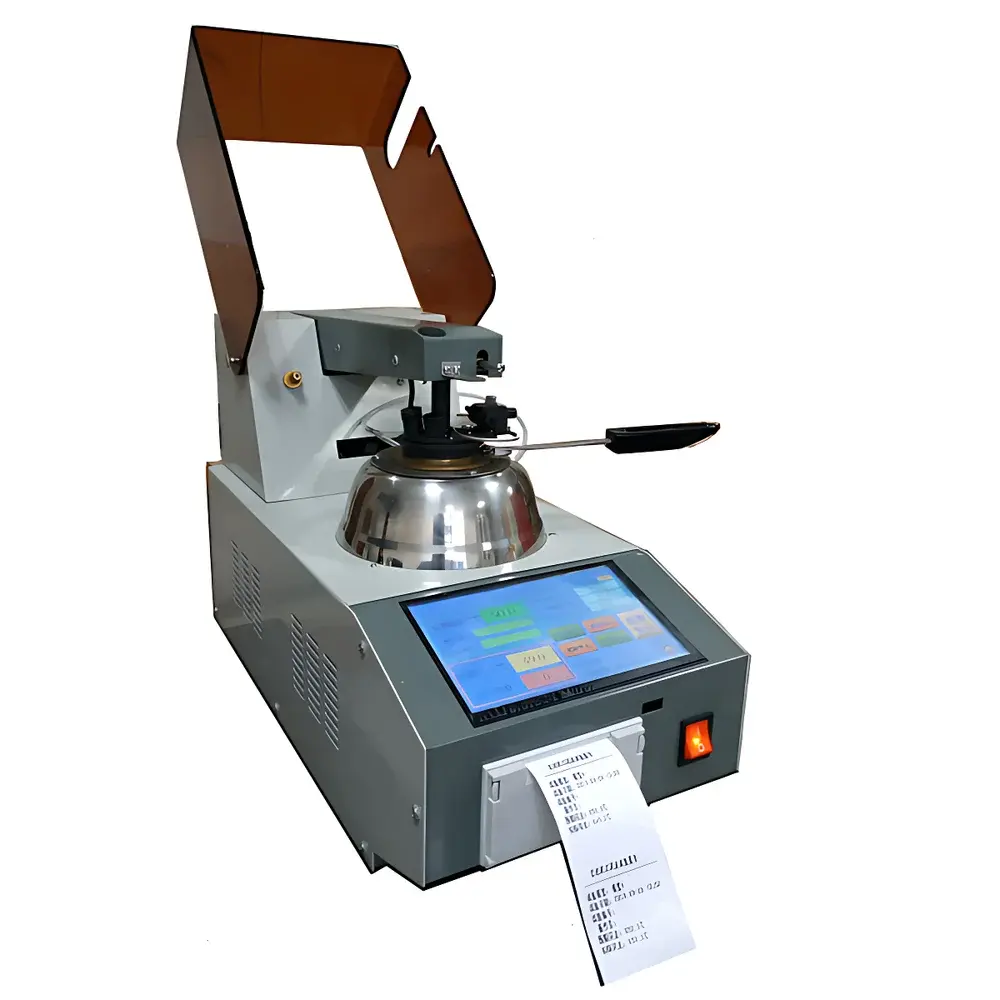
Xufeng XF-56SE Automatic Tag Closed-Cup Flash Point Tester
| Brand | Xufeng |
|---|---|
| Origin | Shanghai, China |
| Model | XF-56SE |
| Detection Method | Closed-Cup (Tag) |
| Operation Mode | Fully Automatic |
| Temperature Range | Ambient to 95 °C (standard) |
| Ignition Methods | Electric spark ignition (standard on XF-56SE) and external fuel gas ignition (compatible via optional inlet) |
| Repeatability | Compliant with ASTM D56, SH/T 0733, and GB/T 21929-2008 |
| Applicable Standards | ASTM D56, SH/T 0733, GB/T 21929-2008, ISO 1523, IP 304, JIS K 2265 |
Overview
The Xufeng XF-56SE Automatic Tag Closed-Cup Flash Point Tester is a precision-engineered analytical instrument designed for the accurate, repeatable determination of flash point values in flammable and combustible liquids using the standardized Tag closed-cup method. Based on the fundamental principle of detecting the lowest temperature at which vapors above a liquid sample ignite momentarily when exposed to a controlled ignition source under specified atmospheric conditions, the XF-56SE implements rigorous thermal ramping, precise vapor-phase sampling, and high-sensitivity thermal detection—fully compliant with ASTM D56, SH/T 0733, and GB/T 21929-2008. Unlike open-cup methods, the Tag closed-cup technique minimizes vapor loss and environmental interference, yielding conservative, safety-relevant flash point data essential for hazard classification, transportation regulation (e.g., UN GHS, IMDG Code), and quality control in petroleum refining, lubricant formulation, solvent manufacturing, and polymer processing.
Key Features
- Fully automated operation with one-touch start: Predefined test protocols execute unattended thermal ramping, timed ignition cycles, and flash point confirmation per selected standard.
- Multi-standard mode selection: User-selectable test configurations for ASTM D56 (Tag method), SH/T 0733 (Chinese Tag variant), and GB/T 21929-2008 (Tager method), each enforcing respective heating rates, stirrer activation timing, and ignition frequency schedules.
- Intelligent expected flash point search mode: For unknown samples, the instrument performs rapid preliminary scans to estimate initial flash point range, optimizing subsequent full-compliance testing efficiency.
- Dual ignition capability: Standard electric spark ignition eliminates dependency on external fuel gas; optional gas inlet port enables compatibility with propane or butane sources where regulatory or procedural requirements mandate flame-based ignition.
- High-stability temperature control: ±0.1 °C accuracy across 0–95 °C range, achieved via Peltier-cooled metal bath (DW-25 optional) or ambient-water circulation, ensuring reproducible sample thermal history.
- Industrial-grade human-machine interface: 7-inch full-color capacitive touchscreen with intuitive icon-driven navigation, real-time graphical temperature curve display, and step-by-step protocol guidance.
- Integrated diagnostics and fault logging: Self-check routines verify thermocouple integrity, cup seal pressure, ignition circuit continuity, and cooling system status prior to test initiation.
- RS-232C serial interface and built-in thermal printer: Enables direct data export to LIMS or central QC databases and hard-copy reporting compliant with GLP audit trails.
Sample Compatibility & Compliance
The XF-56SE accepts standard Tag closed-cup test vessels (40 mL capacity, ASTM-compliant geometry) and accommodates a broad range of petroleum distillates—including gasoline, kerosene, diesel fuels, naphthas, and light lubricating oils—as well as organic solvents (e.g., acetone, ethanol, toluene) and biofuel blends. All operational parameters—including heating rate (1.0–1.5 °C/min), stirrer speed (250 rpm), ignition interval (every 0.5–1.0 °C), and final hold time—are programmatically locked to match the exact procedural mandates of ASTM D56, SH/T 0733, and GB/T 21929-2008. Instrument validation includes traceable calibration against NIST-traceable reference standards, and design conforms to IEC 61010-1 for electrical safety in laboratory environments. Data integrity meets FDA 21 CFR Part 11 requirements when paired with validated software and access-controlled user accounts.
Software & Data Management
While the XF-56SE operates autonomously via embedded firmware, its RS-232C interface supports bidirectional communication with third-party laboratory information management systems (LIMS) or custom QA/QC platforms. Test logs include timestamped temperature profiles, ignition event timestamps, detected flash point value, atmospheric pressure input (manually entered or auto-compensated), operator ID, and pass/fail status relative to specification limits. All records are stored internally with non-volatile memory retention (>10,000 test cycles). Optional PC-based configuration utility allows batch parameter setup, report template customization, and firmware updates—without requiring proprietary software licenses. Audit trail functionality captures all user-initiated changes to test settings or calibration offsets, satisfying ISO/IEC 17025 documentation requirements.
Applications
- Refinery QC labs: Routine flash point verification of finished gasoline and jet fuel batches against ASTM D439 and D1655 specifications.
- Lubricant R&D: Screening oxidative stability intermediates and base oil fractions during formulation development.
- Chemical manufacturing: Release testing of industrial solvents per OSHA HCS and EU CLP hazard communication regulations.
- Regulatory compliance laboratories: Generating certified test reports for UN transport classification (Class 3 flammable liquids) and REACH dossier submissions.
- Educational institutions: Teaching core principles of volatility, vapor pressure, and fire safety testing in chemical engineering and materials science curricula.
FAQ
What distinguishes the XF-56SE from the XF-56S model?
The XF-56SE integrates a solid-state electric spark igniter as standard, eliminating the need for external fuel gas supply; the XF-56S requires propane or butane connection for flame-based ignition.
Can the instrument operate without external cooling water?
Yes—the base configuration uses ambient-air–cooled heat exchange; the optional DW-25 Peltier cooling module enables sub-ambient start temperatures down to 0 °C without external chillers.
Is pressure correction applied automatically?
Atmospheric pressure must be manually entered before test initiation; the instrument applies algorithmic correction per ASTM D56 Annex A1 to report normalized flash point at 101.3 kPa.
How is calibration verified?
Users perform periodic verification using certified flash point reference standards (e.g., n-decane, n-dodecane) traceable to NIST SRM 2721; deviation tolerance is ±0.5 °C per ISO 4619.
Does the system support multi-user authentication?
Local touchscreen operation does not include password protection; however, LIMS-integrated deployments enforce role-based access control and electronic signatures via upstream software.
Related Products






