
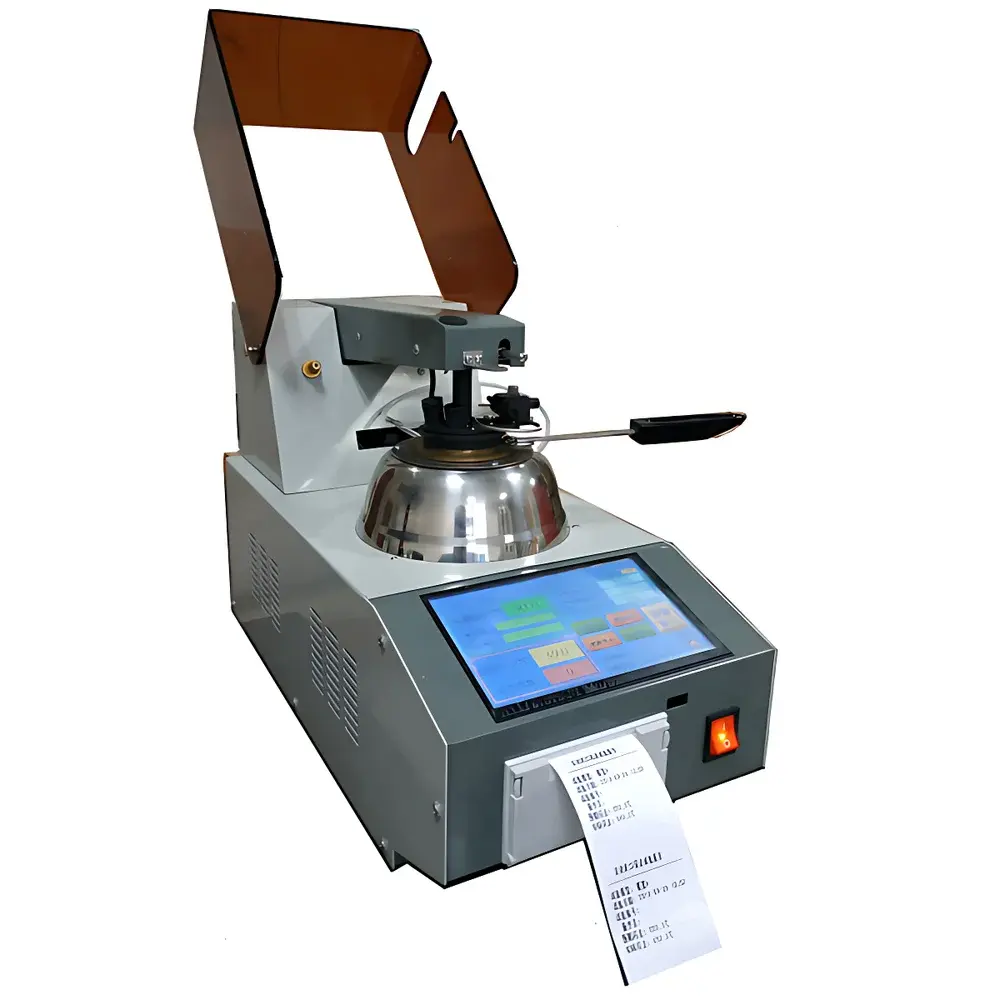
Xufeng XF-56SE Automatic Tag Closed-Cup Flash Point Tester with Electronic Ignition
| Brand | Xufeng |
|---|---|
| Origin | Shanghai, China |
| Model | XF-56SE |
| Detection Method | Closed-Cup (Tag) |
| Operation Mode | Fully Automatic |
| Temperature Range | Ambient to 95 °C |
| Ignition Method | Electronic (Piezoelectric Spark) |
| Repeatability | Compliant with ASTM D56, SH/T 0733, and GB/T 21929–2008 specifications |
| Applicable Standards | ASTM D56, SH/T 0733, GB/T 21929–2008, ISO 1523, IP 304, JIS K 2265 |
Overview
The Xufeng XF-56SE Automatic Tag Closed-Cup Flash Point Tester is a precision-engineered analytical instrument designed for the accurate and repeatable determination of flash point in volatile petroleum products, solvents, lubricants, and related hydrocarbon-based liquids. It operates on the principle of the standardized Tag closed-cup method — a controlled heating and sequential electronic ignition protocol defined in ASTM D56, SH/T 0733, and GB/T 21929–2008. Unlike open-cup methods, the Tag procedure isolates the vapor space above the sample using a standardized brass cup with a hinged lid, ensuring thermodynamic equilibrium between liquid and vapor phases prior to ignition. The XF-56SE employs a high-stability Peltier-cooled metal bath for precise temperature regulation (±0.1 °C), enabling reliable detection of the lowest temperature at which vapors from the test specimen ignite momentarily when exposed to an electric spark under prescribed atmospheric conditions. Its design conforms to international safety and metrological requirements for flammability characterization in QC laboratories, refinery process control, and regulatory compliance testing.
Key Features
- Fully automated Tag closed-cup flash point determination with programmable test modes per ASTM D56, SH/T 0733, and GB/T 21929–2008 — including standard ramp-and-ignite, stepwise search, and expected-flash-point optimization routines.
- Electronic piezoelectric spark ignition system eliminates dependency on external fuel gas supply, enhancing operational safety, repeatability, and laboratory flexibility.
- High-resolution 7-inch full-color capacitive touchscreen interface with intuitive icon-driven navigation; real-time display of bath temperature, sample temperature, ignition timing, and thermal ramp profile.
- Peltier-based cooling module integrated into the stainless-steel heating bath enables active temperature control from ambient up to 95 °C, with optional DW-25 low-temperature accessory extending range down to 0 °C.
- Self-diagnostic firmware with audible/visual fault alerts for sensor calibration drift, lid closure verification, ignition failure, or thermal overshoot.
- RS-232C serial port compliant with standard laboratory data acquisition protocols; supports bidirectional communication with LIMS or centralized QA software platforms.
- Integrated thermal printer (dot-matrix) provides hard-copy output of test parameters, timestamps, atmospheric pressure correction values, and final flash point results — traceable per GLP documentation requirements.
Sample Compatibility & Compliance
The XF-56SE accommodates standard Tag closed-cup specimens (4 mL volume) across a broad spectrum of petroleum distillates, biodiesel blends, industrial solvents, paint thinners, and cleaning agents. It is validated for use with samples exhibiting initial boiling points above 40 °C and flash points below 95 °C. Instrument performance meets repeatability criteria stipulated in ASTM D56 (≤2 °C for duplicate determinations), SH/T 0733 (≤3 °C), and GB/T 21929–2008 (≤2 °C). All mechanical and thermal subsystems are constructed from corrosion-resistant 304 stainless steel, and the entire unit complies with IEC 61010-1 safety standards for electrical equipment used in measurement, control, and laboratory applications. Pressure compensation algorithms support operation at altitudes up to 2,500 m above sea level, with user-adjustable barometric input (kPa or mmHg).
Software & Data Management
The embedded firmware implements deterministic real-time control logic synchronized to ASTM-defined heating rates (0.5–1.0 °C/s during final ramp), ignition frequency (every 0.5–1.0 °C increment), and lid-opening sequence timing. Test logs include metadata such as operator ID, sample ID, atmospheric pressure, ambient humidity (if externally sensed), and firmware revision. Raw thermal and ignition-event timestamps are stored in non-volatile memory with audit-trail capability. Optional PC software (Xufeng FlashLink v3.2) provides CSV export, statistical trend analysis (X-bar/R charts), and 21 CFR Part 11-compliant electronic signature support for regulated environments. Data integrity safeguards include write-protected storage partitions and automatic checksum validation upon file transfer.
Applications
- Quality control of gasoline, kerosene, diesel fuel, and jet fuel in refinery and blending facilities.
- Regulatory submission testing for SDS (Safety Data Sheet) preparation under GHS and CLP frameworks.
- Batch release testing of industrial solvents (e.g., acetone, toluene, xylene) per ISO 3679 and ISO 3678.
- Research and development of biofuel formulations requiring precise volatility profiling.
- Third-party certification labs performing accredited flash point testing under ISO/IEC 17025 scope.
- University teaching laboratories demonstrating fundamental flammability principles in chemical engineering and fire science curricula.
FAQ
Does the XF-56SE require external gas supply for ignition?
No — the XF-56SE uses a solid-state piezoelectric spark generator; no propane, butane, or compressed air lines are needed.
Can the instrument perform tests according to both ASTM D56 and GB/T 21929–2008 in the same session?
Yes — users select the applicable standard via touchscreen menu; the firmware automatically adjusts heating rate, ignition interval, and pass/fail logic accordingly.
Is atmospheric pressure correction applied automatically?
Yes — manual entry of local barometric pressure is required before test initiation; all flash point values are corrected using the algorithm specified in ASTM D56 Annex A1.
What maintenance is required for long-term accuracy?
Annual calibration verification using NIST-traceable reference standards (e.g., n-decane, n-dodecane) is recommended; cup cleaning with solvent and visual inspection of spark electrode wear should be performed after every 50 tests.
Is the instrument suitable for testing viscous or high-boiling samples?
No — the XF-56SE is optimized for low-to-medium viscosity liquids with flash points ≤95 °C; high-viscosity or heavy fuel oils require Pensky-Martens (XF-93 series) or Cleveland Open Cup (XF-92 series) configurations.





